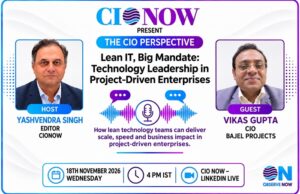





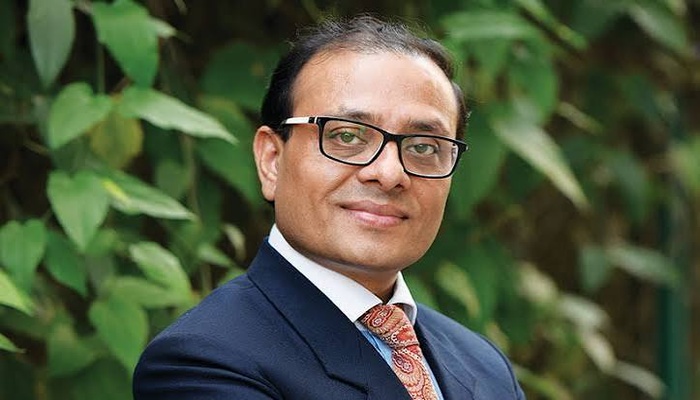
Vikas Gupta joined Bajel Projects shortly after its demerger from Bajaj Electricals, at a time when the company needed to establish itself as a standalone, listed enterprise. With operations spanning remote transmission-project sites, manufacturing, compliance and board-level reporting, IT had to move beyond a support function and become the backbone of execution. In this conversation with CIONOW, Gupta discusses the pressures of building an IT foundation under a tight deadline, the leadership mindset required in EPC, and why AI must move beyond productivity tools to the project site.
You joined Bajel right after its demerger from Bajaj Electricals and had to build a standalone IT backbone in under two months. What was the biggest unknown risk, and how did you mitigate it?
That was a very difficult period. I joined an established organization where the foundation was already there. The infrastructure, apps, processes, policies and way of working had been built up over many years. What was needed was a level of autonomy and a much simpler, operating model following the demerger. That was the explicit expectation at the time I joined.
When I had joined, in less than six months’ time, my entire infrastructure was coming up for renewal. I joined in May, and everything came up for renewal between September and December. If I did not fire, the food would not get cooked and if I decided to go ahead with the renewals, for the next three years I would have to live with that decision.
It was a nightmare. It was something I could not have even dreamed of, because should something have gone wrong the blame and accountability would have solely been on me. Should everything have gone smoothly no one would ever have questioned the decision.
However, I was totally supported by management. They told me ‘don’t worry, we will back you’. We had to choose vendors, find out the technology and be sure that it can work with upstream and downstream applications. Anybody who has been in this industry knows that so much effort is put into just implementing a part of the infrastructure and here were were undertaking a total migration from one architecture to another.
It was definitely tough, but the right decision. The support of the management was necessary and I am happy that everything went smoothly.
Just to show the scale of what we are doing, Bajel alone contributed close to 10 per cent of the total circuit kilometres in India last year. For an organisation that was demerged about two-and-a-half to three years ago, it was an unbelievable achievement and a testament to the dedication of the company and the thousands of people working on live systems, sometimes 24/7.
Currently, 10,000 kilometers of work is in progress, 24×7. As a listed company, we also have to ensure work is safely carried out and manage a whole range of statutory, audit and other compliance requirements in areas such as HR and manufacturing. Quarterly, half-yearly, pre-quarterly and annual board meetings and AGMs, all of this relies on good, current data from our systems, not having to work with spreadsheets.
You moved from the energy sector to EPC. What leadership lesson did you carry forward, and what did you adapt?
In the industry I came from, the assets were built, owned and operated through three separate, arm’s-length entities in order to comply with regulations.
Today, in a B2B model, we only build and hand the asset over to the customer and are hands-off on ownership, usage, and maintenance. While we work in a smaller part of the lifecycle, the extent of execution is as extensive- transitioning from cross-country pipeline to a stretch of infrastructure from the Bay of Bengal to Arunachal Pradesh.
Leadership is just like any habit. You don’t change it just because your staff, customers or organization has shifted. You just adjust how you deal with different circumstances.
It is as if you are a rubber band. You stretch out to fit the demands of a particular situation, but then you snap back to your natural form, adapting as needed without ever losing what makes you, you. As with the sanskaras we absorb growing up and the way we are raised, your leadership qualities are not “refashioned” in the middle of your career at 35 or 45. My original style is still as it was; it has, of course, been enhanced by the new individuals I work with.
Bajel supports complex, remote project sites with a lean IT team. How do you maintain that lean philosophy without burning out the team or compromising innovation?
Let me use an analogy. Imagine a marathon runner, starting at 1 km, moving onto 2, then onto 5, 10, 20 and eventually 42kms. During that run, they will have had to shed excess weight because running for 42kms is intense, you just can’t carry the extra weight for 42kms. But you can’t shed weight haphazardly; you do so relative to a definitive mark.
I take the same approach to what we do. I strive to keep the business lean; to eliminate waste so that we are lean and mean. Equally I don’t want people looking at our group thinking “you only have a small team – how will you do the job?”.
There is definitely peak times when you need more people. The key is having the flexibility to expand and contract. If we identify these areas, then we can bring in specialists for a short term contract or interim and then wind down when that workload passes.
Beyond email drafting and meeting summaries, where do you see the most immediate ROI for AI in power-infrastructure project execution?
EPC is a particularly resource-heavy industry; it’s not like you can just go ahead and automate from end to end. You need AI and robotics to address specific bottlenecks on two fronts: field execution and back-end analytics.
Meanwhile, on execution, we have implemented means to monitor data at its source through partial or full automation. In our most core activity of building up transmission towers, on-site workers must go to the top of the structure to check nuts, bolts and stringing for precisely the required torque and strength. Automated agents and robotics can perform these checks instead, and as such, free human operators of risk and heavy physical exertion.
From the analytics perspective, the real power is integrating that field data into future project planning. When you are looking at a new deal – considering the soil type, wind conditions, the height of the tower, the wattage – and bringing in historical data to confirm a project’s validity, that’s AI in action.
This isn’t about everyday productivity apps that let you write emails or do simple calculations; it’s about truly transforming when AI allows that work to be done.
Are data sovereignty and rising AI costs compelling CIOs to return to on-prem data centers?
Between 2014-2019, companies went to the cloud primarily as a herd response. We have learned since then that not every business (or company) should go to the cloud, and that cloud migration must be based on business needs.
In our current architecture, we don’t have heavy legacy apps or voluminous databases on-prem. All our stack and even Microsoft and SAP share the cloud, supporting the remote and distributed workforce. That also removes the requirement of a vast on-premise presence except for Disaster Recovery. Being entirely cloud-native necessitates a multi-tiered DR approach (vulnerable primary and secondary fallbacks) so the enterprise remains unaffected by downtime.
Your infrastructure strategy should cater to your business, not the crowd. In my former life at larger conglomerates, we used to host a colossal dedicated data center that’s loosely geographically separated and resilient to everything from natural disaster to failure, located in a remote area rather than the cloud to meet group requirements. But cloud-first is actually far more appropriate in our case. Our golden rule: ‘set the ROI first, then move’. Cloud and on-prem are very much two entirely different realms, and a bad move back takes considerable investment.
Regulatory changes is further heightening this attribute. With India’s DPDP Act now becoming fully operational, data residency is essential. This is leading to an increased need for sovereign clouds and data centers in India which ensure data is strictly confined to Indian borders.
Just as Europe did when it brought in GDPR to protect consumer data, India too is heading towards regulatory maturity, with data today, being generated at a scale hitherto unparalleled. Good governance is needed, and when it comes to our data, if we don’t take charge of protecting it – no one else will.