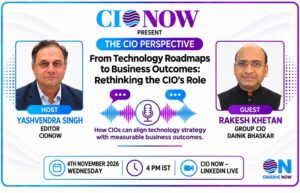





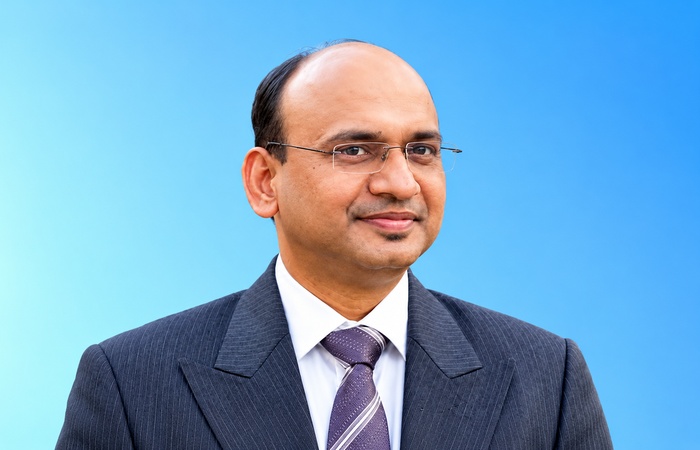
With media changing rapidly, it is important to balance technology, quality journalism, and scale. In a discussion with CIONOW, Rakesh Khetan, Group CIO, Dainik Bhaskar, discusses how technology enables this change in newsrooms, and how they have balanced traditional print media and digital expansion to deliver value to the business.
How have expectations from a Group CIO changed in a media organization where content, audience trust and speed of delivery are central to success?
The business expectations from a CIO have definitely changed. Now, infrastructure is no longer just about IT but is expected to be delivered at a rapid pace. Business expectations have changed rapidly. Infrastructure is no longer just about IT. Every business stakeholder expects things to be delivered at a rapid pace. With AI coming in, patience has almost gone to zero. Everyone has access to AI today, and they expect faster delivery.
We are also adapting to this change. We have deployed different AI tools and given access to everyone in the organization, with the necessary controls and guardrails, to help them perform their day-to-day tasks faster.
When it comes to content, the biggest challenge is verifying facts. Content is available everywhere on the internet, but ensuring its accuracy before it reaches the public domain is important. A human is always in the loop to verify the content before publication.
With media organizations serving both loyal print readers and an expanding digital-first audience, what are the key technology priorities for balancing legacy print operations with digital growth?
Content is being generated across multiple platforms, and we always have a human in the loop. Whether content is published on a digital platform or in print, it is verified before reaching the public.
Being a media organization, we have common editorial functions that manage the content. We prefer our editorial, sales, and marketing teams to use a common database, where information is verified by the respective stakeholders before being made available in the public domain. Hence, there is very less discrepancy in the content.
In a newsroom, speed and accuracy must go hand in hand. How is technology, particularly AI, helping Dainik Bhaskar accelerate content delivery while maintaining editorial integrity and credibility?
This is exactly where AI is helping us. We have defined multiple rules that have gone through several iterations to reach the level at which we use them today.
Every piece of content passes through a long list of AI agents and mostly, the verification is handled via technology before reaching the human-in-the-loop stage. Depending on the nature of the news, one or multiple people verify it.
Within Dainik Bhaskar, there is a particular team assigned to monitor social media for sports-related news. As the content from these sources may not be accurate, there are specific individuals in place to ensure fake/false news does not get published. At the initial stages, AI technology filters the content; therefore, only content that needs final verification is passed to these individuals so it can be published.
We are using various AI tools, while also applying a detailed set of rules (which have been improved upon multiple times).
Is Dainik Bhaskar developing its AI capabilities in-house, or is it adopting enterprise AI platforms available in the market? How are you approaching data security while using these tools?
We have a strong technology team, and most of our team members are in-house. We also have a very lean ecosystem of partners.
We are using most of the AI tools available in the market today, and these are enterprise-grade versions rather than the commonly available free models. We ensure that, since these are enterprise-grade versions, their models are not trained on the basis of our data.
Modernizing legacy systems without disrupting business operations is a significant challenge. How do you decide which systems to modernize, what to retain and when to undertake these changes?
Change is the only constant. Whatever systems and legacy technologies we have must evolve with time. Otherwise, we cannot continue to be market leaders. However, choosing the right systems and the right time to change them is important.
For example, festive seasons are peak periods for print media in India. We do not undertake system changes during these periods. Once the festive season is over, we identify which systems need to be changed and discuss the strategy with our business partners.
Technology cannot make these decisions in silos. We work with business functions, align with them, identify the modules that need improvement and then decide whether to upgrade or migrate to newer technology stacks.
We continue making improvements in phases. Once a new system is in place, we conduct proper user acceptance testing, internal testing and pilot runs in a smaller area. Once everything is finalized, we roll it out across the organization.
Many enterprises are reconsidering their cloud-first strategies in favor of hybrid infrastructure. What is driving this shift, and how is Dainik Bhaskar approaching its infrastructure strategy?
I would not say that on-premises infrastructure is making a comeback. Rather, we are moving towards a hybrid approach. Initially, the entire CIO community was in a rush to adopt a cloud-first strategy. However, the cost of technology has increased significantly. With the advent of AI, the impact of the Ukraine war, rising dollar prices and increasing hardware costs, cloud expenditure is also going up.
As data volumes increase, cloud costs are creating a significant financial burden. That is why we are also moving towards hybrid technologies. We are working with multiple cloud partners alongside on-premises and colocation infrastructure. Cost and data security are the major reasons why hybrid infrastructure is the way forward. We are already operating in a hybrid environment, and we will continue to be hybrid.
Media organizations handle sensitive subscriber information, commercial data and content that directly influences public perception. What are your key cybersecurity and resilience priorities?
I would not say that security is critical only for technology leaders. Today, it is important for every individual. Even a common person can receive a digital arrest call on WhatsApp. The first thing we do is sensitize every employee about the importance of cybersecurity.
We have 24/7 monitoring, strict access controls, and threat management tools. Although we have these measures in place, they need to be regularly reviewed. As we’re a media business operating 24 hours a day, our teams reflect this.
We have key external partners too. We can’t rely purely on internal teams alone given how sensitive/critical our data is. However, we do have appropriate security measures in place to protect key and important information. We do continual training for people in technology, and across all functions. We make it a priority for everyone in the business. We are doing weekly awareness sessions to increase this.
How do you ensure that business leaders understand investments in technology support increased profitability, and increased revenue and productivity in the business, and aren’t viewed as cost?
CIOs are no longer just technology leaders; they are business drivers. We work with business heads, functional heads and their teams to understand their processes.
Implementing technology is my responsibility. Therefore, I need to prepare a business proposition that explains how technology can help increase business value. While talking about sales, I am accountable for generating additional revenue. I have to ensure that only the right and verified content reaches the public domain as a media company, while reducing workloads and improving productivity.
We collaborate with different functional heads and understand their businesses, and then introduce tech solutions via pilots and proofs of concept. Once they experience improved profitability or productivity, we get their buy-in and proceed with the rollout.
What emerging enterprise technology trends do you believe will have the greatest impact on the media industry?
Media is one of the industries that usually explores and pilots new technologies as they emerge. If a technology makes business sense, we adopt it quickly. Employees in the media industry are also quite adaptable and willing to adopt new technologies, provided they see tangible benefits. AI is already here. Looking ahead, I assume quantum computing will become the tech trend as it has lot of potential.
What are some of the challenges in working as a Group CIO?
The biggest challenge is understanding every function in the businesses. Functional leads will only really understand their specific function. As a CIO, you must understand across the whole business and implement the right technologies in each function.
We essentially become a ‘jack of all trades’. Although challenging, it is very interesting. In some functions, CIOs have to have a greater understanding of the function, in detail, than the functional leads. This means that we can provide the most suitable solutions. As a challenge it can be difficult however it is an excellent learning opportunity.
Looking ahead, what is your technology roadmap for Dainik Bhaskar? What are your short-term priorities and long-term ambitions?
Thanks to our promoters, I am working towards making DB Corp an AI-native organization within the next one to one-and-a-half years. The entire team is working towards achieving this goal. We have also recently joined hands with a proven AI platform, which is already in the public domain. This is part of our short-term plan.