




The real competitive advantage lies in how efficiently data is communicated across all phases of a mission, from development and production to deployment, maintenance, and operation.
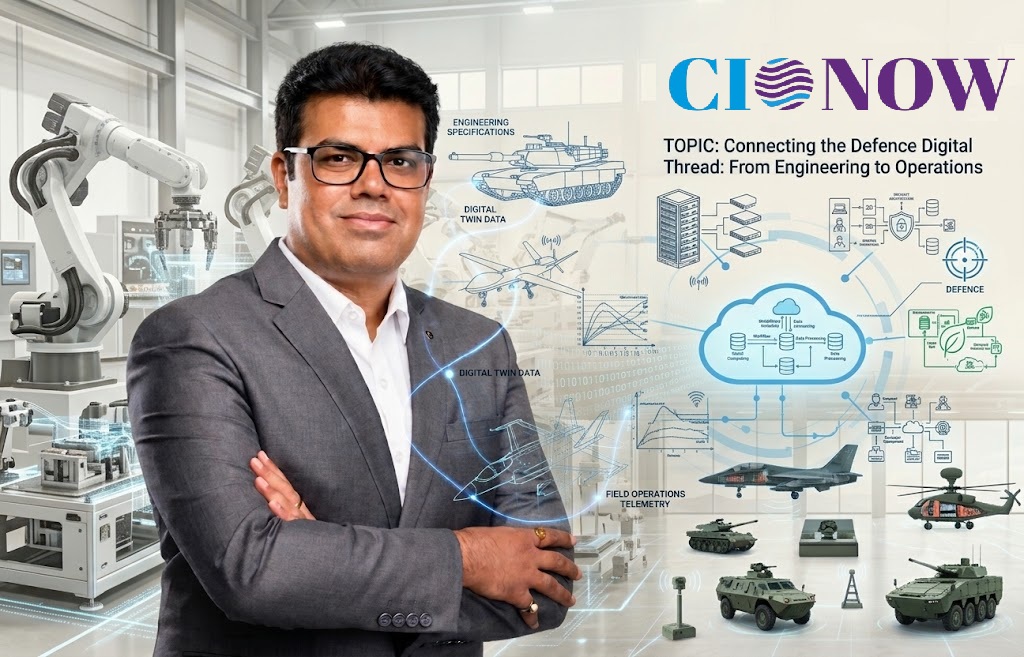
This is where the concept of digital thread comes into play. It links different stages into one single data flow, which implies that information produced at the design or testing stage can be employed when the products are already in operation.
One Digital Thread Across the Lifecycle
A defence platform generates information at every stage of its lifecycle. Requirements come in the planning phase, engineers create models and designs, manufacturers provide production data, testing reveals performance information, and operations generate information after deployment. If every stage is isolated from the others, some important context may be lost between the stages. The digital thread connects all stages of the lifecycle and enables continuity between them.
This allows operational feedback or engineering data to be used for maintenance or decision-making related to missions.
Breaking the Technology Silos
Defense environments usually contain a number of technology layers, including PLM, ERP, OT, IT, C4ISR, MRO, and mission systems. All these systems have different purposes but have information that is much more useful when integrated.
The objective here is not to integrate all systems in a general way, but rather to make important information accessible in a relevant context. For instance, bringing together the engineering specifications, maintenance history, and operational records may give teams a complete picture of the asset’s state and performance. This is a revolution in understanding defense integration regarding systems cooperation.
From Engineering to Mission
The digital thread’s genuine value appears when engineering data can be put to practical use in operational environments.
Engineering concepts, configuration information, and testing outcomes can give valuable context for teams in charge of implementing and maintaining the system. When combined with data from the field, this information provides the opportunity to perform diagnostics, predictive maintenance, mission preparation, and make fast decisions.
It also establishes the possibility of creating a feedback mechanism: engineering influences operations, while operational experience impacts future engineering.
Digital Twins as the Living Layer
Digital twins have the potential to enhance this relationship as they generate dynamic digital replicas of systems, infrastructure, missions, and platforms.
Contrary to traditional digital models, digital twins rely on operational data, environmental conditions, sensor information, and maintenance records, which provide an up-to-the-minute snapshot of the state of a certain asset or system.
In addition, this technology is relevant for critical infrastructure. All kinds of ports, airports, power distribution networks, logistics corridors, and production plants can be digitally modeled for the purposes of better comprehension of dependencies, detection of possible failures, and increasing resilience.
Bringing OT, IT and AI Together
The blending of operational technology, information technology and artificial intelligence introduces yet another level of sophistication in intelligence. OT measures data from the physical world and assets while IT gives the necessary information to help formulate decisions. AI is able to interpret the comprehensive mix of data and identify patterns, abnormal situations and possible risks associated with them.
However, AI cannot deliver meaningful intelligence from disconnected information. A digital thread provides the context needed to move AI from isolated analysis towards more informed operational decisions.
Intelligence at the Edge
To ensure the security and safety of critical infrastructures, it is important for intelligence to work from the place of incidents. The edge intelligence concept enables real-time processing of information in proximity to the area of conflict, platform, industrial zone, or mission site. This type of platform can decrease the time lag and speed up the reaction in regions where Internet connection is unstable. Thus, it is noticed that the focus shifts from using single functions to connecting the whole mission course.
The developed defence digital thread has the potential to create an information stream that works in the following manner: engineering provides information for operational activity, while operational data optimises engineering.