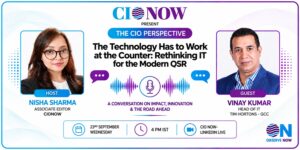






To conventional manufacturers, IT is the utility that keeps ERP humming and the factory hooked up. At Prince Pipes, CIO Keyur Desai is rewriting this approach by focusing on technology as a growth driver linked to business results, rather than a line item. In an interaction with CIONOW, he discusses how he defines the role of IT, building trusted data before AI, creating a governance model that accelerates (rather than hinders) innovation, and the true meaning of Factory 5.0 in the shopfloor.
For years, traditional manufacturing considered IT a cost center. Now with Industry 4.0, IT must be the growth engine. How are you transforming IT from cost center to growth engine even as boards want a 12-month ROI?
I don’t start by defining IT only by cost. The moment we do that, the conversation becomes only about reducing cost or optimizing spend. Instead, I frame technology around the business outcome we are creating.
I bucket my investments into three areas. First, ‘Protect the business’ to include cyber security, security & infrastructure, ERP health, IT business continuity and compliance. The second bucket is around ‘Improve the business’ and involves automation, analytics, better forecast, optimise inventories, improve supply chain and improve productivity. And finally ‘Grow the business’ which relates to digital channels, customer experience, new capabilities and ai-enabled decisioning.
The most important part is that technology teams must understand the process, business challenges and business metrics first, then design initiatives. For example, in a BI or analytics project, success should not be “we built so many dashboards.” Success is: can the business make quicker, better decisions on critical factors because of the visibility this platform gives? That’s where technology becomes a true partner. Turnaround time for decisions must keep coming down, and business teams must feel more empowered with the right data.
Is the perception of IT as a cost center changing in top management, especially after AI and digital have come to the forefront? Do you see that mindset shift actually happening?
Absolutely. In my experience, senior management is very keen to adopt technology—be it AI, overall factory transformation, integrated sales platforms, or building a single source of trusted data. I’ve been fortunate to work with organizations where leadership actively promotes using technology to improve manufacturing processes, sales platforms and decision-making. So for me, the mindset has not just shifted; in many places, it was already oriented this way.
Many CIOs struggle to get clean, governed data before launching AI. What is your step-by-step approach to building a data foundation for AI?
The first question is not “what data do we have?” but “can I trust my data?” The journey begins there.
My approach is simple.
Start with the decision you are trying to optimize: Is it demand forecasting, inventory, price, production planning, procurement, or customer experience? Once you have the decision, you have the data that truly matters.
Establish a common definition of truth: In manufacturing, different reports and dashboards often show different numbers for the same metric. That’s where the cleansing journey starts: what data do we have, and is it in the correct, consistent form?
Fix master data: Garbage in, garbage out. If master data has errors, the output will be wrong. Clearly define who owns master data and who is responsible for its quality. Ideally, this should not be IT; there should be a master data management team accountable for data quality, with IT providing platforms and processes to maintain sanctity.
Bring relevant information together: Data from ERP, sales platforms, demand forecast, supply chain, advanced warehouse management, transport management, manufacturing, finance, HRMS, etc. It’s not about rushing to the newest technology; it’s about getting the basics right so any technology can sit on a solid foundation.
How important is it for a CIO to articulate the business problem before going in for AI implementation? Often there is pressure from peers or top management to “just deploy AI,” and the business problem gets lost.
Understanding the business decision and the problem statement is the most important step. It’s not about implementing technology for the sake of implementation. Even if there is a lot of push to “adopt AI,” the first question must be: what problem are we trying to solve?
For example, in HRMS, there are many AI-enabled platforms covering the entire employee lifecycle. The conversation should start with HR: which area do they want to improve—hiring, attrition, learning, performance? In supply chain, demand forecasting, inventory, sales forecast and seasonal parameters are key. If you put an AI layer on top of a well-understood problem, guiding the supply chain and dispatch teams on overall flow, that’s where value comes. So rather than rushing to AI as a platform, start with the business problem.
For listed firms, AI is a governance mandate too. How have you structured AI oversight at Prince Pipes? Who owns model risk, how are AI decisions audited, and what’s one practice that speeds deployment?
Governance is important whether the organization is listed or not. The AI outcome should not lead to wrong decisions. For me, governance is not just about compliance; it’s about setting the right guardrails. AI can make decisions within certain criteria; if it crosses a threshold, it must come back to the right teams for human decision.
Governance should not kill innovation. It’s about visibility into what AI is doing as part of the overall output journey. Initially, there has to be very close observation to ensure the right decisions are being made by the AI factor—be it AI tools or agentic AI.
It’s also a risk-based approach: who is accountable for the outcome? IT cannot own the overall platform part alone. The business stakeholder must own accountability for decisions. Technology teams own integration, architecture (cloud, hybrid, multi-cloud), data security and data governance—what data moves in and out, whether it’s clean. But for the decisions the AI platform is taking, the business role is vital. The business must lead the project from day one, with IT holding hands and walking along the journey to support and ensure success. Clear lines on who owns what and who is responsible for what are essential.
Industry 4.0 automated and displaced people from data collection but Factory 5.0’s people-centric Approach is returning humans to the shop floor, along with collaborative AI, cobots, sustainability, and resilience. What does Factory 5.0 mean at Prince Pipes? And how are you combining advanced automation with humans?
Industry 4.0 has been around for decades, focusing on connecting systems, machines and processes, automating tasks, and using digital twin and predictive maintenance. Organizations have reaped benefits from that.
Factory 5.0 is about taking two steps further: bringing technology, people, intelligence and business outcomes together. A connected machine is useful. A machine that tells you it may fail tomorrow is more useful. But imagine a system that also tells you what impact that failure could have on production, customer commitments and inventory, and then recommends what action to take. That’s where you touch the human and business element.
It’s not just knowing a machine will fail; it’s understanding the after-effects on each stakeholder. This brings real value addition: visibility, prediction, and then recommendation on how manufacturing as a unit can improve. This adds value to quality information, maintenance, energy consumption, supply chain and inventory management. A lot of data can now be churned into meaningful outputs connected to business outcomes and impact. We have embarked on this journey with our manufacturing teams and will soon achieve this as a business milestone.
Along your Factory 5.0 journey, what are the key lessons you have learned that other CIOs and peers can use when driving similar initiatives?
There are many learnings. First and foremost, it’s about breaking the mindset barrier from just predictive maintenance to what comes next. There’s also a practical learning: there is no threat to current teams or stakeholders. I keep repeating in internal communication that it’s about connecting technology, machines and humans. These three stakeholders will stay connected and bring value addition.
Second, we are in an era where every partner or OEM claims to have the best Factory 5.0 platform. The difficulty is identifying the right partner. We made it a rule book to work with partners who have already supported similar manufacturing variants. Within manufacturing, there are many variants, so we focused on partners who have worked in building materials or pipes and fittings.
Third, there are practical on-ground challenges: connecting PLCs, sensors, realigning the right data from sensors, etc. Even if some units were already connected with other partners, these challenges surface during implementation. Thanks to the right partners, we can make it happen. Our journey is still on, so I’m sure there will be more learnings as we proceed.
In manufacturing, IT-OT convergence has made cyber resilience a must-have. How do you approach cyber resilience, and how are you embedding security into every layer of your digital architecture?
In manufacturing, IT-OT convergence is the most important line that needs focus. But before that, the mindset shift is crucial: it’s not just about cyber security or protecting IT systems; it’s about protecting the business. If a machine gets attacked, it’s not just the machine that’s impacted—it’s the business and the subsequent line of stakeholders: inventory, material flow, delivering to the right customer or distributor at the right time.
So the focus is not on protecting the system, but on ensuring the business is protected and business continuity is maintained. That’s how I look at cyber resilience: how do we ensure the business can continue to operate even when parts of the system are under attack.