





Xebia, DYPIU Launch four AI-Led degree programs with confirmed internships

Xebia and D. Y. Patil International University (DYPIU), Pune, have announced a strategic collaboration to launch four industry-integrated B.Tech, M.Tech, and MCA programs in AI, cloud, data, and software engineering. Bringing together Xebia, a global AI-first, digital transformation and engineering partner, and DYPIU’s learner-centric academic environment, the programs are designed to bridge the gap between university classrooms and modern enterprise engineering.

As enterprises shift from experimenting with artificial intelligence to deploying autonomous systems and AI-native applications in production, the expectations placed on early-career technologists are changing rapidly. Tomorrow’s engineers will not simply write isolated code, analyze static datasets, or manage routine infrastructure; they will architect AI-powered products, orchestrate multi-agent systems, and solve complex business challenges. The DYPIU–Xebia programs are built around this convergence of software engineering and AI, immersing students in modern technology stacks, real-world engineering workflows, and hands-on product development from day one.

Speaking on the occasion, Glory Nelson, MD, APMEA and India Country Head at Xebia said, “The pace at which AI is reshaping software engineering and enterprise operations means traditional, theory-heavy curricula can no longer keep up with what the industry actually needs. Through our partnership with D. Y. Patil International University, we are bringing real enterprise engineering directly into the academic experience. By combining practitioner mentorship, product-focused building, and confirmed internships, we want students to graduate not just with a degree, but with proven experience building production-grade AI systems. Once they complete these programs, we are also providing them with hands-on internship experience at Xebia to learn more closely from industry experts while solving real-world challenges through software-led interventions.”

 Prof. (Dr.) Manish Bhalla, Vice Chancellor, at DY Patil International University said, “At D. Y. Patil International University, our focus has always been on building a learner- centric environment that evolves alongside industry realities. Partnering with Xebia allows us to move well beyond conventional classroom instruction while embedding product thinking, hands-on engineering, and exposure to global technology ecosystems directly into our B.Tech, M.Tech, and MCA curricula. With practitioner mentorship and confirmed remote internships built into these programs, our students will graduate ready to architect AI-driven solutions from day one.”

Industry-Aligned Degree Programs for the AI Economy

Under the collaboration, DYPIU and Xebia are rolling out four specialized undergraduate and postgraduate programs tailored to high-demand technology domains:

Program Duration Core Future Skills
B.Tech – DevAIOps with Microsoft 4 Years Cloud, DevOps, Kubernetes, Infrastructure Automation, SRE, AI-driven Operations
B.Tech – Full Stack AI with GitHub 4 Years Full Stack Engineering, AI-assisted Development, GenAI, RAG, Agentic Applications
M.Tech – Agentic AI & Autonomous Systems 2 Years Agentic AI, Multi-Agent Systems, Autonomous Systems, AI Engineering
MCA – Enterprise Data & Autonomous Analytics 2 Years Data Engineering, Enterprise Analytics, AI, Autonomous Decision Systems

Moving Beyond Classrooms to Product Thinking

Unlike conventional academic tie-ups limited to guest lectures, the partnership embeds industry methodology across the entire student lifecycle:

  • Practitioner-Led Instruction: Students learn directly from industry experts through specialized masterclasses, technical workshops, and practitioner-led sessions that bring real enterprise context into the classroom.
  • Portfolio of Real-World Builds: Coursework emphasizes hands-on execution across application development, cloud and DevOps implementations, RAG pipelines, agentic AI workflows, data analytics use cases, and end-to-end capstone projects, ensuring students graduate with tangible proof of what they can build.
  • From Projects to Product Thinking: A defining element of the Xebia approach is shifting students from isolated project assignments to end-to-end product thinking. Students are challenged to identify real-world problems, design solutions, build functional prototypes, and present usable applications at product showcases, ideathons, and industry hackathons.
  • Confirmed Internships and Career Pathways: To strengthen the transition from education to employment, Xebia will provide confirmed remote internships to all students enrolled in the Xebia-integrated programs, alongside dedicated placement support.

Grounded in a Multi-Platform Global Technology Ecosystem

To ensure graduates are adaptable across diverse enterprise environments rather than restricted to a single vendor stack, the curriculum draws on Xebia’s global partner ecosystem—including Microsoft, GitHub, Google Cloud, AWS, and Databricks. Students gain practical fluency in the platforms, engineering standards, and collaborative development practices that power modern global enterprises.

CrowdStrike to Acquire Zscaler, Bringing Network Security and Zero Trust to the Falcon Platform

CrowdStrike and Zscaler today announced that they have entered into a definitive agreement under which CrowdStrike will acquire Zscaler in an all-stock transaction that values Zscaler at approximately $43.9 billion. Under the terms of the agreement, Zscaler shareholders will receive 1.135 shares of CrowdStrike common stock for each share of Zscaler common stock they own.

Network Security on the CrowdStrike Falcon Platform

With Zscaler, CrowdStrike will enter network security, cybersecurity’s largest single addressable market segment. Users, applications, and now AI agents connect directly to the cloud, and that traffic never comes back through the data center. Firewalls and VPNs built to guard the data center can’t see, inspect, or stop that traffic, the threats coming in, or the data going out. Zscaler’s SSE is purpose-built for the AI era, with the Zscaler Zero Trust Exchange sitting inline between every user, agent, and application to enforce zero trust on every connection. SASE builds on that foundation to bring security and the network together, creating zero trust everywhere.

CrowdStrike is a leader in securing the endpoint, the workload, the identity, and the data. Zscaler is a leader in securing the connections between them. After closing, CrowdStrike will unite endpoint security with Zero Trust SASE to deliver a unified platform that puts both controls in the adversary’s path to stop breaches.

“Security used to be about keeping the adversary out. Today, safety is required to let AI in,” said George Kurtz, CEO and founder of CrowdStrike. “The network used to connect people to places. Now it connects agents to data. With Zscaler, we’re building cybersecurity’s operating system: a single control plane to deploy AI, control AI, and enable any agentic application to run safely. We see a path to become the largest AI safety and security company the world has ever seen.”

“We built Zscaler to bring a new approach to the cybersecurity industry and that is a Zero Trust architecture,” said Jay Chaudhry, CEO, chairman, and founder of Zscaler. “In the AI era, Zero Trust security has become non-negotiable, and AI agents are rapidly becoming the new weakest link. This agreement will accelerate our ability to bring Zero Trust Everywhere to a larger customer base. We see a significant opportunity to offer customers far superior protection in a rapidly evolving threat landscape and enable enterprises to safely adopt AI. Zscaler and CrowdStrike are complementary and this is the natural evolution of our longstanding partnership. We look forward to enabling our employees, customers, and shareholders to be a part of the significant upside that this transaction brings.”

One Platform, One Data Layer, One Flex Contract

With Zscaler, the Falcon platform will own the two most important control points: the Falcon sensor across every endpoint and cloud workload, and the Zero Trust Exchange on every user, agent, and application connection. The endpoint is where the agent runs. The network is where it goes. Falcon Next-Gen SIEM, the agentic SOC, will unify device and network telemetry into one security data set. Falcon Flex will bring Zscaler onto the commercial model customers already use, so they commit once and expand from there.

Strategic Rationale and Value Creation Opportunity

  • Brings Zscaler’s Zero Trust SASE, Security for AI, and Data Protection to the Falcon Platform: Zscaler protects 50 percent of the Fortune 500 and operates the world’s largest distributed inline security cloud across more than 200 service locations. After closing, CrowdStrike will offer Zscaler’s Zero Trust SASE, security for AI, and data protection as part of the Falcon platform.
  • Combines Device and Network Data: The Falcon platform generates trillions of events daily from the endpoint and cloud workloads, and Zscaler’s Zero Trust Exchange processes more than 750 billion transactions per day. After closing, device and network telemetry will converge into a single data set, allowing CrowdStrike’s SafeMind frontier security models to train on the adversary’s full attack path.
  • Unlocks Cross-Sell Across Both Customer Bases: Approximately 8,000 Zscaler customers are not yet CrowdStrike customers. Within the shared customer base, CrowdStrike sees room for even more platform adoption. After closing, customers of either company will be able to add the other’s products on a single Falcon Flex contract. Both companies have best-in-class gross and net retention.
  • Expands the Market and the Partner Ecosystem: CrowdStrike estimates the acquisition will expand its total addressable market by more than $185 billion in calendar year 2029. Zscaler’s solutions will be sold through CrowdStrike’s global system integrators, resellers, distributors, and cloud marketplaces, with significant opportunity downmarket and into the MSSP space.
  • From Partnership to One Platform: The acquisition builds on one of CrowdStrike’s largest technology alliances, spanning more than 2,000 shared customers and 16 integrations. For years, customers have asked CrowdStrike and Zscaler to join forces, and the two companies come together from positions of strength. A partnership integrates separate products. One company integrates everything: the data, the roadmap, the go-to-market, and the commercial model, and AI accelerates the integration. After closing, the integration of Zscaler into the Falcon platform will give customers one platform, one data layer, and one contract.
  • Increases Scale and Accelerates Profitable Growth: At closing, the combined company is expected to begin with more than $10 billion in ARR. Zscaler reported $3.9 billion of ARR as of its recently completed fiscal quarter. The acquisition is expected to add incremental high-margin recurring revenue streams to CrowdStrike’s financial profile.
  • Creates Significant Revenue Synergies: CrowdStrike expects revenue synergies to build progressively over the first 30 months following close, reaching approximately $1 billion in annualized run-rate revenue synergies by the end of that period. These revenue synergies are expected to come from deepening combined customer relationships, expanding cross-sell and upsell opportunities, and integrating Zscaler’s solutions into CrowdStrike’s Falcon Flex go-to-market motion.
  • Drives Margin Expansion and Free Cash Flow Accretion: CrowdStrike expects to achieve $500 million in annualized run-rate cost synergies within 18 to 24 months following the close, primarily through optimization of its data center infrastructure, vendors, and broader operations. These initiatives will support additional operating leverage and margin expansion over time. The transaction is expected to be significantly and immediately accretive to free cash flow per share before factoring in any synergies. The transaction is also expected to be accretive to revenue growth, non-GAAP operating margin, and free cash flow margin, after synergies, within the first fiscal year after close.

Transaction Details

Under the terms of the agreement, which has been unanimously approved by the boards of directors of both companies, CrowdStrike will acquire Zscaler in an all-stock transaction valued at an enterprise value of approximately $43.9 billion, based on CrowdStrike’s closing share price as of November 20, 2026. Each outstanding share of Zscaler common stock will be exchanged for 1.135 shares of CrowdStrike common stock, representing an implied value of approximately $260.41 per Zscaler share, based on CrowdStrike’s closing share price as of November 20, 2026. This represents a premium of approximately 34% to Zscaler’s closing share price as of November 20, 2026. Following completion of the transaction, existing CrowdStrike shareholders are expected to own approximately 84.1% of the combined company, and existing Zscaler shareholders approximately 15.9%.

The transaction is expected to close in the second half of CrowdStrike’s fiscal year 2028, subject to approval by Zscaler shareholders, receipt of required regulatory approvals, and satisfaction of other customary closing conditions. In connection with the transaction, Jay Chaudhry and his affiliates, representing approximately 34% of Zscaler outstanding shares, have entered into voting agreements in support of the transaction. Until closing, both companies will continue to operate independently.

Following the close of the transaction, Jay Chaudhry will continue to lead the Zscaler business and will join the CrowdStrike Board of Directors.

Note: The source of the release is CrowdStrike.

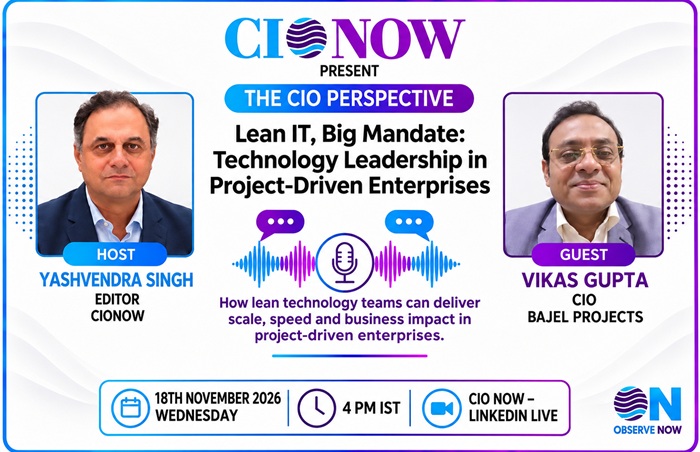
From Demerger Deadline to 10,000 Km of Execution: Inside Bajel Projects’ Lean IT Playbook

Vikas Gupta joined Bajel Projects shortly after its demerger from Bajaj Electricals, at a time when the company needed to establish itself as a standalone, listed enterprise. With operations spanning remote transmission-project sites, manufacturing, compliance and board-level reporting, IT had to move beyond a support function and become the backbone of execution. In this conversation with CIONOW, Gupta discusses the pressures of building an IT foundation under a tight deadline, the leadership mindset required in EPC, and why AI must move beyond productivity tools to the project site.

You joined Bajel right after its demerger from Bajaj Electricals and had to build a standalone IT backbone in under two months. What was the biggest unknown risk, and how did you mitigate it?

That was a very difficult period. I joined an established organization where the foundation was already there. The infrastructure, apps, processes, policies and way of working had been built up over many years. What was needed was a level of autonomy and a much simpler, operating model following the demerger. That was the explicit expectation at the time I joined.

When I had joined, in less than six months’ time, my entire infrastructure was coming up for renewal. I joined in May, and everything came up for renewal between September and December. If I did not fire, the food would not get cooked and if I decided to go ahead with the renewals, for the next three years I would have to live with that decision.

It was a nightmare. It was something I could not have even dreamed of, because should something have gone wrong the blame and accountability would have solely been on me. Should everything have gone smoothly no one would ever have questioned the decision.

However, I was totally supported by management. They told me ‘don’t worry, we will back you’. We had to choose vendors, find out the technology and be sure that it can work with upstream and downstream applications. Anybody who has been in this industry knows that so much effort is put into just implementing a part of the infrastructure  and here were were undertaking a total migration from one architecture to another.

It was definitely tough, but the right decision. The support of the management was necessary and I am happy that everything went smoothly.

Just to show the scale of what we are doing, Bajel alone contributed close to 10 per cent of the total circuit kilometres in India last year. For an organisation that was demerged about two-and-a-half to three years ago, it was an unbelievable achievement and a testament to the dedication of the company and the thousands of people working on live systems, sometimes 24/7.

Currently, 10,000 kilometers of work is in progress, 24×7. As a listed company, we also have to ensure work is safely carried out and manage a whole range of statutory, audit and other compliance requirements in areas such as HR and manufacturing. Quarterly, half-yearly, pre-quarterly and annual board meetings and AGMs, all of this relies on good, current data from our systems, not having to work with spreadsheets.

You moved from the energy sector to EPC. What leadership lesson did you carry forward, and what did you adapt?

In the industry I came from, the assets were built, owned and operated through three separate, arm’s-length entities in order to comply with regulations.

Today, in a B2B model, we only build and hand the asset over to the customer and are hands-off on ownership, usage, and maintenance. While we work in a smaller part of the lifecycle, the extent of execution is as extensive- transitioning from cross-country pipeline to a stretch of infrastructure from the Bay of Bengal to Arunachal Pradesh.

Leadership is just like any habit. You don’t change it just because your staff, customers or organization has shifted. You just adjust how you deal with different circumstances.

It is as if you are a rubber band. You stretch out to fit the demands of a particular situation, but then you snap back to your natural form, adapting as needed without ever losing what makes you, you. As with the sanskaras we absorb growing up and the way we are raised, your leadership qualities are not “refashioned” in the middle of your career at 35 or 45. My original style is still as it was; it has, of course, been enhanced by the new individuals I work with.

Bajel supports complex, remote project sites with a lean IT team. How do you maintain that lean philosophy without burning out the team or compromising innovation?

Let me use an analogy. Imagine a marathon runner, starting at 1 km, moving onto 2, then onto 5, 10, 20 and eventually 42kms. During that run, they will have had to shed excess weight because running for 42kms is intense, you just can’t carry the extra weight for 42kms. But you can’t shed weight haphazardly; you do so relative to a definitive mark.

I take the same approach to what we do. I strive to keep the business lean; to eliminate waste so that we are lean and mean. Equally I don’t want people looking at our group thinking “you only have a small team – how will you do the job?”.

There is definitely peak times when you need more people. The key is having the flexibility to expand and contract. If we identify these areas, then we can bring in specialists for a short term contract or interim and then wind down when that workload passes.

Beyond email drafting and meeting summaries, where do you see the most immediate ROI for AI in power-infrastructure project execution?

EPC is a particularly resource-heavy industry; it’s not like you can just go ahead and automate from end to end. You need AI and robotics to address specific bottlenecks on two fronts: field execution and back-end analytics.

Meanwhile, on execution, we have implemented means to monitor data at its source through partial or full automation. In our most core activity of building up transmission towers, on-site workers must go to the top of the structure to check nuts, bolts and stringing for precisely the required torque and strength. Automated agents and robotics can perform these checks instead, and as such, free human operators of risk and heavy physical exertion.

From the analytics perspective, the real power is integrating that field data into future project planning. When you are looking at a new deal – considering the soil type, wind conditions, the height of the tower, the wattage – and bringing in historical data to confirm a project’s validity, that’s AI in action.

This isn’t about everyday productivity apps that let you write emails or do simple calculations; it’s about truly transforming when AI allows that work to be done.

Are data sovereignty and rising AI costs compelling CIOs to return to on-prem data centers?

Between 2014-2019, companies went to the cloud primarily as a herd response. We have learned since then that not every business (or company) should go to the cloud, and that cloud migration must be based on business needs.

In our current architecture, we don’t have heavy legacy apps or voluminous databases on-prem. All our stack and even Microsoft and SAP share the cloud, supporting the remote and distributed workforce. That also removes the requirement of a vast on-premise presence except for Disaster Recovery. Being entirely cloud-native necessitates a multi-tiered DR approach (vulnerable primary and secondary fallbacks) so the enterprise remains unaffected by downtime.

Your infrastructure strategy should cater to your business, not the crowd. In my former life at larger conglomerates, we used to host a colossal dedicated data center that’s loosely geographically separated and resilient to everything from natural disaster to failure, located in a remote area rather than the cloud to meet group requirements. But cloud-first is actually far more appropriate in our case. Our golden rule: ‘set the ROI first, then move’. Cloud and on-prem are very much two entirely different realms, and a bad move back takes considerable investment.

Regulatory changes is further heightening this attribute. With India’s DPDP Act now becoming fully operational, data residency is essential. This is leading to an increased need for sovereign clouds and data centers in India which ensure data is strictly confined to Indian borders.

Just as Europe did when it brought in GDPR to protect consumer data, India too is heading towards regulatory maturity, with data today, being generated at a scale hitherto unparalleled. Good governance is needed, and when it comes to our data, if we don’t take charge of protecting it – no one else will.

PwC India Opens The Future AI Experience Lab, Giving Business Leaders a Sandbox to Validate Bold AI Ideas

PwC India today launched its Future AI Experience Lab in Gurugram, an experiential space designed to help businesses explore the possibilities offered by AI and move rapidly towards business impact. This Lab is a part of PwC India’s broader push to help clients accelerate decision-making, mitigate risk, and maximise return on investment through hands-on experimentation with next-generation technologies.

As the conversation around AI shifts from pilot projects and token costs to autonomous agents, Physical AI, AI-led cyber risk, and new operating models, business leaders are increasingly focusing on a different set of questions: where to invest, how much to govern, and how quickly an organisation can adapt. The Future AI Experience Lab is designed to help answer these questions. More than a technology showroom, it is an immersive, collaborative environment where clients can bring their business challenges, work alongside PwC experts to identify relevant solutions, and test emerging technologies in a hands-on setting.

Housing over 90 industry and sector-specific AI assets, the Lab brings together PwC India’s expertise and alliance ecosystem to demonstrate the practical applications of emerging technologies across industries. The solutions in the Lab span agentic AI, robotics and Physical AI, and have been built, tested and validated in live business scenarios across manufacturing, infrastructure, pharmaceuticals and life sciences, healthcare, telecom and BFSI, among others. It enables leaders to explore different scenarios and build early prototypes to find scalable solutions to address their business challenges.

Sanjeev Krishan, Chairperson, PwC in India, said, “India stands on the cusp of its next big leap in growth, and the enterprises that lead it will be those that make bold technology choices with confidence. The Future AI Experience Lab gives businesses an opportunity to explore these possibilities in the context of their own organisations, test their assumptions, and make decisions backed by evidence. It is about helping our clients move beyond the promise of AI to realise its potential for meaningful business impact.”

Walk in with a challenge, walk out with a blueprint

Every visit to the Lab is tailored to the client’s needs and ends with a clear plan. Leaders first see where their industry is heading, then test solutions relevant to their business. Our approach draws on lessons from more than 500 client workshops and more than 200 PwC accelerators, and every solution is tied to a measurable outcome, whether that is revenue growth, productivity, risk reduction or better customer service. 

The Lab offers an immersive experience across several dimensions of enterprise transformation, including:

  • The intersection of physical and digital AI: Exploring how AI can connect the physical and digital worlds to transform business processes and operations.

  • The new Human–AI operating model: Experiencing how people and AI can work together to reshape the way organisations operate.

  • The future of customer experience: Understanding how AI is transforming customer interactions and experiences in an increasingly phygital world.

  • Immersive visualisation: Experiencing the possibilities of future products, factories, and spaces through immersive technologies.

  • The future of enterprise functions: Exploring how AI can transform core business functions and enable new ways of working.

  • Robotics and intelligent devices: Engaging with robots, wearables, and other emerging technologies to experience their potential applications.

Manpreet Singh Ahuja, Chief Clients & Industries Leader at PwC India and Americas and Asia Pacific Alliances Leader at PwC, said, “Everything in this Lab is designed to be experienced, not just observed. Leaders don’t simply watch demonstrations; they can run their own scenarios, test their ideas and see the outcomes for themselves. With more than 90 AI solutions and assets across sectors, the Lab brings together technology, industry expertise, and practical applications to help businesses understand not just what AI can do, but what it can do for their business.”

The Future AI Experience Lab is a key step in scaling PwC India’s AI capabilities and advancing its broader commitment to technological innovation. It also aligns with the firm’s Vision 2030 ambition and its goal of achieving 5x growth in three years by bringing together sector expertise, leading technology, its alliance ecosystem, and a strong focus on governance, cyber security and responsible AI to help clients unlock the full potential of AI and drive sustainable business impact.

The AI Execution Gap: Why Leadership, Not Technology, Will Determine Business Success

In recent years, the application of Artificial intelligence has evolved from its experimental phase to assuming a significant role in the field of business. Even though about 88% of organizations implement AI in various operations, only a few of them have succeeded in the proper implementation of such technologies.

Some years ago, the introduction of AI into business used to be considered rather complicated, but the implementation stage has recently become the factor defining effective use of the technology. Two main reasons behind this gap between the pilot project and the results are the absence of the necessary leadership and difficulties with management.

When an organization successfully deals with these issues, the difference between AI pilots and their practical output reduces automatically.

Early Warning Signs of a Stalled Pilot

Dead-end pilots exhibit similar traits in the course of operations. For example, after the launch, usage decreases. Organizations keep on working manually, and business executives often think of the project as an IT initiative. Besides, the success metrics appear to be not as strong from the business angle as from the IT aspect.

To overcome these obstacles, business executives can add one question into reviews: what is the decision today versus the previous ones, or is there any other result of the pilot? If the answer is silence, the pilot can be viewed as a demo project.

Establishing Executive Ownership across Functions

AI software can enforce initiatives across all departments and as such, a single executive with sufficient power must be appointed to oversee all functions. Along with the use of AI, there is a need for a business sponsor, who speaks on its efficacy. The technology side usually focuses on getting a tool live and does not follow up on the use and acceptance afterwards.

A single business unit shields the data within itself and produces its own standards, thus increasing the complexity of the second use case for all players. Finance usually sets savings objectives, and because of that there can be not enough room for the learning AI needs.

Engaging Middle Managers and Frontline Teams

The engagement of AI in everyday decision-making has taken away from the middle management’s involvement in the process. The decision-making process is thus now dictated by the choices made by the model and not by the middle management. Moreover, the absence of consultations with the managers does nothing but play tricks on them, which is evident through ineffective attempts like: an explanation-less breakthrough, avoidance, and compliance with no actual repercussions.

In most cases, it is wise to engage the management in the process from the very beginning. With the help of the managers, one can plan the workflow. They can identify which decisions are made by people themselves and which need to be monitored through AI technologies. It is important to assist the staff in learning how and when they should act according to AI results. Otherwise, they may start unduly strict following the AI guidelines or, vice versa, abandoning them altogether.

A Disciplined Approach to Scaling, Redesigning or Closing Pilots

It is necessary for each pilot to reach a conclusion and for the leadership team to make a decision before the money is spent. In order to facilitate that four questions can be posed:

  • Has an identifiable owner been found who is willing to make an improvement?
  • Can value be translated into a financial measure that can be quantified?
  • What will be the cost of running the system besides building it?
  • Will it be possible to keep the data flow at the level of production?

In this situation, only those pilots which can be categorized as such can be scaled while the pilots which do not fit into this category must go through a redesign process. Furthermore, it is necessary to terminate the pilots which cannot meet the ownership and value requirements. The experience which has been gained from the closed pilots should be taken into account in future.

Role-Based Reskilling for Lasting Adoption

Reskilling works best if it is aligned with the job. Business leaders need to know what AI has to offer and the cost-benefit ratio of using it. This helps them understand the outputs of models, optimize processes, and help teams implement the procedures.

People in operations should learn how to use the tools they will be using at work. Technologists should also be familiar with data engineering, data monitoring, and responsible AI. It would be good to implement this learning on the job instead of having one-hour or monthly training.

Governing AI in Regulated Industries

The banking, insurance and healthcare sectors must adhere to varying types of regulations and guidelines. Audit trails, model assurance and model validation, transparency, protection of client information, and human control are essential; as a result, compliance and risk management measures must be employed from the moment a solution is being created. Moreover, the approval process takes a long time and it must be planned as well.

Unlike companies that are in direct contact with the public, which can introduce a new feature and then monitor its efficiency and make adjustments, a regulated company must provide proof of efficiency of its product before launching it. The best way to do it is to carry out the test in a low-risk environment, for example, in the sphere of document processing or case assessment. The key moment at this stage is to gain trust of regulators and risk advisers prior to introducing AI technologies for client-related decisions.

A Practical Path for Mid-Sized Companies

It is necessary to pay close attention to restricted budgets. Concentrate on two or three relevant cases that will solve concrete business problems. Rather than building everything from scratch, use existing platforms that you have access to by teaming up with guidance partners by appointing a responsible executive. Set up a 90-day check up on each of the use cases based on the agreed metrics.

Make sure to embed basic data from the very beginning since further use cases will depend on it. Companies that understand how to bring technology, talents, and operations together to address existing shortcomings without raising fixed costs are in demand nowadays.

The Leadership Imperative

Transitioning from the trial phase to the results stage requires leaders to see AI as an approach that alters decision-making patterns. Technology itself is important but it is the ownership, governance, motivation and competencies that define the value of this change. Organizations that succeed in reconfiguring four mentioned components in the context of AI will be able to see tangible results.

Eventus Security Launches New Platform to Give Enterprises Better Visibility into Cyber Risks

Eventus Security, a globally trusted managed security services provider (MSSP) specialising in platform-driven cybersecurity services, today announced RedArc CTEM, its agentic Continuous Threat Exposure Management platform, designed to help enterprises identify exposed assets, assess security weaknesses in business context and prioritise remediation.

Security teams often work with separate asset inventories, vulnerability reports and business priorities, making it difficult to identify unknown assets and decide which findings need attention first. RedArc is designed to bring these inputs together, connecting each exposure with the affected asset, its business importance and the team responsible for addressing it.

“Security teams need to know which exposures matter most to their business and what to do about them. With RedArc, we aim to bring asset visibility, business context and validation together so customers can make better-informed remediation decisions and coordinate action with the right teams,” said Manish Chasta, Co-founder & CTO, Eventus Security.

RedArc’s commercially available External Attack Surface Management (EASM) offering covers the discovery and inventory of internet-facing assets, technology fingerprinting and assessment of external exposures. Its assessment approach is designed to select relevant checks based on the assets and technologies identified, while correlating observations and reducing duplicate findings.

RedArc’s AI-assisted context engine uses asset, technology, business and threat context to recommend relevant assessments, while explicit authorisation and policy controls govern execution. Rather than relying on vulnerability severity scores alone, RedArc treats the exposure as the central point for connecting evidence, context and remediation.

A roadmap for broader exposure management

RedArc’s development roadmap extends beyond EASM to cloud posture signals, vulnerability context, ownership mapping, and internal and identity exposure management. Controlled adversarial exposure validation also forms part of the broader direction, helping teams assess whether selected exposures can be demonstrated within an explicitly authorised scope.

Development will progress within a single platform roadmap, with subsequent capabilities introduced as they become available.

RedArc is designed to give security, engineering and leadership teams a shared view of exposures and remediation progress. Intended outputs include prioritised risk views, engineering tickets supported by evidence, remediation guidance and tracking, and executive dashboards. Ownership mapping is intended to help route findings to the responsible teams, while ongoing reassessment tracks changes in exposure.

Over time, RedArc is intended to connect exposure intelligence with SOC operations, threat hunting and incident response, while using threat intelligence to inform reassessment and prioritisation. For example, an identified internet-facing weakness could provide context for a SOC investigation. These connections are planned integration use cases.

“Discovery is the starting point. Teams also need to understand the asset, its business importance and the evidence behind a finding. RedArc’s architecture is designed to bring those inputs into assessment and, as validation capabilities develop, help teams test selected exposures within an approved scope,” said Jay Thakker, Director, Solutions Engineering, Eventus Security.

Why CIOs Are Reconsidering Captive Data Centers

For a large part of the past decade, ‘cloud first’ was less of a strategic choice and more of a reaction for enterprise technology leaders. However, AI is now changing that response. With enterprises transitioning generative AI out of pilots and into production, the issues around data sovereignty, costs and the requirement for performance are prompting CIOs to ask an obvious question again: where should each workload really run? For some, the answer lies in re-establishing control of the captive data center.

The AI Price Shock

When an organization scales an AI app into production, the economics change. In the pilot stage, a public-cloud LLM service with token-based pricing may not seem to be expensive, since the workload is small and only a few people are testing it.

However, as usage increases from 30 to 30,000 users, the economics get a lot more complex. Usage becomes less predictable, and some of the costs that seemed reasonable when the application was being tested may become (or soon become) a large, unanticipated budget item. While the application may be very popular and provide a lot of value, it can still be a shock to the budget.

This is where CIOs need to work with their enterprise architects and ask a fundamental question: does this use case require the latest, most powerful proprietary model, or could an open-source model running in the organization’s own data center meet the business requirement? There is a strong probability that the latter suffices.

Cloud Costs and Workload Maturity

Cloud economics recommends pay-as-you-go to perfectly variable, bursting workloads. Yet large, mature enterprise workloads are paying through the nose for elastic capacity that they are not consuming. Add onto this rapidly mounting costs for the data egress-elastically moving data out of a cloud ecosystem-infrastructure-to support data analytics and AI training pipelines.

It’s not an unfamiliar pattern: a piece of infrastructure that has remained flat and predictable for decades is still priced as if it will spike up tomorrow.

Data Sovereignty

Beyond cost, using private data centers for local deployment can give IT leaders more control over where their data lives, security and performance. While this may make private data centers applicable to enterprise AI not en- masse but as one component of a CIO’s overall deployment mix.

For banks, insurers, health care providers and others who are already accountable to regulators in terms of where their data resides and who can see it, the issue of control is a matter for the board, not just a technical fix. Training or tuning a model on internal sensitive data raises it even more.

The Correct Strategy

For enterprise technology decision-makers, the right approach would be to select the appropriate model for the job. For the right workloads, a self-hosted model might give more control and predictable costing, in part by not relying on a usage-based service. However, any comparison of the two should factor in infrastructure, operational and scaling costs, not just the cost per token.

This means that the right approach is a hybrid one. Speed, agility and access to emerging features can be derived from the public cloud, while private infrastructure is likely to be more appropriate for specific workloads, those with a particular cost profile and those with certain data demands. CIOs need to assess where an AI workload fits.

The New Age Datacenter

While there is a business case for enterprises to build a data center, it certainly doesn’t entail returning to the traditional server rooms. For the data center CIOs are considering today, this new data center must be: modular and high-density, designed to house GPU-ready racks with the latest cooling, co-located, and automated with the self-service portals expected from the cloud. It must also be connected into the public cloud so workloads can be shifted on demand.

Of course, it has risks too. CIOs need to plan and purchase hardware in anticipation of demand, power and cooling are real bottlenecks, and finding the right skilled resources to manage such infrastructures can be tricky. An under-utilized GPU farm is as expensive as an out of control token bill. The rule is simple: account for all costs, match each workload to the right environment, and reassess as demand scales.

That said, this can not be a substitute for the cloud but for those businesses which had begun to perceive the cloud as the sole solution, the captive has now earned a renewed right to the table.


Hitachi Digital Launches HARC Compose to Turn Enterprise Intent into Trusted Outcomes at AI Speed

Hitachi Digital Inc.1, the global digital services company recently unveiled by Hitachi, Ltd., launches HARC Compose, a unified product combining technology and services that helps enterprises consistently govern the lifecycle of agentic engineering across complex, AI-driven systems through enterprise-specific context, guardrails, and intent. Building on Hitachi’s experience, HARC Compose helps companies orchestrate their execution of AI, from development to deployment through to operations and continuous improvement in a closed loop via standardized, failure-conscious engineering.

Hitachi Digital FDEs (forward deployed engineers) use HARC Compose to build trustworthy AI-native applications faster, and to continuously maintain and improve the performance of AI agents once deployed. This strengthens Hitachi Digital’s recurring service model, enabling its FDEs to provide customers with end-to-end support from ideas to outcomes, driving sustained value creation. With compatibility across multi-vendor environments, enterprises can leverage HARC Compose in its entirety or opt to use individual capabilities that suit their specific business goals.

HARC Compose strengthens HMAX by Hitachi, a next-generation suite of solutions bringing the power of AI to social infrastructure. The product augments HMAX Foundry solutions, including HMAX Data Fabric, HMAX AI Operations, and HMAX Cyber.2 These collective capabilities provide end-to-end support, from developing secure AI agents that leverage enterprise knowledge and data to enabling stable, autonomous operations in secure environments, helping advance the real-world deployment of advanced AI.

“HARC Compose is Hitachi Digital in action,” said Anand Birje, CEO and Chairman, Hitachi Digital. “The true promise of AI isn’t just writing code faster, it is shifting human ingenuity toward composing resilient, mission-critical systems. By bringing our engineering and operational expertise together, HARC Compose allows clients to innovate at AI speed while running what they build with proven reliability. Eliminating the divide between build and run closes the feedback loop, delivering the governance and trust that the world’s most demanding enterprises require.”

AI has made code development significantly faster and more productive. But that does not mean it is trustworthy when running across enterprise systems. Without the right context—enterprise knowledge, company goals, policies, systems, and risk requirements—fast code becomes fast failure. From planning through production, HARC Compose carries enterprise intent as it orchestrates AI agents across the build, deploy and operate agentic engineering process. All while keeping human experts in control of critical decisions.

“In an era of AI-generated software, speed is expected—trust has to be earned,” said Premkumar Balasubramanian, Chief Technology Officer, Hitachi Digital. “Customers need clarity on what a software change is meant to improve, proof that it worked, and confidence in the process behind it. With HARC Compose, we’re making AI-native engineering faster, more consistent, and fundamentally accountable. Our forward deployed engineers direct AI agents to build, test, and coordinate changes, while maintaining strict human oversight over what goes live. By using live production evidence to verify outcomes, we give customers true peace of mind for the software their businesses run on.”

 Built for Trust in Production:

HARC Compose helps enterprises standardize and govern how they build, deploy, and run software. Engineering and operations teams work from shared business goals, applying enterprise policies at each stage. These goals and policies guide what teams build, how they use AI agents, when they release changes, and how they judge success in production. HARC Compose then enables Hitachi Digital’s global FDEs to rapidly drive continuous improvement and reduce risks across AI-driven enterprises.

Alongside its core Build, Deploy, and Operate capabilities, HARC Compose includes the following:

  • CAKE (Context-Aware Knowledge Engine): connects enterprise intent, domain knowledge, systems, policies, risks, security, decision and production history. Gives AI agents that information to enable reliable, responsible output. Also flags gaps and contradictions before agents act, so new work isn’t built on guesswork or unresolved production issues.
  • Orchestration Engine: coordinates multiple agents across the build, deploy and operate processes as one system. Grounded in enterprise-specific context and guardrails, the engine supports various AI agents and tools selected by customers, enabling them to be flexibly combined and utilized even within a multi-vendor environment. This allows enterprises to augment the value and productivity of their current systems without having to replace their existing coding tools, AI harnesses, or development and operations environments.
  • Failure-conscious Engineering: teams use failure mode and effects analysis (FMEA) to identify how a proposed change could fail and to decide what to test before release. Translates those risks into tests, controls, and recovery strategies.

Spanning the above are universal platform capabilities, adding still more oversight. Responsible AI guards against system deviations such as agent drift. Meanwhile, guided and autonomous work maintain human engagement. Engineers review decisions prior to agent action in guided work, whereas agents proceed within agreed limits as engineers monitor them in autonomous work.

Via Hitachi-driven system integration and extensible interfaces, HARC Compose is designed to work within existing enterprise technology environments—supporting preferred software delivery, operational, governance, and business intelligence systems.

 Outcome-Forward Engineering Connects Intent to Outcomes

HARC Compose is built on OFE (outcome-forward engineering), a methodology used by Hitachi Digital’s own FDE teams. Outcome-forward engineering treats Define, Build, Deploy and Operate processes as one continuous system. Further, delivery is considered complete only when a system yields the intended business outcomes in the real world; not at system release.

This is made possible by OFE’s defining principles:

  • Fidelity: establishes intent, constraints, failure risks and guardrails before work begins
  • Throughput: uses coding agents to rapidly turn clear intent into operable change
  • Trust: validates intended outcome is achieved and sustainable in production

The above three principles are connected by CAKE, with the engine giving AI agents access to relevant enterprise knowledge including earlier engineering decisions.

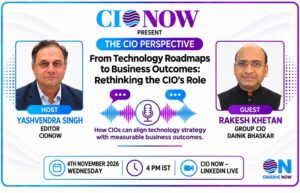
Building an AI-Native Newsroom: How Dainik Bhaskar Is Reimagining Technology Leadership

With media changing rapidly, it is important to balance technology, quality journalism, and scale. In a discussion with CIONOW, Rakesh Khetan, Group CIO, Dainik Bhaskar, discusses how technology enables this change in newsrooms, and how they have balanced traditional print media and digital expansion to deliver value to the business.

How have expectations from a Group CIO changed in a media organization where content, audience trust and speed of delivery are central to success?

The business expectations from a CIO have definitely changed. Now, infrastructure is no longer just about IT but is expected to be delivered at a rapid pace. Business expectations have changed rapidly. Infrastructure is no longer just about IT. Every business stakeholder expects things to be delivered at a rapid pace. With AI coming in, patience has almost gone to zero. Everyone has access to AI today, and they expect faster delivery.

We are also adapting to this change. We have deployed different AI tools and given access to everyone in the organization, with the necessary controls and guardrails, to help them perform their day-to-day tasks faster.

When it comes to content, the biggest challenge is verifying facts. Content is available everywhere on the internet, but ensuring its accuracy before it reaches the public domain is important. A human is always in the loop to verify the content before publication.

With media organizations serving both loyal print readers and an expanding digital-first audience, what are the key technology priorities for balancing legacy print operations with digital growth?

Content is being generated across multiple platforms, and we always have a human in the loop. Whether content is published on a digital platform or in print, it is verified before reaching the public.

Being a media organization, we have common editorial functions that manage the content. We prefer our editorial, sales, and marketing teams to use a common database, where information is verified by the respective stakeholders before being made available in the public domain. Hence, there is very less discrepancy in the content.

In a newsroom, speed and accuracy must go hand in hand. How is technology, particularly AI, helping Dainik Bhaskar accelerate content delivery while maintaining editorial integrity and credibility?

This is exactly where AI is helping us. We have defined multiple rules that have gone through several iterations to reach the level at which we use them today.

Every piece of content passes through a long list of AI agents and mostly, the verification is handled via technology before reaching the human-in-the-loop stage. Depending on the nature of the news, one or multiple people verify it.

Within Dainik Bhaskar, there is a particular team assigned to monitor social media for sports-related news. As the content from these sources may not be accurate, there are specific individuals in place to ensure fake/false news does not get published. At the initial stages, AI technology filters the content; therefore, only content that needs final verification is passed to these individuals so it can be published.

We are using various AI tools, while also applying a detailed set of rules (which have been improved upon multiple times).

Is Dainik Bhaskar developing its AI capabilities in-house, or is it adopting enterprise AI platforms available in the market? How are you approaching data security while using these tools?

We have a strong technology team, and most of our team members are in-house. We also have a very lean ecosystem of partners.

We are using most of the AI tools available in the market today, and these are enterprise-grade versions rather than the commonly available free models. We ensure that, since these are enterprise-grade versions, their models are not trained on the basis of our data.

Modernizing legacy systems without disrupting business operations is a significant challenge. How do you decide which systems to modernize, what to retain and when to undertake these changes?

Change is the only constant. Whatever systems and legacy technologies we have must evolve with time. Otherwise, we cannot continue to be market leaders. However, choosing the right systems and the right time to change them is important.

For example, festive seasons are peak periods for print media in India. We do not undertake system changes during these periods. Once the festive season is over, we identify which systems need to be changed and discuss the strategy with our business partners.

Technology cannot make these decisions in silos. We work with business functions, align with them, identify the modules that need improvement and then decide whether to upgrade or migrate to newer technology stacks.

We continue making improvements in phases. Once a new system is in place, we conduct proper user acceptance testing, internal testing and pilot runs in a smaller area. Once everything is finalized, we roll it out across the organization.

Many enterprises are reconsidering their cloud-first strategies in favor of hybrid infrastructure. What is driving this shift, and how is Dainik Bhaskar approaching its infrastructure strategy?

I would not say that on-premises infrastructure is making a comeback. Rather, we are moving towards a hybrid approach. Initially, the entire CIO community was in a rush to adopt a cloud-first strategy. However, the cost of technology has increased significantly. With the advent of AI, the impact of the Ukraine war, rising dollar prices and increasing hardware costs, cloud expenditure is also going up.

As data volumes increase, cloud costs are creating a significant financial burden. That is why we are also moving towards hybrid technologies. We are working with multiple cloud partners alongside on-premises and colocation infrastructure. Cost and data security are the major reasons why hybrid infrastructure is the way forward. We are already operating in a hybrid environment, and we will continue to be hybrid.

Media organizations handle sensitive subscriber information, commercial data and content that directly influences public perception. What are your key cybersecurity and resilience priorities?

I would not say that security is critical only for technology leaders. Today, it is important for every individual. Even a common person can receive a digital arrest call on WhatsApp. The first thing we do is sensitize every employee about the importance of cybersecurity.

We have 24/7 monitoring, strict access controls, and threat management tools. Although we have these measures in place, they need to be regularly reviewed. As we’re a media business operating 24 hours a day, our teams reflect this.

We have key external partners too. We can’t rely purely on internal teams alone given how sensitive/critical our data is. However, we do have appropriate security measures in place to protect key and important information. We do continual training for people in technology, and across all functions. We make it a priority for everyone in the business. We are doing weekly awareness sessions to increase this.

How do you ensure that business leaders understand investments in technology support increased profitability, and increased revenue and productivity in the business, and aren’t viewed as cost?

CIOs are no longer just technology leaders; they are business drivers. We work with business heads, functional heads and their teams to understand their processes.

Implementing technology is my responsibility. Therefore, I need to prepare a business proposition that explains how technology can help increase business value. While talking about sales, I am accountable for generating additional revenue. I have to ensure that only the right and verified content reaches the public domain as a media company, while reducing workloads and improving productivity.

We collaborate with different functional heads and understand their businesses, and then introduce tech solutions via pilots and proofs of concept. Once they experience improved profitability or productivity, we get their buy-in and proceed with the rollout. 

What emerging enterprise technology trends do you believe will have the greatest impact on the media industry?

Media is one of the industries that usually explores and pilots new technologies as they emerge. If a technology makes business sense, we adopt it quickly. Employees in the media industry are also quite adaptable and willing to adopt new technologies, provided they see tangible benefits. AI is already here. Looking ahead, I assume quantum computing will become the tech trend as it has lot of potential. 

What are some of the challenges in working as a Group CIO?

The biggest challenge is understanding every function in the businesses. Functional leads will only really understand their specific function. As a CIO, you must understand across the whole business and implement the right technologies in each function.

We essentially become a ‘jack of all trades’. Although challenging, it is very interesting. In some functions, CIOs have to have a greater understanding of the function, in detail, than the functional leads. This means that we can provide the most suitable solutions. As a challenge it can be difficult however it is an excellent learning opportunity.

Looking ahead, what is your technology roadmap for Dainik Bhaskar? What are your short-term priorities and long-term ambitions?

Thanks to our promoters, I am working towards making DB Corp an AI-native organization within the next one to one-and-a-half years. The entire team is working towards achieving this goal. We have also recently joined hands with a proven AI platform, which is already in the public domain. This is part of our short-term plan.

Chat with CIONow.in