Happiest Minds’ Arttha deployed by Absa’s Spark in Mauritius for Digital Banking Services

Happiest Minds Technologies Limited, an AI-first, customer-centric digital engineering company, today announced the deployment of its cloud-native digital banking platform, Arttha, to support selected capabilities within Spark by Absa, the digital banking and lifestyle app from Absa Bank (Mauritius) Limited.

Arttha’s Open Banking and Financial Marketplace modules power selected Spark capabilities, including account linking, payment options, offers and experience bookings. Happiest Minds provided technical integration and implementation support, while Absa Mauritius led the development of the Spark proposition and customer experience.

Arttha is Happiest Minds Technologies’ cloud-native digital banking platform, supporting banks and financial technology companies across markets with capabilities spanning payments, lending, core banking and open banking.

Joseph Anantharaju, Co-Chairman & CEO, Happiest Minds Technologies, said: “The launch of Spark by Absa reflects the strength of our relationship with Absa Mauritius and our shared commitment to making digital services more relevant and accessible. Through Arttha, we are pleased to provide the underlying platform capabilities that support the bank in bringing its vision for Spark by Absa to market and creating greater value for customers in their everyday lives.”

Prathamesh Kulkarni, CEO, BFSI, Healthcare & Life Sciences, and Retail & CPG, Happiest Minds Technologies, added: “Arttha is an important part of our digital banking portfolio. Its deployment in support of Spark by Absa demonstrates how underlying technology platforms can support banks in responding to changing customer needs and delivering more connected digital experiences. We value the opportunity to support Absa Mauritius as it advances its digital strategy.”

Udeet Bhagat, Arttha Business Head, Happiest Minds Technologies, said: “Absa has been a valued customer in Arttha’s growth journey, and the launch of Spark by Absa further strengthens this relationship. Arttha provides selected underlying platform capabilities that support Absa Mauritius’ proposition, bringing banking, payments and lifestyle services closer together with the customer at the centre.”

Yousuf Hoossainsaeb, Head of Open Banking at Absa Bank (Mauritius) Limited, said: “Spark by Absa reflects our ambition to play a more meaningful role in our customers’ everyday lives. Conceived, designed and built in Mauritius, Spark is proudly Made in Moris and shaped around the evolving needs of our market. It brings payments, banking services, offers and lifestyle experiences together within one convenient digital platform.

Happiest Minds supports Spark through selected underlying technology capabilities and technical integration expertise. At its heart, Spark is about using technology to address real needs and create value beyond traditional banking.”

For Happiest Minds, the deployment of Arttha in support of Spark by Absa marks a further step in its relationship with Absa. It also demonstrates the role that underlying technology platforms can play in supporting banks as they introduce digital propositions that respond to changing customer expectations.

The collaboration combines Absa Mauritius’ locally conceived and built Spark proposition and customer experience with selected underlying platform capabilities from Arttha and technical integration support from Happiest Minds. Spark remains a distinctly Mauritian proposition, created in Mauritius for the evolving needs of the local market.

Transforming Insurance Through Technology, Trust and Empathy

The insurance sector often comes into play when people are stressed and trying to understand complex policies, file claims after an accident or receive support in their time of need. These situations can be made worse by the insurance process.

For insurers, it’s about identifying the points of friction across the process and leveraging technology to help make insurance easier, quicker and more accessible.

In a discussion with CIONOW, KV Dipu, Senior President at Bajaj General Insurance talks about how AI, Cloud and Data are impacting the insurance sector, balancing innovation while keeping businesses running and ensuring trust, security and empathy are at the center of the sector.

What customer issues should insurers focus on before adopting technology rather than simply following trends or cutting costs? 

In the insurance industry, it is crucial to identify areas where customers are facing the highest friction and then provide services with the right technology adoption. This way, you can get the best ROI. 
For customers, insurance literature can be complex, especially when they need to understand medical and legal terms, inclusions, and exclusions. We launched a GenAI tool called ‘Insurance Samjho.’ Using this, customers can upload the insurance docs they find difficult to understand, and then the tool converts them into a simple summary.

It might seem simple for customers, but at the backend, it’s a classic case of solving real customer issues using state-of-the-art technology, with a simple front end and complex processing at the backend.

How can insurers redesign journeys such as policy purchase, servicing, claims and renewals to make insurance docs simpler, faster and more transparent?

To address the customer problem, one needs to think like a customer. For example, in case of car crash, you will call the insurance company, then the insurer needs to locate you, find the nearest surveyor and arrange them to come to the accident site which is a time taking process.

To reduce this waiting process, we opt AI and machine vision by which customer simply takes damaged car photographs and upload them through the mobile apps. The AI tool assess those pics and identifies potential fraudulent claims and estimates the extent of damage.  This hardly takes 20 minutes, and the customer receives the estimated amount. Once customer confirms, the money is transferred.

After launch, customer firstly found it unbelievable as the experience was dramatically shorter than what they were used to.  As an insurer, if you know which problem you are solving, the technology automatically falls into place. You don’t need to worry about ROI as you are solving the real problems that customers are finding easier and helpful. 

A seamless front-end experience is impossible if the back end is siloed. What architecture is needed to connect digital channels, core insurance systems, agents, partners and customer-service platforms?

The insurance process includes many third parties such as garages, hospitals, distributors and other partners. And it is very important for information to flow smoothly in both directions at every point in the value chain.  We moved to cloud and shifted from data stored in separate data marts to a single, holistic data lake, years ago, which ensured customer data was consolidated. To create seamless customer experience, we opted for partner integration and a unified data foundation that could share the needed information on the respective devices of our teams and partners. 

No major insurer can shut down operations for a year to overhaul its technology. How can insurers modernize legacy systems incrementally while maintaining business continuity?

One should continue using the existing system to run current operations, but freeze new requirements except the truly compelling ones, such as regulatory mandates; meanwhile, work on the new system and add new features there. This way, your existing system will continue to serve the run-off business until it is no longer needed while ensuring customers and distributors are not affected. Any duplication, redundancy, or integration between the old and the new systems should be managed with extreme rigor. If both systems are controlled properly, they can operate side by side. Once done with the older system, move to the new system smoothly.

What role do cloud platforms, APIs, real-time data and modern analytics play in making insurance operations more agile and scalable?

The rapid evolution of AI is a real challenge. By the time you understand one form of AI, another form becomes the trend. To tackle this situation, insurers need to move from a long-gestation mindset to an agile one. They must be ready to seize the latest opportunity. They need a strong internal team that builds solutions across the value chain, but also knows when an external solution is better. They must be nimble enough to adopt it. Once you combine internal capabilities with the best external solutions, you will get the best of both. 

You have championed the idea that AI should expand access and financial inclusion. How can insurers use AI to reach customers with different levels of digital literacy?

At Bajaj General Insurance, we opted two approaches. As India has plethora of languages, we used digital tools and AI in Indian languages, and using them helped amplify reach. Another initiative was Insurance on Wheels, a digitally equipped vans that travelled from village to village on a planned route, where customer could visit the van to understand insurance, buy a policy, raise a claim or make changes to the existing policy. All of this happens in vernacular languages. These initiatives are live and help expand access to insurance.

 AI is often seen as a way to replace people. How do you design workflows where machine speed and human empathy complement each other rather than create friction?

We developed Care Angels, a human relationship manager that provides empathy and support while the servicing itself is completely digital. This platform works with human touch and machine efficiency. The response from the customer was so strong that now 75% of our cashless claims are covered by Care Angels. Our Net Promoter Score is above 95 without a single detractor. This is an excellent case of combing human and machine; you create a sense of oneness with the customer. 

As systems become more interconnected and rely on large customer datasets, how should CIOs protect sensitive data and remain resilient against cyberattacks and outages?

In this digital era, security is most important. With expanded digitalization, the attack surface has expanded exponentially. Simultaneously, response time to an incident has reduced. Humans may miss out the risks that need a quick response; to counter that, we need AI to counter AI. As cyber criminals use AI to create problems, enterprises also need to use AI in the right way to keep them at bay. Enterprises need both advanced technology and continuous training to make employees digitally aware. Therefore, a strong combination of repeated awareness and state-of-the art tools keeps you in business. 

AI is often described as an energy guzzler. How can insurers manage energy consumption, infrastructure demands and lifecycle impact without compromising performance?

There is an opportunity to deploy smaller language models and do the same thing but with less energy consumption. Businesses have an ESG agenda and so energy consumption becomes a factor. There are many solutions available here which are well known and in many cases required.

Whilst scaling AI, organizations should look to enable employees to embrace the use of AI but also raise awareness regarding energy consumption and how they can be good corporate citizens. By looking at everything from multiple angles, organizations can ensure that AI adoption and sustainability work together.

When measuring ROI, which technology and business metrics best demonstrate that digital transformation and AI programs are improving claims, service quality, productivity and business value?

ROI is often a consideration. If you are not solving a real customer problem, and getting too caught up with the latest thing, then the solution you implement will not be scalable. You are now stuck with two solutions and an expensive white elephant.

If you solve a real problem then scalability will happen. As you scale your AI solution, you can decommission the previous solution. For example, in customer service we used to have around 80% call center and 20% digital. Since the pandemic, we have completely flipped this around and have 80% AI and 20% non-AI.

As we have invested in our AI solution, we have been able to reduce the number of call center seats. We were profitable from day one and have shown savings from lower operating expenditure on millions of transactions.

However, we also look at some of the non-financial outputs. Customer and employee satisfaction, grievance ratios and NPS. From a regulatory viewpoint, we are one of the best in terms of our grievance ratio. We also have independent studies showing we are the best in the market for NPS. Ensure you are solving the correct problem, you will then get scalability. If both solutions are running in parallel you wll have double the cost.

Finally, what emerging technology trends will have the greatest impact on digital insurance over the next three to five years, and what should CIOs prepare for now?

There’s risk in crystal ball gazing. But one thing that will always stay constant is that customers will demand the best service and security will be key.  Clearly, there will be lots of impact from AI. We have moved from traditional AI to generative AI and now agentic AI. So it’s important that organizations keep up, understand the right use cases, and scale appropriately.

Secondly, in an Indian context, we need to ensure that we increase reach beyond just English and a couple of large Indian languages. We want to be where the customer is.

Thirdly, we need to make sure that although we digitize processes, we remain human. Customers won’t call their insurer when they are doing well; they will call when they are in trouble. Empathy is key. As long as technology leaders focus on solving real issues, keeping security, increasing reach and keeping empathy, they will be in business no matter what new technology comes out.


81% of Software Teams Have Merged AI-Written Code They Didn’t Fully Understand, Finds TestMu AI’s State of AI in Quality Engineering 2026 Report

TestMu AI (formerly LambdaTest), the Agentic AI Quality Engineering platform, today released the State of AI in Quality Engineering 2026 report. It finds that 81% of software teams have merged AI-generated code or tests they did not fully understand, and 44% report more escaped defects or production incidents as AI-written code has grown. AI now writes much of the code and many of the tests, yet most teams still verify that work with a person after the fact, or with another AI model.

97% of teams surveyed now use AI in testing or plan to. For most of them, the open question is how AI-generated code and tests get verified before they ship.

Key findings from the State of AI in Quality Engineering 2026 report:

  • The verification gap: Only 41% of teams run any automated check on AI-written code before merge; most rely on manual review (55%) or a QA hand-off after the code is written (51%). Teams without separate CI tests see escaped defects rise more often (49%) than teams that run them (38%).
  • Developers are the most exposed: 93% of developers have merged AI output they did not fully understand.
  • AI grading AI widens the gap: Teams that use one model to score another (LLM-as-a-judge) regularly merge AI output they do not understand twice as often as other teams (29% against 15%). AI-generated tests are “almost right, but not quite” a median 65% of the time.
  • AI agents ship on human review and demos: 77% of teams build AI agents they need to test, but 37% of them have no systematic way to evaluate those agents, and only 28% test agents against users who try to break them.
  • Budgets fund generation, not verification: 50% of teams spend most of their AI testing budget on producing AI output, against 17% on verifying it.
  • Few are prepared for AI mistakes: Only 13% of teams have an incident-response plan for AI errors.

“Software teams now rely on AI to write their code, generate their tests, and increasingly determine whether both are ready to ship. Verification, however, has not kept pace with that shift. We believe any output AI produces should be validated by a system independent of the model that produced it, before it merges and every time it changes. The teams in our survey that already follow this discipline see fewer defects reach production, and we expect it to become the standard for engineering organizations shipping with AI”, said Asad Khan, Co-founder and CEO of TestMu AI 

NTT DATA and IIT Jammu Partner to Establish AI Center of Excellence for Climate Resilience and Tech Innovation

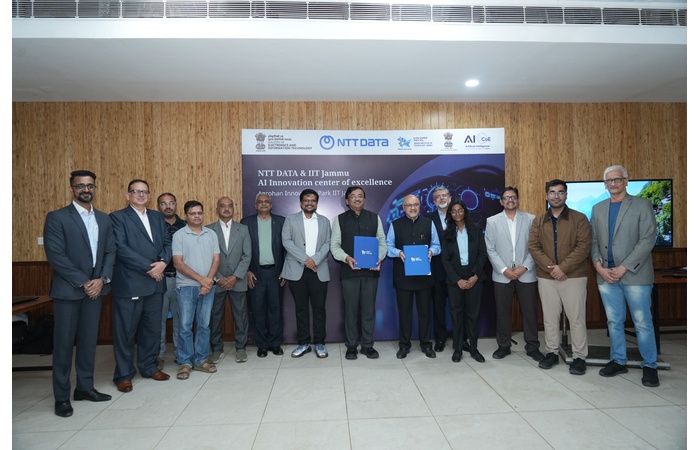
NTT DATA, a global leader in AI, digital business and technology services, and the Indian Institute of Technology Jammu (IIT Jammu) today announced a strategic collaboration to establish an AI center of excellence (AI-CoE) at IIT Jammu with the goal of helping make communities safer, expanding local access to AI capabilities, developing the region’s talent and creating new pathways for local economic opportunity.

Jammu and Kashmir’s (J&K) mountainous terrain and river systems present complex challenges related to floods, landslides, infrastructure planning and emergency response. Strengthening climate and disaster resilience will therefore be an important focus, with potential applications including flood monitoring and early warning for the Tawi and Chenab river basins, as well as sensor-based approaches to landslide and flood risk.

NTT DATA and IIT Jammu will explore how AI, geospatial data, digital twins, IoT and edge technologies could help better understand existing risks, strengthen preparedness and response. They will also explore locally relevant AI, including research into Indian languages such as Dogri, to help make digital services more accessible.

NTT DATA will leverage its global network of Innovation Centers to connect IIT Jammu’s research capabilities with industry needs and NTT DATA’s global advanced technology capabilities. The collaboration will explore relevant use cases in the wider J&K region, with the potential for successful approaches to be adapted more broadly across India.

Four areas of innovation

The planned AI-CoE will organize its work around four areas:

  • Secure and responsible AI innovation: Develop secure, responsible and locally relevant AI, including small and large language models, agentic AI and AI governance. This will include AI capabilities in Indian languages such as Dogri, with potential applications in digital public services. 
  • Digital twins: Create virtual models of physical environments and infrastructure to support better planning, monitoring and decision-making, with applications spanning smart campuses, infrastructure management, environmental monitoring and climate and disaster resilience.
  • Physical AI: Combine AI with robotics, computer vision, IoT and edge computing for applications including infrastructure monitoring, autonomous systems, situational awareness and public safety.
  • Research commercialization and startup lab: Help translate research into intellectual property, product development and startup formation, supporting deep-tech entrepreneurship and economic opportunity in J&K.

Developing skills alongside technology

A talent development program will connect the four areas of innovation, giving students, researchers and faculty opportunities to work directly on real-world challenges. Planned activities include industry projects, faculty engagement, fellowships, hackathons and practical exposure to AI, high-performance computing and edge computing. 

“AI’s greatest impact happens when it helps solve real problems for people and communities. Together with IIT Jammu, we will give researchers and students a pathway to turn promising ideas into practical solutions and commercial applications. By combining local insight with NTT DATA’s global technology capabilities, we can develop solutions that are relevant to Jammu and Kashmir and have the potential to scale more broadly,” said Avinash Joshi, Executive Managing Director, India, NTT DATA.

“By bringing together IIT Jammu’s research and talent with NTT DATA’s technology and industry expertise, we want to create an environment where ideas can move from research to real-world application. The collaboration will give our students, researchers, and faculty opportunities to address challenges that matter to Jammu and Kashmir while developing innovations that can have relevance across India,” said Professor Manoj Gaur, Director, IIT Jammu.

Bring CIOs Into the Deal Before Signing, Not After

Sometimes a deal adds up, but a business ends up with incompatible systems, hidden costs and features it can’t tap. As technology leaders, CIOs confront the humongous challenge of post-merger in not just tying together two technology stacks, but also it’s working with the business to turn the deal into value.

Top CIOs deliberated on this subject at a panel discussion themed ‘Architecting the Modern Enterprise: Boardroom Strategies for M&A, Ecosystem Alliances, and Accelerated Growth.’ The session was a part of the CIO Retreat event organized by ObserveNow in Gurgaon.

Start with Business Outcomes

Speaking at the session, Rajiv Mishra, CIO, Hindustan Times, recalled being called into a board discussion during the pandemic, only to discover that an acquisition was already being considered without a technology assessment.

“I was not even aware that we were acquiring that company,” he said. Expectedly, before proceeding, he sought time to examine its technology stack, infrastructure, spending and team capabilities.

The experience illustrated the limitations of bringing technology leaders into a transaction late. By then, assumptions about cost, compatibility and execution may already have shaped the business case.

Priya Dar, Head-IT, Valvoline Cummins, described an earlier merger in which IT received a fixed-asset register containing approximately 80 lakh lines and instructions to combine the entities.

Today, she said, the opening questions should be different. “What are the KPIs? What is it that we want to accomplish? What are the timelines, and how much are we going to spend?”

Platform choices matter, but they should follow clarity on the outcomes the transaction is intended to achieve.

Look Beyond the Balance Sheet

Some of the most consequential technology dependencies are barely visible in formal asset records.

Annapurna Kuchibhatla, CTO, Bajaj Electronics, pointed to spreadsheets, cloud subscriptions, open-source tools and internally developed applications that may operate outside central IT’s knowledge. Acquiring these environments without examining how they work can create unexpected dependence on particular teams or individuals.

She recalled an acquisition that included a substantial software platform without first establishing whether it matched the buyer’s requirements. It subsequently became a “white elephant.”

Atul Govil, Chief Transformation Officer & Head (SAP & IT) – Corporate at India Glycols, highlighted another hidden exposure: “tribal knowledge”, where only two or three people understand an application critical to the business.

Sustaining that group for 12-18 months and even possibly having their knowledge documented, or starting the re-build of the application, must be included in the cost of the transaction and not an operational problem to overcome downstream.

Translate the Risks of Integration into the Bottom Line

The board needs more than a description of ageing technology stacks or moribund applications. The board needs to understand the impact on capital deployment, risks and returns.

Govil urged CIOs to explain the cost of securing legacy systems, retaining essential employees and delaying integration.

“You have to speak in the language which they want to understand,” he said.

This is particularly important when an acquisition’s financial rationale depends on synergies. Shared platforms and consolidated processes cannot generate immediate savings if the underlying systems cannot be integrated.

In cases where those benefits will take a year or two longer to materialize, CIOs should be up-front about this delay and its associated costs before those benefits turn into commitments.

Make Controls Non-Negotiable

Gyan Pandey, CDIO, Polycab, listed cybersecurity deficiencies, data ownership issues, residencies, compliance and complexity of integration as reasons to challenge a suggested technology configuration. Similar to entry, exit considerations: how hard is it to leave a platform or partnership?

But to protect the business, not all corporate systems need to be installed all at once.

“When you start forcing everything to be implemented at the same time, it is a sheer disaster,” he said. His methodology isolates critical controls –financial validation, audit trail, cyber security and role-based access –from the incremental processes.

The sales office might require the customer interface to be implemented first; the manufacturing process could require that operational processes are available first. Training, local champions and reviews at regular intervals can help that transition to be practical.

Preserve Continuity and Local Relevance

Mishra advocated phased modernization in publishing, where daily operations cannot pause for a technology transition. Legacy systems must remain secure and functional while newer capabilities are introduced and tested.

Dar offered a parallel lesson from a joint venture involving Cummins and Valvoline: collaboration should enable learning without forcing uniformity.

“We take the good bits from Cummins. We take the good bits from Valvoline, but we make our decisions that work for India,” she said.

That requires transparency, regular engagement and recognition that global practices may need adaptation to local commercial realities.

Integrate Selectively

The panel’s closing message was that integration should serve the business, not become an end in itself.

Govil cautioned against compromising the acquiring company’s core systems while focusing on the new enterprise while Annapurna suggested that some acquired capabilities may suit only selected divisions.

Dar captured the leadership imperative: remain open to learning, but be prepared to challenge unnecessary consolidation. “Not everything has to be merged in a merger and acquisition,” she said.

For CIOs, the mandate is to help enterprises integrate deliberately—preserving valuable differences while making the costs, risks and benefits of change clear.

Netskope Appoints Carrie Francey as Global Channel Chief

Netskope, a leader in modern security and networking for the cloud and AI era, today announced the appointment of Carrie Francey as Senior Vice President of Global Channel Sales. Reinforcing the company’s investment in a partner-led go-to-market strategy, Francey will oversee Netskope’s global partner organisation and its channel partners, managed service provider (MSP), managed security service provider (MSSP), cloud marketplace, and global systems integrator (GSI) programs.

Francey is a respected technology executive with experience leading global partner organisations at HPE, Microsoft, ServiceNow, and Zendesk. Throughout her career, she has built high-performing teams, transformed partner ecosystems, and developed strategic relationships that create measurable value for customers, partners, and businesses. Francey is also co-founder of Women in Cloud, an organisation founded in 2017 that helps women-led technology companies and female entrepreneurs grow in the cloud economy.

At Netskope, Francey will lead Netskope’s global channel sales organisation, focused on expanding a cybersecurity ecosystem that accelerates sustainable productivity, creates new business opportunities, and drives customer success. She will work with channel partners, MSPs, MSSPs, cloud marketplaces, and GSIs to deepen collaboration, expand market reach, strengthen customer trust, and deliver modern, differentiated solutions fit for secure AI adoption.

“Partners are essential to helping organisations securely navigate the rapid changes taking place across cloud, data, and AI,” said Francey. “I am excited to join Netskope and work with our partners to create new opportunities, deliver greater customer value, build trust, and establish a durable foundation for shared success.”

“The channel ecosystem is a cornerstone of Netskope’s strategic growth. When our partners thrive, Netskope thrives, and our customers thrive,” said Raphaël Bousquet, Chief Revenue Officer, Netskope. “Carrie’s proven track record and vision will ensure our partners receive world-class enablement and resources, empowering them to expand their capabilities and lead the market in AI-ready solutions.”

Francey’s appointment reinforces Netskope’s commitment to building a trusted, high-performing cybersecurity ecosystem that drives long-term partner relationships, innovation, customer confidence, and success. Among recent channel program updates, the company launched the Netskope Catalyst MSP/SP Program, a comprehensive partner enablement program built around partners’ go-to-market needs, and the ability to sell Netskope services with flexible, simplified pricing models.

Netskope’s channel-first, go-to-market approach includes ongoing, expanded partnerships with cloud providers such as Amazon Web Services (AWS), GSIs including Accenture, Deloitte and Wipro, and service providers including BT International and Macquarie Telecom, among many others.

53% of Organisations Struggle to Translate Business Context into AI Systems Despite Rising AI Investments: Alteryx Research

 As organisations accelerate investments in artificial intelligence (AI), ensuring that AI systems understand business requirements and operational processes is emerging as a major challenge. According to global research by Alteryx, an AI-ready data and analytics company, 53% of organisations struggle to translate business context into AI systems and workflows, even as 80% expect their AI spending to increase over the next two years.

The findings are part of Alteryx’s 2026 IT Leader Research: The State of AI Ownership, Agents, and ROI, based on a survey of 1,400 technology leaders globally. The study highlights a growing gap between AI investments and organisations’ ability to translate them into consistent, measurable business outcomes.

While 69% of organisations report moderate or significant returns on their AI investments, 77% of technology leaders believe business context is essential for generating accurate and relevant AI outputs. This indicates that successful AI implementation requires more than advanced models and access to data. AI systems also need to understand the business rules, policies and processes that guide everyday organisational decisions.

The challenge is particularly relevant for Indian enterprises, where AI adoption and investments are gaining momentum, but data readiness remains a concern. A separate Dun & Bradstreet AI Momentum Survey released in August 2026 found that all surveyed Indian businesses had AI-related projects underway, while 69% planned to increase their AI investments. However, only 4% said their enterprise data was fully ready to support AI at scale. Although 73% reported some measurable returns from AI investments, the findings point to the need for stronger data foundations as businesses move towards wider AI deployment.

Much of an organisation’s business knowledge remains scattered across spreadsheets, internal documents, email conversations, macros and employee expertise. For instance, financial forecasts depend on specific assumptions, tax processes follow defined rules and exceptions, while supply chain decisions rely on inventory levels and operational requirements. Unless such knowledge is accessible to AI systems, their outputs may not always reflect an organisation’s actual business requirements.

Commenting on the findings, Sabya Sen, Vice President, IMEA & APAC, Alteryx, said, “India is moving rapidly towards wider enterprise AI adoption, with organisations increasingly investing in AI to improve productivity, efficiency and business outcomes. However, the next phase of this journey will depend on how effectively businesses connect AI with the knowledge and processes that drive their operations. AI systems need more than access to data; they need the right business context to generate outputs that are relevant, reliable and aligned with organisational requirements. As enterprises move from experimentation to deployment at scale, making business logic accessible, governed and repeatable will be critical to translating AI investments into measurable business value.”

The Alteryx research also highlights limited access to data as another challenge for enterprise AI adoption. Only 18% of organisations have achieved fully self-service access to cloud data for business users. Meanwhile, 38% report a mixed model of data access, while 15% say business users remain largely dependent on technical teams. This can make it difficult for employees with a deep understanding of business operations to access and work with the data needed to develop and improve AI workflows.

Collaboration between IT and business teams is emerging as another important factor. While strategy and delivery responsibilities remain largely concentrated within IT departments, 71% of technology leaders believe AI initiatives are most successful when IT and business teams work closely together. Additionally, around two-thirds believe AI and agent-based systems are most productive when managed within business functions.

As Indian organisations move towards wider AI deployment, the ability to make business knowledge accessible, governed and repeatable will become increasingly important. Connecting AI systems with the rules, processes and operational knowledge that drive businesses can help improve the relevance of AI-generated outputs, strengthen trust and create a closer link between technology investments and business objectives.

Savex Technologies is Alteryx’s distribution partner in India, driving the reach and adoption of analytics and automation solutions across the country.

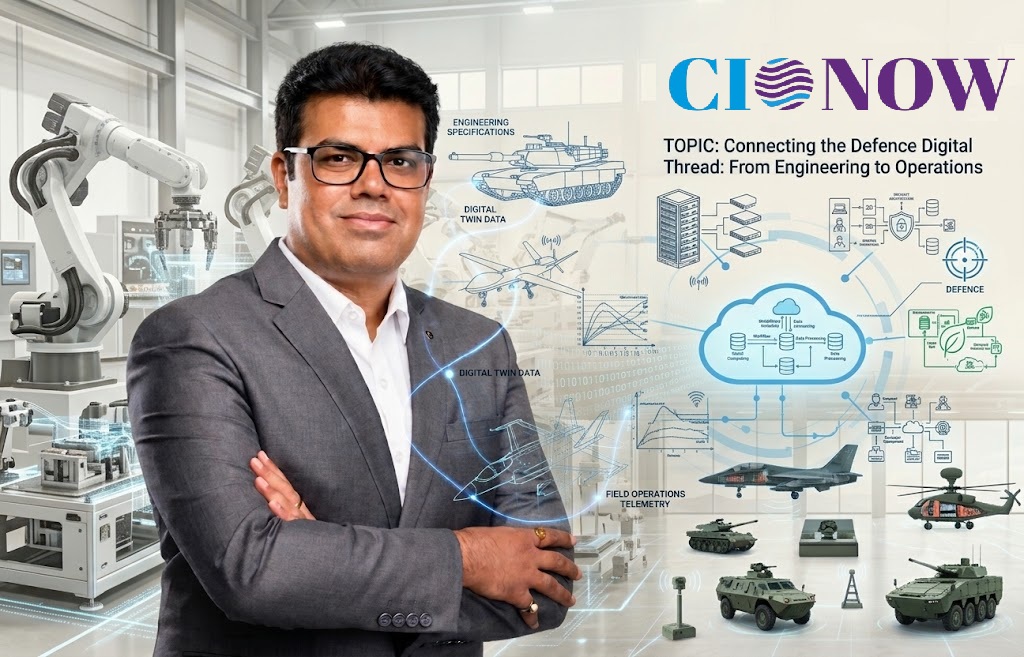
Connecting the Defence Digital Thread: From Engineering to Operations

The real competitive advantage lies in how efficiently data is communicated across all phases of a mission, from development and production to deployment, maintenance, and operation.

This is where the concept of digital thread comes into play. It links different stages into one single data flow, which implies that information produced at the design or testing stage can be employed when the products are already in operation.

One Digital Thread Across the Lifecycle

A defence platform generates information at every stage of its lifecycle. Requirements come in the planning phase, engineers create models and designs, manufacturers provide production data, testing reveals performance information, and operations generate information after deployment. If every stage is isolated from the others, some important context may be lost between the stages. The digital thread connects all stages of the lifecycle and enables continuity between them.

This allows operational feedback or engineering data to be used for maintenance or decision-making related to missions.

Breaking the Technology Silos

Defense environments usually contain a number of technology layers, including PLM, ERP, OT, IT, C4ISR, MRO, and mission systems. All these systems have different purposes but have information that is much more useful when integrated.

The objective here is not to integrate all systems in a general way, but rather to make important information accessible in a relevant context. For instance, bringing together the engineering specifications, maintenance history, and operational records may give teams a complete picture of the asset’s state and performance. This is a revolution in understanding defense integration regarding systems cooperation.

From Engineering to Mission

The digital thread’s genuine value appears when engineering data can be put to practical use in operational environments.

Engineering concepts, configuration information, and testing outcomes can give valuable context for teams in charge of implementing and maintaining the system. When combined with data from the field, this information provides the opportunity to perform diagnostics, predictive maintenance, mission preparation, and make fast decisions.

It also establishes the possibility of creating a feedback mechanism: engineering influences operations, while operational experience impacts future engineering.

Digital Twins as the Living Layer

Digital twins have the potential to enhance this relationship as they generate dynamic digital replicas of systems, infrastructure, missions, and platforms.

Contrary to traditional digital models, digital twins rely on operational data, environmental conditions, sensor information, and maintenance records, which provide an up-to-the-minute snapshot of the state of a certain asset or system.

In addition, this technology is relevant for critical infrastructure. All kinds of ports, airports, power distribution networks, logistics corridors, and production plants can be digitally modeled for the purposes of better comprehension of dependencies, detection of possible failures, and increasing resilience.

Bringing OT, IT and AI Together

The blending of operational technology, information technology and artificial intelligence introduces yet another level of sophistication in intelligence. OT measures data from the physical world and assets while IT gives the necessary information to help formulate decisions. AI is able to interpret the comprehensive mix of data and identify patterns, abnormal situations and possible risks associated with them.

However, AI cannot deliver meaningful intelligence from disconnected information. A digital thread provides the context needed to move AI from isolated analysis towards more informed operational decisions.

Intelligence at the Edge

To ensure the security and safety of critical infrastructures, it is important for intelligence to work from the place of incidents. The edge intelligence concept enables real-time processing of information in proximity to the area of conflict, platform, industrial zone, or mission site. This type of platform can decrease the time lag and speed up the reaction in regions where Internet connection is unstable. Thus, it is noticed that the focus shifts from using single functions to connecting the whole mission course.

The developed defence digital thread has the potential to create an information stream that works in the following manner: engineering provides information for operational activity, while operational data optimises engineering.

Rubrik Extends Cyber Resilience Across Enterprise Unstructured Data

Rubrik , the Security and AI Operations Company, announced today Rubrik-Hosted Protection for On-Premise Unstructured Data. The offering is built on Rubrik’s Network Attached Storage (NAS) Cloud Direct service. Customers now have clean recovery for enterprise-scale NAS data without having to buy, build or manage backup storage.

“Backups mean nothing if you can’t be confident in a clean recovery, and hardware limitations shouldn’t stand between an enterprise and its resilience,” said Anneka Gupta, Chief Product Officer, Rubrik. “By taking on backup storage and orchestration directly in our cloud, Rubrik reduces infrastructure friction so organizations can protect business-critical NAS systems across vendors under one unified policy.”

Modern enterprises rely on business-critical unstructured data that is expensive and difficult to recreate, such as medical scans, seismic surveys, design assets, and AI datasets. When unstructured data is lost or locked by ransomware, the applications that depend on it stop operating. Protecting it on-premises traditionally meant buying, racking, and maintaining backup storage infrastructure. The acceleration of AI and increasing costs make hardware difficult to source and force enterprises to choose between infrastructure and security budgets.

Rubrik-Hosted Protection for On-Premise Unstructured Data addresses the protection and the hardware sourcing challenges. Rubrik runs the storage, capacity and updates, allowing security teams to manage policy and recovery in Rubrik Security Cloud without managing the infrastructure underneath.

Clean Recovery Without the Storage Burden

Rubrik-Hosted Protection for On-Premise Unstructured Data includes:

  • Rubrik-Hosted Backup Storage: Rubrik operates the backup storage, capacity and updates on its NAS Cloud Direct service. Lightweight software components (data movers) run on customers’ existing servers and connect their NAS to Rubrik’s cloud, so there are no bulky backup servers or large appliances to install on-premises.
  • Isolated and Immutable: Every backup lands in a Rubrik-hosted vault on a separate Rubrik identity domain, protected by retention lock, and designed so production admin credentials can’t reach or delete it.
  • Protect and Recover Across a Heterogeneous Estate: A unified policy protects data across various storage vendors. Customers can recover to a different array, cloud storage, or into an isolated recovery environment (IRE) to test recovery safely.
  • Ransomware Detection Built Into Every Backup: Anomaly detection runs on every backup, analyzing file entropy and change patterns with no second scan or add-on tool. Threat hunting across backup history helps teams identify a safe recovery point.
  • Find Sensitive Data Before It Becomes a Risk: Sensitive data discovery and classification scans primary file shares directly. Customers can discover and locate sensitive data, then apply protection policies, retention lock, and legal hold to critical assets, which helps regulated organizations support audit and compliance requirements.
  • Move Data Without Leaving the Platform That Protects It: With Copy and Migrate, customers can move NAS data across platforms, secondary sites, or cloud storage on a copy schedule, and then protect it at the destination with policies directly in Rubrik Security Cloud.

“Achieving cyber resilience for unstructured data takes strong collaboration across the ecosystem,” said Alvaro Gonzalez, SVP, Product and Go-to-Market, Assured Data Protection. “While MSPs anchor customer relationships and services, Rubrik removes the underlying infrastructure burden. Rubrik gives Assured customers cyber resilience and peace of mind, allowing them to recover quickly from any cyber incident without managing the operational burden themselves.”

Chat with CIONow.in