




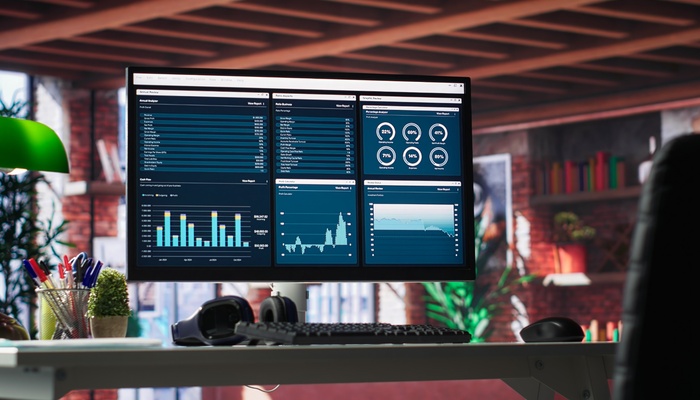
For two decades, the enterprise dashboard has been the central CIO response to making data visible. If something was important, it went onto a dashboard. If a business leader wanted to look at data, they would get yet another chart. This approach is now shifting.
While dashboards are not totally on their way out, they are fast becoming a secondary form of the user interface. The primary surface of intelligence is moving away from screens to a bi-directional, decision-first experience that tells what to do, rather than what just happened.
Why Dashboards are Losing Relevance
Dashboards were important when data was limited, access was low and the main job was to create a shared understanding of the past. They are great at illustrating what is already done: sales in the last quarter, incidents last month, adoption last week. However, they are much less adept at answering today’s technology and business leaders’ inquiries such as What’s the priority this week? What risks are lurking under the radar? What decision will have the biggest impact? How do I communicate this to the board in a couple of slides?
There are three forces driving the decline of dashboards as the primary interface. The first is information overload. Organisations typically have more dashboards than anyone has time to digest. CIOs have dozens of software tools, each with their own screens. The outcome is not clarity, but fatigue.
The second is generative AI and natural language. Technology decision-makers don’t want to learn another UI. They want to ask a question in natural language and get a one-sentence answer with sourcing: What is causing the surge in cloud costs? What vendors are most at risk this quarter? Dashboards are not effective at answering these questions, but AI assistants can.
Third is speed to act. In today’s world, it’s no longer about watching everything, but only what is relevant. At any moment, a dashboard can have all the gauges on the screen. The ‘power’ is the intelligent overlay that tells you which gauge to pay attention to, and what to do next.
What This Means for CIOs
For enterprise technology leaders, it’s a natural transition to a new era. The de-emphasis on dashboards has immediate consequences for CIOs’ perspectives on platforms, data and value.
CIOs today are accountable for demonstrating impact on the business. From being responsible for getting you to your data, they must embed analytics into conversations and workflows.
Dashboards were traditionally IT-led projects. Future dashboards and all intelligence should be owned by business product leaders while the CIO must function as a platform provider, as steward for its governance and as an AI capabilities provider. Enterprise technology leaders need to become decision-products enablers not report creators.
Armed with AI insights, IT decision makers must advocate for lineage, quality and explainability. In this scenario, the problem isn’t too little data, it’s too much untrusted output. Ownership of governance shifts from access to value.
What Replaces Dashboards
The next generation of dashboard will not be a single replacement. It will be a mixed approach that will bank on decision-first intelligence delivered omnichannel.
While the majority of organizations are still working through their own dashboarding aspirations, there are already pioneering CIOs who have moved on. They aren’t waiting for the ‘next generation’ of capability, they’re making a hybrid decision-first intelligence layer today by combining the conversational, embedded and alert-driven capabilities that they already have.
Conversational APIs enable top executives to ask questions in simple English and get short source-verified responses and recommended actions. For example, rather than logging in to a cost dashboard, a CFO might ask, “Which three cloud services will cause us to overspend this month and where should we increase our spend?”
The embedded insight is where the magic happens. The insights are embedded within the use of tools sitting at the very point of decision-making, such as ERP, CRM, ITSM, collaboration tools, board packs. The insight comes to the user, not the user to the insight.
The decision briefs and playbooks provide the middle ground – they use the knowledge and classifications of the abstractions of data, possibility and risk, and translate into decision-ready counsel to the leader: Here are the options, here are the risk areas, here are the check questions to ask, here are the recommended next steps. It can be manually written, AI-assisted, or a hybrid.
Event-driven alerts are anticipation, high impact notifications that alert leaders when it’s crossed a threshold or is out of pattern, and instantly advise the appropriate actions.
Scenario and simulation layers enable executives to say “What if?” and project the effects of alternative decisions on cost, risk, capacity or customer experience, in addition to analyzing past trends.
For executives, dashboards will take a backseat and serve as a reference layer for analysts.
The Way Ahead for CIOs
The CIOs who are spearheading this transition will view it as a move towards a product-led transformation rather than a technology upgrade. These are some of the best practices for CIOs who are getting off the dashboard.
Figure out the 10 to 15 critical decisions that your organisation is making that introduce value and risk. Make sure you can get intelligence for these, not just those you can quantify.
Create an AI Ready Data Foundation. Decision-first and conversation-first experiences require auditable, well- organized, clean, refined, and easy to interpret data sets. If not, the AI is simply boosting the noise.
Choose what you publish, not what you build. Rather than building yet another dashboard, try publishing a weekly or bi-weekly decision brief: one story, one insight, one action. Foster a high- signal, trusted intelligence culture.
Co-design decision products with your CEOs, CFOs Co-own the questions; co-own the platform, governance and enablement with your business leaders.
The dashboard age brought us visibility. The next age must bring us clarity and action. CIOs who make that transition will become the captains of better decisions.