





In the industrial world, data has become the ultimate compass as it provides business the right direction through AI and ML (Machine Learning). However, moving AI and ML from mere lab experiments to core shop floor reality is an extremely difficult challenge.
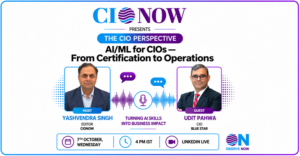
In an interaction with CIONOW, Udit Pahwa, CIO at Blue Star, outlines frameworks for moving beyond experimentation toward scalable business value.
Where do you see the most meaningful AI/ML opportunities for a manufacturing company like Blue Star today?
In manufacturing, there are plenty of AI/ML opportunities, such as predictive maintenance, R&D research, etc. In predictive maintenance, when there are connected shop floors, lots of data points get collected via signals, SCADA, etc. Putting this data into deep learning and machine learning models, and then building predictive models to identify whether any anomaly is developing on the production line in terms of machine health is where predictive maintenance of machines becomes very relevant. I think a lot of my peers in the manufacturing industry are leveraging this today.
In R&D research, product lifecycle management is complex, and earlier it was driven more by heavy human engineering. This is where AI steps in to design shape-based search. Humans might do data duplication, but with AI, it will not happen.
For us at Bluestar, we are exploring Vision AI for our service operations. For example, when our customer site breaks down, we get AI onto the video call to observe and comment to identify the quality of installation.
How far along are Indian manufacturing companies on the path to Industry 5.0? What should CIOs concentrate on next, and how far have they come?
The Indian industry is on 5.0; I think it’s still in nascent stages. We can’t even claim that we are on the maturity side of 4.0. Many industrial houses today, especially in the MSME sector, are completely averse to 4.0 implementation. Large houses, large companies, etc., have adopted 4.0 and are looking at 5.0, so we are somewhere in the midst of achieving maturity on 4.0 and running, you know, initial trials, learnings, etc. with 5.0.
When you are evaluating multiple AI opportunities, what criteria do you use to decide which use cases should be pursued first?
There are three simple logics. First, is this going to solve the genuine business pain points? Second, if it will solve it, what will be the cost? Third, will it create a unique competitive advantage or USP for the organization? Broadly, these are the three filter criteria that we apply in assessing a use case to be taken up.
How can a CIO assess and communicate the ROI of tech investments to upper management, particularly when the advantages are difficult to measure?
I treat ROI parameters as accounting. To measure ROI, the company must consider the cost of each quotation before and after the improvement. If one can produce more quotations at the same cost, it will surely cost less per quotation. Therefore, companies must translate every improvement into financial value, and this helps in measuring the actual return on technology investments.
Could you share an IT initiative that has moved beyond experimentation and delivered a tangible impact in business for you? Any specific project that comes to your mind that has actually delivered tangible ROI?
Our company had a large tender business where important data, such as deadlines, penalties, and technical requirements, used to take days to review.
With the help of the startup partner, we developed an AI solution to speed up this review procedure and build a multilingual tool trained on five years of our past tender data. This way, teams were capable of asking queries related to tenders in their preferred language with a voice interface, irrespective of the language of the original documents.
How do you integrate AI into existing enterprise and operational systems such as ERP and manufacturing execution systems and other plant flow technologies without disrupting established processes?
Existing ERPs and CRMs, are themselves coming out with their AI and ML models. Each one of them is offering what we call agentic AI or Gen AI kind of interfaces. So, one can consider adopting the AI offerings because they come from the very same OEM from which we are using the ERP or CRM. We develop our own model through a data interface where we take the data from the respective ERP or CRM and then use that for training and allow our models to use that data and deliver whatever is expected.
There could be times when the OEM’s product is not too mature, and you might have to actually take it from a third party. So it’s all a play of the data that we pull from the respective ERPs and CRMs.
As AI becomes embedded in operations, what changes are required in the IT organization’s workforce skills and collaboration between IT and business teams?
The tech professionals frequently employ specialized jargon that is not widely understood. We must convey ideas simply so that each and everyone in the company can align with the goals of the programs.
On the technical part, a basic knowledge of Python is helpful for running queries and working directly with data, as AI relies on the right data to get relevant results; a solid foundation of data models and datasets is equally crucial.
What safeguards are necessary to ensure AI models remain reliable, secure, and accountable once they are making or supporting operational decisions?
The very first safety measure one can take is to do scrutinize AI model’s outputs regularly, as the data, sales patterns, or seasonal trends keep on changing, which can affect results. We should monitor the data being fed into the model and clearly define who is responsible for its outcomes. Thus, human oversight becomes very crucial until the AI model is mature enough to work independently. There is one principle of Zero Trust in cybersecurity: ‘Trust, but Verify’.
We can definitely trust AI outputs, but a human must verify them. Even as the model matures, regular checks and safeguards are a must to identify and flag any anomalies.
What other technological factors should CIOs take into account before deploying AI, other than having the appropriate data in place?
From a tech perspective, CIOs can start experimenting with a very small base. There is no need to go ahead and buy a huge appliance, which will require a huge capex investment. But you can have a very small VM spun off only for experimentation. Always start with only one GPU, for example, and try to run some models on it. Try and scale some data sets on it, and see what is the outcome. So start small and build on it.