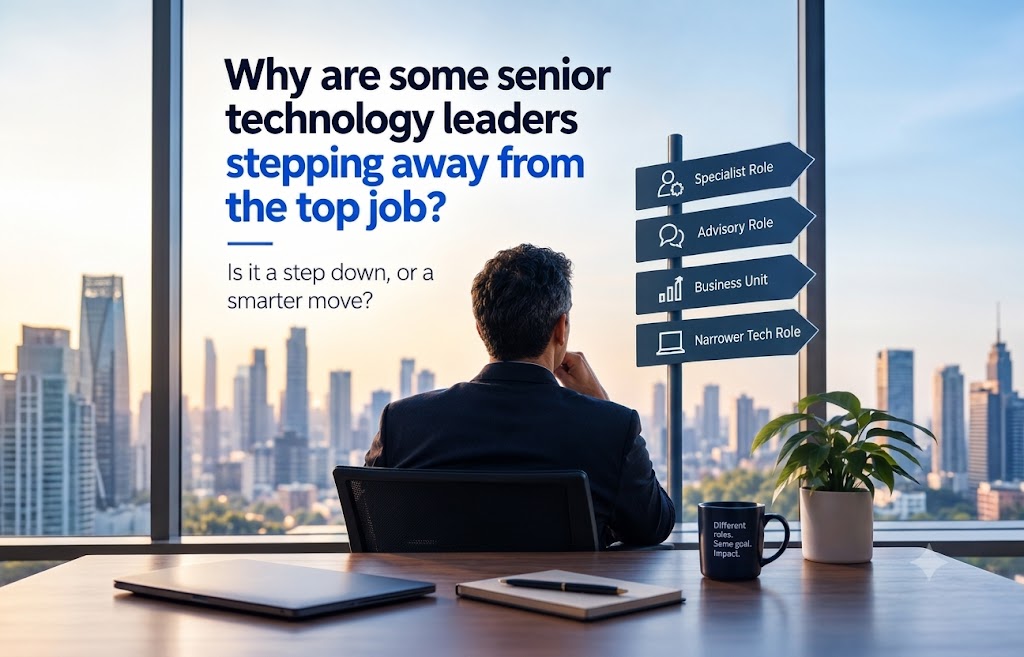
For many senior technology leaders, career progression no longer follows a predictable path. After decades of managing IT operations, transformation programs and bearing responsibility for enterprise results, CIOs are facing a growing array of options — a different C-suite position, an operational transformation mandate, a smaller business to run, or even a title downgrade in exchange for greater responsibility or a greater chance of ownership.
What are the factors influencing these decisions, and how are IT leaders translating the concept of a better next role?
The industry leaders believe that the answer cannot be solely judged by the title. There are multiple things, just as much as seniority, that influence this decision, such as scope of responsibility, decision-making authority, and capability to influence business outcomes.
The Title is no Longer the Whole Story
According to several technology decision makers, professional advancement is more about responsibilities than the title of the position. Greater power over company choices and technology investments may still be available with a junior designation. Vinay Kumar, Head of IT at Tim Hortons GCC, believes CIOs must look beyond titles while moving to their next role.
Vinay Kumar, Head IT, Tim Hortons GCC
“It’s a shift from title-based seniority to impact-based seniority. Smart CIOs today should judge roles by scope of ownership and business influence, not by the size of the job title on the business card.”
Kumar’s own career displays the importance of mandate. Being in IT positions at companies like Coca-Cola, Bata, and McDonald’s, he is now responsible for digital transformation, point-of-sale (POS) modernization, and AI strategy across multiple markets.
This role transition highlights a crucial distinction — a role’s designation may not fully reflect the scale of its responsibilities.
Accountability Without Authority
While the role’s scope is tempting, the real test is the authority it carries. For technology leaders, responsibility for business outcomes does not always translate into the authority to influence the decisions behind them.
This disconnect between expectation and decision-making authority, is highlighted by Sandip Kothaari, COO and CTO at Laser Securities. He stated that enterprises are expecting leaders to own business outcomes, while their authority often remains limited to technology execution.
Sandip Kothaari,COO & CTO, Laser Securities
“The gap can leave technology leaders responsible for results that depend on decisions made elsewhere in the organization. A CIO may be accountable for an AI initiative, for instance, but have limited influence over business adoption, process redesign or the allocation of resources.
This brings up an important point regarding technology leadership: can CIOs produce enterprise-wide results without having a significant influence over the choices that determine them?
For technology leaders considering a move, fixating on the CIO designation may be misplaced. What matters more is the influence the new role offers—the ability to shape decisions, drive business outcomes and deliver measurable value.
Experience Alone no Longer Guarantees Relevance
Technological leadership requires expertise, but the expectation attached to it keeps on changing with new trends. As every other year, there are new technology trends such as AI, data, and digital business models that change enterprises’ priorities and reshape business requirements. As a result, seniority alone may not be enough to sustain a leader’s market value.
The demand for those technology leaders has increased who can connect technical decisions with business performance, navigate organizational change, and adopt emerging capabilities.
Rajiv Batra, Former CIO at The Times Group, points to the growing demands of the role and the need for continuous learning.
Rajiv Batra, Former CIO at The Times Group
“Being an expert in a specific technology is no longer sufficient. Leaders need to cultivate business acumen, interpersonal skills, and a commitment to continuous learning to remain relevant in the market.”
Simply, the experience is still not irrelevant, but the standards have changed, which requires the values to keep on evolving. For CIOs considering a career change, the key question is whether their existing expertise can be adapted to meet the capabilities that organizations will require moving forward.
The Personal Cost of Staying at the Top
Another aspect of career decisions at the senior level is sometimes not just about ambition but about the demands attached to the role. The role can shift from managing cyber risks and transformation pressures to navigating board expectations and cost constraints, which can make it increasingly difficult to sustain over time. Sometimes personal circumstances and financial considerations can also influence career decisions. “For few leaders, the opportunity could be a response to the changing priorities rather than straightforward pursuit of a higher designation,” says Batra.
The difference is important. A deliberate decision to change the pace or type of work may result in a transfer to a less senior position. In some cases, this change could be driven by the need for greater job security or a lack of opportunities.
For technology decision makers who have worked under pressure for years, the choice is about more than just their potential career gains. What they are individually willing to endure is also a factor.
What CIOs Must Assess Before Moving
Overall, IT leaders are required to analyze the job role’s mandate in detail. They must evaluate whether the role involves oversight of customer experience, data outcomes, etc, or if it’s limited to responsibilities like system uptime and technology delivery. Next, they must identify whether they have the necessary authority for decision-making or influencing investment priorities.
Another metric would be whether it aligns with their future technology goals. Does it give enough opportunity to learn new trends? They should analyze how strongly the role is shaping their career pathways irrespective of the title or the company.
The final aspect would be sustainability. The TopResume study highlights that IT leaders are not just seeking less stressful roles; instead, they are redefining the value of work for a stable, adaptable, and well-being-focused job. CIOs who have spent years managing ongoing crises, cost pressures, and increased accountability are choosing a different role as a strategic decision rather than a retreat.