






For years, online travel agencies have been helping travelers with search, comparison, and booking of hotels and flights. However, expectations of travelers keep on changing, and providing additional options is no longer the next frontier; instead, it is about identifying what a traveler actually wants and assisting them along the way.
To align with this trend, technology is transforming from a passive booking tool to an active travel companion, from making a dynamic multi-city itinerary to helping a traveler navigate a lengthy layover or handling an unforeseen setback.
In an interaction with CIONOW, Dr. Shakti Goel, Chief Architect and Data Scientist at Yatra Online, talks about how data, artificial intelligence, and intelligent business architecture are creating more individualized, responsive, and reliable travel experiences.
As the industry moves toward more intelligent and personalized experiences, how do you see the role of technology changing across the entire travel journey?
In the early 2000s, the entire travel sector was very fragmented. Now, technology has evolved from a passive booking facilitator into an intelligent travel companion. Innovations like Yatra’s DIYA exemplify this shift, generating dynamic multi-city itineraries from live flight and hotel inventory in minutes rather than weeks. Additionally, top markets, top restaurants, top activities, attractions, and local experiences are presented as part of the trip plan. This allows a traveler to create a dynamic travel package as per his choice.
Technology that has played the role of a facilitator is now playing the role of a travel buddy, an assistant that helps you plan a trip and travels with you. Now imagine you are at an airport, and your next flight is after ten (10) hours. What if you want to leave the luggage behind and explore the city? But where is the luggage storage facility? What if you want to take a shower? You would want to know the nearest shower stall or lounge. What if someone is stuck in a country due to an emergency, for example, a war? How do you get out of the place? Can the travel buddy help you? For a corporate traveler, can the travel buddy help her get a red-light therapy session or arrange for a coworking space? Expectations of travelers have increased, and technology must find ways to serve them.
If the next generation of travel platforms has to understand a traveler’s intent rather than just respond to a search query, what kind of data and intelligence needs to sit behind that experience?
One can search for flights by entering the origin and destination cities and the travel date. The travel platform will display flight options sorted by price or duration. Now that is boring! We would want the platform to be able to “read the traveler’s mind”. Instead of filling in a form, the traveler may say “Show me flight options from Delhi to Mumbai for the coming Thursday. Do not show me flights to Navi Mumbai airport. My preference is Air India, and I am looking for morning flights”. The user has expressed the intent in their natural language (which need not be limited to English).
The intelligence to understand the user intent comes from Large Language Models (LLMs) such as Google Gemini or OpenAI GPT models. The LLM would then call an API that will do a flight search. This will be followed by filters on time, airport, and airline preference. The end result is that the user will see on the screen exactly what she intended.
Now let us talk about the data part. What if the user does not provide much information and instead provides just the date of departure and the origin and destination airports? How would you like to display the search results? Here is where ML algorithms such as Collaborative Filtering and HRNN come to help. These algorithms will analyze historical data of all the travellers that have booked flights using the platform. The users would then be segregated into cohorts. Flight options that the user or the cohort is most likely to book would be displayed at the top. This is personalization of results. The data needs to be curated and passed through the rigorous steps of data governance before it can be used to train the algorithm(s).
Travel generates data across searches, bookings, pricing, customer behavior, flights and hotels. How do you bring these different data points together to build a meaningful understanding of the traveler?
At Yatra Online, we have developed a comprehensive Enterprise Data Warehouse (EDW) that covers multiple product lines such as flights, hotels, cabs, trains, buses etc. across multiple lines of business such as Business-to-Consumer (B2C), Business-to-Business (B2B) and Business-to-Enterprise (B2E). The EDW covers many subject areas such as searches, bookings, invoices, payments, cancellations, and a few others. See the diagram below.
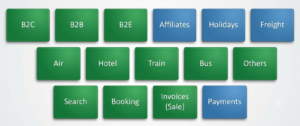
EDW allows us to track user activity on our platform and presents a 360-degree view of the traveler. We also track user activity on Yatra’s portals. This allows us to do funnel analysis from searches to bookings and understand where the portal needs optimization. We also analyze various levels of hierarchy. For example, a corporate traveler belongs to a single corporation. This one-to-many analysis allows us to study the booking behavior of the corporation. The same data can be sliced by the product dimension, and popular flights (airlines with flight numbers) across B2C, B2B, and B2E can be determined. This helps us in our negotiations with our suppliers.
Along the time dimension, we track how our business performs in the current versus the previous years. Cohort analysis tells us how existing customers churn, and new customers get added. There is a lot of curated data in the EDW; how you use it is only limited by your imagination.
Once that data foundation is in place, where is AI creating the most practical impact today: from recommendations and personalization to customer service and travel planning?
AI, specifically LLM-based GenAI, helps us in trip planning. We provide flight recommendations using historical searches, bookings, and cohort analysis. But the biggest impact is in customer service. We have developed multiple solutions where emails sent by our customers are analyzed, and quick responses backed up by actual data are provided. For example, our corporate customers send us emails asking for flight options.
Sometimes they provide preferences around departure times. They seek options for departures on different dates and for different airports. An example would be: “I want to travel to London from Delhi. Show me the flight options for 24 or 25 November. I want to skip and stopover in the Middle East. Give me options for Heathrow or Gatwick only.” We have travel consultants who search for options and then respond to emails.
For a multi-date and multi-airport request such as the one given above, the consultant cannot possibly find all the options. It would take an inordinately long time. This is where AI comes to help. We have automated the process that understands the intent and provides flight options along with cancellation and baggage options. The response is sent in minutes instead of hours, providing a superior experience for the customers. On similar lines, we send automated cancellation and flight change information to the B2C customers using AI-based solutions.
Generative AI and AI agents could take this further by helping travelers discover, plan and even book trips. What would need to change in the underlying architecture to make that possible at scale?
One must understand that AI is not an elixir; it is not a cure-all. AI is a façade that sits over APIs and data. AI expects adoption by business and users. If any of the three is a weak link, AI will fail. Therefore, for AI Agents to work, the APIs should work flawlessly. If the search API returns flights with prices that are significantly higher than other platforms, then users will not use your platform. If the underlying data is missing or not curated and AI provides a misleading answer to a user query, then the penalty must be paid by the company. After putting in all the hard work, if the business or the customers reject the use of AI, then having the whole architecture would have no meaning.
Once an organization has overcome these hurdles, then architecture at scale is possible. The architecture would be based on the principles of software engineering. Don’t forget GenAI is just another piece of technology. You would need servers that can scale as per the load, network bandwidth should not be limited, best cybersecurity practices should be in place and any rate limits on calling GenAI APIs should be skillfully managed. One should keep in mind the tenets of data privacy and data sovereignty guidelines. I ensure that BDOTS – business, data, operations, technology, and security – work in tandem when implementing any software solution. At Yatra Online, several of our GenAI applications are in production and operate at scale using BDOTS.
Travel also depends heavily on real-time integration with airlines, hotels, payment platforms and other partners. How do you build an architecture that can support this growing intelligence without compromising reliability and speed?
If you have mastered this integration in a way that makes your platform robust and fast, you are in business. There are two ways to build this architecture. One is to integrate with every airline in the world (there are more than 4,000 airlines) and with every hotel in the world (there are approximately 6 million hotels). Then there are tens of payment platforms out there. While some travel portals try to do this, building a platform with all-inclusive inventory would require large teams and budgets. The other way is to integrate your platform with aggregators. There are companies such as HotelBeds and WebBeds that would have contracts with millions of hotels. A platform like Yatra would then integrate with HotelBeds and WebBeds to get access to these millions of hotels. Yatra also has an aggregator platform called Travelguru that has a large inventory of hotels in India. Many online travel agencies (OTAs) use Yatra’s Travelguru platform. Additionally, there are platforms like Juniper that are not exactly hotel aggregator platforms but provide technology to hotels and manage the latter’s inventory and share it with subscribing OTAs.
Aggregator platforms exist for airlines also. Amadeus is a very popular Global Distribution System (GDS) providing access to almost all the full-service international airlines. Galileo, Travelport, Travelsky and Sabre are other examples of GDS. Similarly, there are aggregators for New Distribution Capability (NDC).
These aggregator platforms provide a commitment of how fast the response would be. For API integration, the response time is generally 3-7 seconds, whereas for B2B portals it could be 25 to 30 seconds. The results of any platform that performs slower are automatically rejected.
Generally, a microservices-based architecture is implemented that allows API integration with multiple service providers. This architecture is highly scalable and fosters speed and reliability.
As platforms become more personalized and AI-driven, how do you balance personalization and convenience with privacy, security and customer trust?
Privacy, security, and customer trust are of paramount importance especially in the context of data laws such as DPDP, GDPR, and CCPA, to name a few. Security can be enforced in several ways. Critical data such as personally identifiable information (PII) can be encrypted or anonymized before saving in a database. Never submit any PII on the free version of AI tools such as Gemini or ChatGPT. At Yatra Online, we use licensed APIs to access LLM models. In this case, LLM providers do not store user data and do not use it to train their models. We have an Enterprise Data Warehouse (EDW). We do not give direct access to the EDW to anyone. Instead, data is shared using the built-in security of Power BI. Security in our solutions has been Yatra’s USP and a differentiator.
We also enforce customer privacy and adherence to data privacy laws by using cohorts to categorize customers. This way, PII information does not come to the fore, and all the information of the user is anonymized. We use this data to train our models. When a user logs into our portal and searches for flights, the results are displayed in a personalized manner. This builds customer trust as the data is kept in a secure manner, never shared with a third party, and yet the results are personalized.
From your perspective as a Chief Architect and Data Scientist, what are the biggest challenges in making AI work reliably in a complex travel ecosystem?
I believe one of the biggest challenges in making AI work reliably is the absence of the underlying robust API infrastructure. If APIs do not perform, failing frequently or returning incorrect results, then it is the AI product that gets the “blame.” This is even more challenging when you try to integrate across decades-old GDS, non-standardized NDC feeds, proprietary Central Reservations Systems (CRS), and fragmented supplier APIs lacking uniform data schemas.
The other challenge is around orchestration of AI Agents. GenAI is still very much prone to hallucinations. Consider a scenario where a traveler asks AI for cancellation charges for a flight that he booked. The AI Agent interpreter hallucinates and calls the “Cancellation API” and cancels the booking! In another incident, there was a case where a user asked for a file to be deleted, and the AI Agent deleted the entire backup.
Handling Data Sovereignty is another challenge. Can you build a single set of enterprise-level AI Agents for an organization that operates in multiple countries? The answer is a resounding No. Travel inventory is extremely perishable. Seat availability, dynamic fares, and room allotments fluctuate. Cached AI content degrades almost immediately.
Travel platforms rely on high look-to-book ratios. Tens of thousands of searches are routinely processed. Agentic multi-hop calls will introduce unacceptable latency and prohibitive compute costs. During bad weather delays or cancellations, there is no synchronization between unrelated operators such as airlines, trains, hotels, ground transfers, etc. AI Agent Orchestration will not work here. AI can recommend a comprehensive trip plan, but during booking, an AI timeout or rejection on, say, leg 3 leaves the user with a half-booked itinerary. Travel ecosystems are very complex. For AI to work effectively, we need all the actors of the ecosystem to come together and support AI.
How should travel companies measure whether an AI initiative is genuinely improving the business and customer experience?
AI effectiveness can be measured by defining key metrics and observing changes therein. NPS is a powerful metric that measures customer satisfaction. Did NPS increase after the introduction of AI, say, to the customer service portal? Measure the elapsed time and number of interaction steps required for a traveler to find and book a complex trip or modify an itinerary and compare it to traditional app navigation. Count the number of instances where the customer’s intent (e.g., cancellation, date change, baggage inquiry) is fully resolved without human intervention and compare them to frustrated user exits. Check if the ancillary attach rate or the average order value increases after introducing AI-based recommendations.
If AI is implemented for internal support agents, did the time taken to navigate through complex fare rules decrease? In the case of massive disruptions, measure how long it took AI to accommodate corporate travelers by making bookings across airlines and hotels. Measure the count of booking attempts that failed due to stale cached results. Compare customer Lifetime Value (LTV) of the cohort that used AI to make bookings with the one that did not. Using the metrics discussed above, whether the AI initiative is working or not can be assessed.
Looking three to five years ahead, what do you think the intelligent travel platform will look like, and what will fundamentally change about the way people discover, plan, and book travel?
I believe a lot may change in the way travel happens over the next five years. There may be zero-friction clearance and widespread adoption of biometric tokens, eliminating the need for repetitive data entry and physical verification. Videos, spatial media, and messages may become the immediate source of bookable itineraries. A picture of Machu Picchu may motivate someone to book a trip to Peru to study the culture of the Incas. Airlines and hotels might use user profiles to create individualized pricing where fare conditions and ancillaries are evaluated in real time. Platforms will shift from a point-in-time sales engine to managing real-time weather-dependent itinerary adjustments and post-trip automated expense filing.
Origin, destination, and date-based forms will become obsolete and will be replaced by intent-driven searches. Travelers may authorize AI agents to negotiate directly with suppliers for seat preferences and dynamic fare rules, thus giving birth to the concept of AI-led programmatic bookings. It is possible that a consortium of airlines, hotels, rail, and other modes of transport may be established to trigger cross-supplier re-bookings in case of disruptions. As discussed earlier, dynamic packages may become a strong reality where disparate providers such as boutique stays, regional rail, and local activities may stitch into a single transaction.