New Relic, the intelligent observability platform, today announced the launch of New Relic Autopilot Kubernetes Agent. Designed for operations teams, including site reliability engineers (SREs) and platform engineers, the new agent is a highly specialized, domain-specific extension of New Relic Autopilot, a fleet of SRE agents that investigate incidents and accelerate response workflows. Purpose-built for highly complex Kubernetes environments where incident detection and resolution are traditionally difficult, New Relic Autopilot Kubernetes Agent automatically pinpoints root causes and generates context-aware fix code for engineers to review and execute. This allows teams to proactively address anomalies, troubleshoot faster, and resolve disruptions before they impact end users.
Eliminating the guesswork from complex cluster incidents to protect engineering velocity and application reliability
According to the Cloud Native Computing Foundation, 66% of organizations running generative AI rely on Kubernetes, but the resulting multi-cluster sprawl is exposing a critical expertise gap. Kubernetes environments are incrementally more complex than traditional architectures and structurally different, shifting operations from managing fixed machines to managing a dynamic, self-healing distributed system. Diagnosing issues across large container setups has always required deep Kubernetes knowledge that few teams possess. When outages strike, engineers can waste hours stitching together fragmented dashboards or sifting through speculative advice from generic LLMs that lack operational context. To protect application uptime and engineering productivity, teams need automated systems that give all team members the insight to diagnose complex problems and resolve incidents before customer experience suffers.
New Relic Autopilot Kubernetes Agent is designed for this highly complex environment. While the broader New Relic Autopilot ecosystem handles full-stack observability queries, the specialized New Relic Autopilot Kubernetes Agent zeroes in on containerized environments. It runs more than 90 specialized diagnostic detectors across Kubernetes events, object descriptions, logs, and APM traces, isolating root causes and delivering ready-to-run remediation code. Unlike generic LLMs that rely on speculative advice, the AI agent is powered by the New Relic Ground Truth context engine to evaluate deep, highly correlated operational data built on OpenTelemetry, enabling it to pinpoint exact root causes and generate context-aware, ready-to-run remediation code.
“When critical Kubernetes infrastructure fails, engineers need clear answers, not just more alerts,” said New Relic Chief Product Officer Brian Emerson. “The New Relic Autopilot Kubernetes Agent embeds specialized, agentic AI directly into the engineer’s containerized workflows to eliminate the guesswork from complex cluster incidents while keeping the engineer safely in control. Because it works natively across any telemetry source, it provides a level of full-stack observability that specialized or closed-system tools cannot match.
Additional capabilities of the New Relic Autopilot Kubernetes Agent include:
Targeted Kubernetes diagnostics: Specifically engineered to isolate root causes for the most common and complex infrastructure failures, including noisy neighbors and compute resourcing, scheduling failures, network errors, and cloud misconfigurations like Application Load Balancer (ALB) or ingress.
Seamless workflow integration: Built to operate directly within standard SRE and platform engineering workflows, it features flexible human-in-the-loop options so engineers can maintain oversight and control during incident investigations.
BookMyShow, India’s entertainment technology platform for movie and live event ticketing, sells 22 million tickets a month (264 million annually) to 100+ million monthly active users across movies, live experiences, sports and events. The company was running all its analytics through a single central data team, a bottleneck that limited how fast the business could act. After migrating to the Databricks Data + AI Platform and adopting Unity Catalog and Genie, BookMyShow gave business teams across marketing, finance, live entertainment and cinemas the ability to ask their own data questions in natural language. The shift cut publisher integration times, replaced manual reporting for key partners and reshaped how the company makes decisions.
Overcoming data bottlenecks in a fragmented landscape
BookMyShow’s push toward data democratization began with a clear operational problem: too many business-critical questions were dependent on a small central team. When Noel Curtis, Chief Technology Officer at BookMyShow, joined the company, its data infrastructure was split between a data warehouse on Amazon Redshift and a data lake built on Amazon S3 and Athena, with Glue handling ETL and Apache Iceberg™ as the underlying data format. There was neither a unified data platform nor a unified catalog and governance mechanism. Every analytics request, whether from marketing, the executive team or a business unit like live entertainment, had to be routed through a central data analytics and engineering team.
That team fielded the requests, wrote the SQL and delivered results before moving to the next request in the queue. Capacity became the gate on how many analyses the business could perform and how fast. Only power users familiar with SQL could access self-service analytics through Redshift or Athena, and even then, the underlying data wasn’t cataloged in a way that made independent analysis realistic for most teams.
“There was practically no self-serve capability,” Noel said. “If you were a power user who understood SQL, you had the capability, maybe, to write SQL queries against Redshift or Athena. But that was really the limiting factor.”
BookMyShow moved its warehouse and lakehouse workloads to the Databricks Platform. It also invested early in Unity Catalog to enable data democratization across the company. As Genie became available, that investment paid off faster than expected. “The combination of Unity Catalog and all of the features that Genie provides brings together context with model capability that leads to tremendous outcomes for the organization,” Noel said.
Empowering teams with Genie and Unity Catalog for analytics
To scale self-service analytics beyond a handful of technical users, BookMyShow focused on two requirements: making insights accessible in natural language and maintaining consistent governance as usage expands.
BookMyShow now runs on the entire Databricks Data + AI Platform, including Unity Catalog, Lakeflow Jobs, Lakeflow Spark Declarative Pipelines and Lakeflow Connect for data engineering and governance, alongside Genie One, Genie Agents and Genie Code. It also uses Databricks Apps and the Databricks Model Router (Unity Gateway), which now handles all of BookMyShow’s LLM traffic regardless of underlying model. Machine learning capabilities in Unity Catalog are also being extended into personalization and search.
Domain-specific Genie Agents for marketing, live events and cinemas
Rather than build a single general-purpose assistant, BookMyShow set up domain-specific Genie Agents for individual business units, including marketing, customer lifecycle management (CLM) and digital marketing, live events and cinema and movie intelligence. Each is grounded in that team’s data context. Genie One remains available company-wide for more general questions, but Noel’s team steers users toward their domain-specific Agents where available.
“We find that the outcomes are much better when you’re doing that,” shares Noel. Once teams become comfortable with their Genie Agents, some move on to Genie Code for deeper, more independent analysis and dashboard building, often working alongside BookMyShow’s data engineering team to get there. That marketing and CLM agent alone helps the team track more than 3,500 offers running across payment promotions, promo codes, third-party partnerships and loyalty programs at any given time, work that previously had no dedicated self-service path.
Genie One, Agents and Code have now rolled out across finance, live entertainment, movies and cinemas, marketing, sponsorships and brand IPs, with engineering also a heavy user. The questions users ask span the business, from unique transactors and tickets sold for a movie title, to gross merchandise value by city or event category, week-over-week performance of a specific offer type, or top events by revenue over time. “We see very frequently with Genie folks across these departments trying to analyze trends and trying to either diagnose an anomaly or trying to find another theme,” Noel said.
Unity Catalog governance that carries through to every Genie question
Underpinning all of it is Unity Catalog, which BookMyShow relies on for fine-grained access control, data classification and lineage, particularly for personally identifiable information, as the company prepares for India’s Digital Personal Data Protection (DPDP) Act.
“Something that you get in the data lake ultimately percolates all the way into Genie,” Noel shares. “I never have to be worried about someone from the marketing team asking a Genie question and ultimately sharing a particular type of data asset that would be in breach of some DPDP policies.”
Streamlining partner integrations and enhancing self-service reporting
With governed self-service insights in place thanks to Genie, BookMyShow started applying the platform to high-leverage operational workflows, especially partner reporting and external data sharing. The company’s goal was to reduce manual reporting, speed up integrations and make teams more independent without sacrificing data governance.
One of the clearest productivity gains has come from how BookMyShow shares data with its publisher partners, who list its movies and events for lead generation and aggregation. Every one of these integrations used to require custom engineering work. After standardizing on OpenSharing as the single consolidated method for publisher data access, that process now largely comes down to BookMyShow’s engineering team sending an API contract and configuring the relevant filters, cutting integration time from months to about a day.
BookMyShow also rebuilt the way it delivers analytics to its Indian Premier League (IPL) ticketing partners. Rather than compiling custom post-game reports for each franchise, the team built a self-service app on Databricks Apps: a single Flask service that queries a serverless SQL warehouse directly, with Chart.js and Leaflet powering the front end and Google Analytics and internal APIs feeding occupancy data. Using Databricks Apps’ built-in authentication, a single data analyst built and deployed the entire app, front end and back end, in a couple of hours, then scaled access from one franchise to four in a matter of days.
At a Mumbai Indians game this season, Noel watched the team’s ticketing head pull up live occupancy data on his phone during the match. “I’d never had this before; it’s absolutely a game changer for me,” the ticketing head told him. “It allows me to make decisions at a point in time now before I have to go into the next game, and I can share this data with anyone that I need in my organization.”
More broadly, Noel points to a shift in how the organization operates: the central data team now focuses on maintaining Unity Catalog, data pipelines, and the medallion architecture as business teams answer day-to-day questions directly in Genie.
Meanwhile, the volume of small analytics questions that used to sit in a queue is now largely answered directly through Genie. “Productivity has gone up by an order of magnitude,” Noel said.
Looking ahead, BookMyShow expects Databricks to play a growing role in real-time personalization, fraud and bot defense during high-demand ticket sales, natural language customer support and new attribution work for sponsorships and ad tech. Governance remains central to that roadmap as well: “Databricks is going to be the governance backbone for us with Unity Catalog,” Noel said, pointing to the DPDP Act as an ongoing priority.
Indian enterprises are expanding their SaaS portfolios, relying more on contractors and stepping up AI experimentation. Yet visibility into these costs remains limited, with spending scattered across business units or tied to legacy contracts
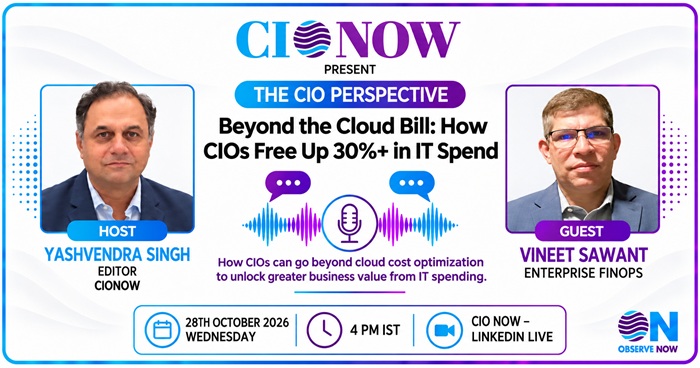
According to Vineet Sawant, author of The CIO’s Guide to Enterprise FinOps, CIOs may alter this by tapping beyond cloud-only FinOps. In an exclusive interaction with CIONOW, he discusses on how tech leaders can identify waste across the entire IT portfolio, set consumption accountability, and free up up to 30% of spending to invest in business innovation, modernization, and artificial intelligence.
Vineet Sawant, Author -The CIO’s Guide to Enterprise FinOps,
Traditionally, FinOps was looked as a control variable for public cloud costs, but these days, public cloud accounts for less than 25% of the usual company tech budget. Why is it dangerous to focus only on the cloud? Cloud FinOps is a subset of enterprise FinOps. Whilst this is often associated with AWS and Azure bills, it’s actually under the control of the CIO (infrastructure, software, services, contractors and labor).
In cloud FinOps, you will often see the most obvious areas as being your workloads, AI token usage and overprovisioning. However, the real pain points are in license waste, duplicated SaaS tools, software, shadow IT, long standing contractors and fragmented vendor contracts. Software is often a good place for CIO’s looking for quick wins as it can deliver savings without any big investment into new technology and processes.
What are the most common hidden costs that enterprises eventually overlook?
Cluttered data is one of them. Even if a user spends $20 a month for a tool, it becomes a significant line item when you increase that amount over thousands of employees.
There are also people who are over-provisioned on premium software editions when a basic edition would meet their needs. Shadow IT is another major issue, especially with AI tools, where employees may sign up for individual subscriptions that slip under normal audit thresholds.
Contractors are another area. I have seen contractors remain with companies for 10 years after starting as a three-month engagement. If someone is that valuable, perhaps they should be converted into an employee rather than continuing at a contractor rate that may be twice as expensive.
Aside from upfront costs, what should CIOs consider when looking to compare cloud infrastructure with an enterprise data center?
The data center will be an asset that is depreciating but there will be ongoing opex costs associated, including power, cooling, maintenance, staff, licenses, and infrastructure costs. Cloud is flexible and less capital intensive. However, if you’re not managing your consumption well, you can end up paying more.
CIOs need to consider capital and operating costs. A hybrid solution can often get the best outcome. It can be crucial to have control over data, latency, security, and consistent consumption. You will gain scalability and agility by using the public cloud. It all boils down to what your task demands and what is most economical.
Generative AI means organizations now need to think about new costs associated with tokens. How can organizations avoid AI costs spiraling?
One of the main issues with generative AI is consumption. You may have a 30-user pilot, where consumption seems low. Once you scale your application to 30,000 users, the economics can change. It is important to understand the costs around AI. How much will you be consuming, how many tokens, what models are you using, and how much will the application cost you to scale?
A good option is to use Open-Source Large Language Models or bespoke AI models. Using these within your enterprise data centers on GPU infrastructure such as NVIDIA AI computing will reduce reliance on token costs. You will also have more control over data, latency and compliance. However, you will still have hardware, maintenance, power and operating costs. CIOs will need to consider these factors.
Should FinOps be focused on reducing token consumption rather than understanding the value AI applications are providing?
It’s not about reducing token consumption. You need to understand what value you’re getting for your money. If your AI application is providing value in productivity, efficiency, or revenue, then higher token use may be justified. It comes down to whether you are getting value from the spend.
CIOs need to consider if the model you have chosen is appropriate. Start using lower cost models and only move to high-cost models when you have a business requirement. Getting FinOps involved early on will help. Get them involved in the pilot and planning process. This will allow you to understand what the consumption will be, have controls in place and understand the costs. As AI gets adopted, you will want to understand token consumption.
While infrastructure can be a large part of IT spend, vendors and staff costs can also take up a big chunk of the technology budget. Where should CIOs look to optimize?
Vendors and staff can be looked at in the same way. Look to reduce vendors. If you have multiple vendors providing the same things, it can create a lot of overhead. Consolidating vendors where possible will help give you a better negotiation position.
Consider SLA’s. Sometimes businesses pay for 24×7 support but don’t really need it. If you can run the service with 18×7 support, then consider whether you need to pay for a high SLA. Consider staff. Are you using external contractors? Are you paying for deliverables or the number of people?
Sometimes you will have contractors that have been in place for a long time and costs can spiral. This can result in ‘headcount fraud’. Monitoring overtime and location of staff can also provide benefits. Overall, you should regularly review your recurring vendor and staff costs.
Software licenses and long-term vendor contracts often have auto-renewal. What should CIOs consider when looking to renegotiate?
With software licenses, check if you are paying for premium versions when you don’t need them. Ensure you are not paying for the same number of licenses as last time; understand how many people are actually using it. Consider payment options. Can you have tiered contracts? Are there any commitments that can be deferred? Can you align payment to consumption? Don’t assume you need to pay for the same amount as last year. Regularly review your vendors to understand if you are paying for anything that isn’t justified.
With business teams buying their own SaaS and playing with AI it can be difficult to manage shadow IT. How can CIOs manage this without limiting business agility?
The challenge is to ensure you are getting visibility without limiting procurement. Often business teams will buy applications to solve an issue. With the increase in SaaS and AI, this has become more common. However, when multiple departments buy similar applications, you can end up paying multiple times. You may also have licenses that aren’t being used.
A good option is to look at license harvesting. Before you go to purchase more licenses for a new requirement, look to see if you have any licenses that can be reclaimed. You don’t need to invest in a costly solution to start with. A simple spreadsheet to track what software you own, licenses, consumption, and renewal dates can show you where you are paying unnecessarily.
As your organization matures, you could put this into an automation solution using ITSM tools. Ultimately, you want to get visibility of software consumption but give business units flexibility.
How can organizations ensure they don’t create another bureaucracy by optimizing software?
The aim should be to gain visibility. CIOs need to understand what applications are being used, who owns them, whether they are duplicating anything, and whether we are getting value from the licenses. Regularly review software to understand if there are any modules that aren’t being used. Are there any duplicates and licenses that can be reallocated?
Ensure your procurement policy allows business teams to easily request new applications. If it’s too complicated, they wll find alternative ways to get what they need. Good governance will make technology more sustainable.
You advocate using the Run/Transform/Innovate 360 framework to manage technology spend. How does this framework help CIOs approach their IT budget?
The framework helps break down technology spend into three categories. First is the cost to run your business. Often this will be around 70% of your IT budget. Second is transform, where you are investing in modernizing your infrastructure and applications. This could be to reduce technical debt, improve security, and increase integration. And last is Innovate, where you are spending on new capabilities.
The issue with this is that a large chunk of your budget goes into Run, and you don’t have much flexibility to invest in Transform & Innovate. This is where FinOps can help. By identifying waste, reducing software licenses, optimizing infrastructure, and improving vendor contracts you can identify savings in your Run spend. This can then be reinvested into modernizing your organization.
The framework also helps with communicating with business leaders. Rather than just telling them that you have infrastructure, software and operating costs, you can tell them how much you are spending to keep your business running, how much you are investing to transform and how much you are investing for growth.
What impact will this have in the long term if organizations continue to invest in Run costs?
You will incur technical debt if you consistently spend the majority of your tech budget on maintaining your systems. Infrastructure becomes less adaptable, security becomes more complicated, integrating legacy apps with new platforms becomes challenging, and expenses can skyrocket.
Eventually, you will get to a point where it becomes more expensive and difficult to modernize. CIOs need to continually review the balance between Run, Transform and Innovate. You don’t want to stop running costs; businesses need reliable systems and infrastructure. However, you need to ensure they are being managed efficiently so they don’t eat up your whole tech budget. Having a structured FinOps approach can help.
With AI, hybrid infrastructure, and decentralized technology adoption, how should CIOs approach FinOps going forward?
FinOps needs to be viewed as a wider financial optimization. You can’t just look at your cloud consumption and identify unused VM’s. You need to have visibility across all of your technology spend. Including physical infrastructure, software, vendors, staff and AI.
As AI is becoming more prominent, it’s becoming more important. Traditional models are changing. Token costs, GPU infrastructure, and increased compute requirements all add new considerations. However, the basics still apply. You want visibility, accountability, and to understand how your investment is providing value.
The CIO’s role is to ensure that your technology spend is being spent strategically. Ultimately, having a good FinOps approach will mean your current technology investments are working harder for you. Giving you flexibility and investing in your next phase of growth.
Technology investments may look important to CIOs, but the CEO or CFO may not have the same point of view. Their perspectives may differ as they think about its impact on business, costing, profitability, and the consequences of not investing. This difference in outlook between the top management and the CIO is one of the biggest challenges that technology leaders face today. No doubt CIOs are increasingly becoming part of the business decision-making process, but their ability to influence those decisions still depends on how IT investments are connected with business priorities. As a result, gaining the trust of business executives, comprehending organizational priorities, and positioning technology as a strategic contributor rather than just a cost center are now more important than getting tech projects approved.
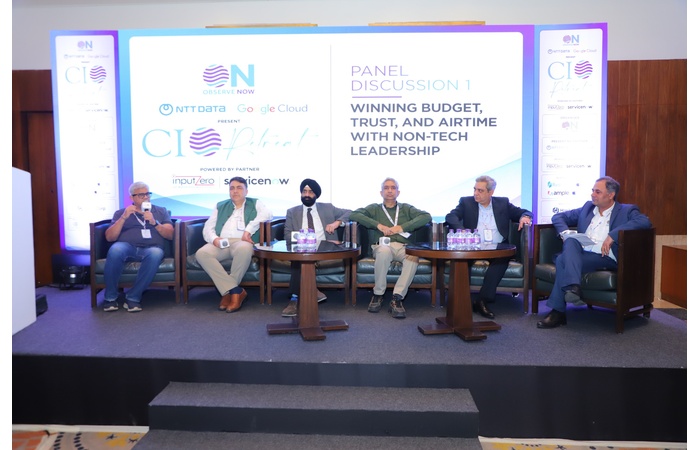
A panel discussion at the recently held ObserveNow CIO Retreat 2026 in Gurugram explored how technology leaders can speak the language of business. Panellists examined the importance of understanding organisational dynamics, demonstrating financial accountability, aligning stakeholders and building credibility through execution.
The Business Case Comes Before the Budget
Enterprise technology decision makers need to change their communication approach to build a strong business case. Their technology investment pitch must clearly address the business priorities, financial outcomes, and organizational challenges.
Speaking at the panel, Ashok Nayak, CIO at Ipca Labs, asked tech leaders to communicate in business language, as tech jargon is not necessarily understandable to the board. He said, “The focus should be on the value technology is bringing in terms of productivity, quality, compliance, and business growth.”
Chander Khanduja, GCIDO at Baxy Group, insisted that understanding an enterprises’ culture and appetite for technology is very important. “IT leaders must identify and align with the organization’s key power centers to build consensus with stakeholders, making it easier to secure desirable board decisions,” he suggested. Aligning with Business Owners is the Key to Success
For CIOs, it is crucial to understand informal power structures, maintain credibility, stay alert to the enterprise’s financial and strategic context, and make disciplined decisions across projects to accelerate, pause, or stop. Dilraj Singh, CDO at TAFE, highlighted three broader factors: “First is the CIO’s own credibility through delivered projects and ROI achievements. Second is the credibility of the sponsoring function; poor past returns can weaken future proposals, and last is the organization’s current awareness, such as financial condition, strategic vision, IPO plans, or possible sale, all of which affect budget allocation and how a proposal should be positioned.” Dr. Shakti Goel, Chief Architect and Data Scientist at Yatra Online, suggested CIOs to reduce costs by measuring right sizing servers, postponing hiring, or using interns, while assuring that cutting projects entirely could cause bigger future loss.
Reframing Technology as a Strategic Enabler
A boardroom seat is not granted by title; it is earned by becoming indispensable to the organization’s strategy and outcomes.
Describing the CIO as a ‘Tech Portfolio Manager’, Tarun Anand, Group CIO at Jackson Group, said, “IT leaders are those who help the organization decide where to invest for better returns. The ultimate goal should be to make it difficult for the organization to exclude the technology leader from strategic discussions.”
Concluding the session, Nayak said that to attain the permanent seat, CIOs must know both sides of the coin, i.e., business priorities and technology possibilities, and build credibility and trust across the organization.
Analog Devices, Inc. today announced the completion of its acquisition of Alif Semiconductor. The combination of ADI’s leadership across sensing, signal processing, power, connectivity and application software, with Alif’s AI-native microcontrollers and fusion processors, expands ADI’s total addressable market and accelerates innovation across industrial, data center infrastructure, defense, energy, robotics, digital health and wearable applications.
“We are excited to welcome the Alif team to ADI and begin realizing the potential of bringing our technologies together,” said Vincent Roche, CEO and Chair of ADI. “For decades, ADI has helped customers solve their most complex system-level challenges through deep domain expertise and a cutting-edge technology portfolio spanning the physical-digital boundary. Alif’s AI-native platform builds on that foundation, advancing systems that can understand real-world signals, reason, and act locally within demanding power, latency, security, and reliability constraints. This is physical intelligence in action.”
Snowflake (NYSE: SNOW), the AI Data Cloud company, today at Snowflake Expedition 2026 announced a set of innovations that make Snowflake the foundation of the agentic enterprise. Now organizations can put AI agents to work that understand the business, operate within its controls, and can be trusted to deliver real results.
These product advancements include Business Ontology,4 which grounds agents in definitions the business has approved, whileCortex AI Gateway2 governs every model, tool, and action those agents touch. With that foundation in place, Snowflake CoCo, the coding agent for data teams, and Snowflake CoWork, the personal work agent for knowledge workers, take on the recurring work that slows teams down across the business to drive impact. Pushing autonomous work even further, new CoCo and CoWork Bots5serve as always-on AI coworkers that continuously work in the background, act directly in the tools teams already use, and check in only when a decision or sign-off is required.
Most enterprises don’t have trouble building an AI agent. They have trouble trusting one enough to put it into production. According to a recent MIT Technology Review report sponsored by Snowflake, 55% of executives cite a lack of business context as the primary cause of low-quality AI agent insights, with fragmented or inaccessible data ranking second at 45%. An agent that doesn’t know how the company defines revenue gives a confident wrong answer that someone has to catch. Meanwhile, agents are connecting to models, MCP servers, and enterprise systems faster than IT and security can keep up, which brings new risks and unexpected bills. As a result, a lot of companies are keeping their AI agents in pilot phase, grappling with how to fully trust and control these agents in order to scale them across the business.
Snowflake is uniquely positioned to close that gap. For over 14,500 global enterprises,1 Snowflake already sits at the center of the data, business context, AI models, and workflows that agents depend on, serving as the governed control plane for the agentic enterprise. Today’s announcements turn that foundation into a complete system for the agentic enterprise. Context, controls, and execution are built together, so each makes the others stronger.
“The enterprises that win won’t be the ones with the most agents. They’ll be the ones whose agents know exactly what the business means by accessing the right data, abide by governance and guardrails specified, and can account for actions taken by agents,” said Christian Kleinerman, EVP of Product, Snowflake. “That’s the difference between an agent that guesses and an agent the business can run on. Snowflake already holds the data, context, and governance enterprises rely on. By extending Snowflake Horizon Catalog with Business Ontology and Cortex AI Gateway, context and governance stop being afterthoughts and become the foundation every agent is built on for the agentic enterprise.”
It Starts with Context: Agents That Know What the Business Means Consider a sales leader who asks an agent for a weekly net revenue report. A dashboard gives one number, an analyst another, and an agent a third. For the report to be worth anything, the agent first needs to know the company’s official definition of net revenue and who signed off on it.
Business Ontology, the newest capability in Horizon Context, the home for governed business context inside Snowflake Horizon Catalog, provides that. A Business Ontology governs the official meaning, a Semantic View calculates it, and Cortex Sense5 infers what isn’t already defined. Together, this unified framework establishes one single, authoritative business context for every agent, app, and person across the enterprise. Teams approve official definitions for core concepts like net revenue, assign each one an accountable owner, and link it to the underlying data, inside and outside of Snowflake. However, approved definitions always take precedence. Organizations can migrate existing definitions from a third-party catalog or spreadsheet in a single guided CoCo session, and every change is logged. When an auditor asks what net revenue meant in Q2, the answer is a simple lookup.
“The value of a data product depends on everyone agreeing what each attribute means, whether it’s a household income band or a B2B firmographic segment,” said Joe Tobey, Head of Data Product Engineering, dentsu. “As agents become how people query that data, those definitions can’t live in a static data dictionary. Business Ontology gives every definition an accountable owner, links it to the data that implements it, and makes it the answer every agent returns. That’s what lets us put agents in front of our data with confidence.”
Then Control: One Set of Rules for Every Agent An agent that knows the right definition still needs the right controls on how to access data, call models, and use tools. Cortex AI Gateway2 is the single front door for agents in an organization. As a part of Horizon Catalog, Cortex AI Gateway applies one set of policies to agent connections across clouds, frameworks, and AI providers. Agents take action on enterprise data through MCP servers, and Cortex AI Gateway applies the company’s access policies, authentication, and permissions to those calls. Agents inherit the controls already established for human users, removing the overhead of creating and managing a different set of operations.
Back to the net revenue report. Through Cortex AI Gateway Tools,3 every tool call the agent makes is checked against fine-grained authorization policies before it runs. Cortex AI Guardrails3 protect it against prompt injection and jailbreaks. Cost governance2 attributes the spend to the team that owns the report and enforces hard limits, while Dynamic Model Routing5 sends routine work to lighter, lower-cost models. Observability2 records every step in the customer’s own Snowflake account, where teams can analyze it with Agent Trace Intelligence.5Agent Abuse Detection5 analyzes complete agent trajectories, not individual prompts, to catch agents operating beyond their permissions.
“We run a lot of AI against a lot of data, and the question we couldn’t answer was which teams and which agents were driving the spend,” said Andy Owens, VP of Data and AI, Kargo. “Cortex AI Gateway gave us that breakdown, plus hard limits so a runaway process doesn’t quietly burn through a budget. Routing each request to the right model means our routine work isn’t running on our most expensive one. We’re running more agents than ever and we know what each of them costs.”
Then Execution: Agents That Keep Working After You Log Off With context and controls in place, enterprises can do what they’ve been holding back on: let agents work on their own. CoCo and CoWork now take on recurring work for both the data teams who build on Snowflake and the business teams who rely on it.
With CoCo Automations,2 data teams describe a workflow once and CoCo runs it autonomously at any frequency. Teams can run agents on a schedule to perform recurring or long-running tasks, like a routine pipeline health check or a weekly report someone used to build by hand. Every run keeps an audit trail and task history, so teams can see exactly what CoCo did and suspend or rerun a job whenever they need to. CoCo and CoWork also work where people already do, through Snowflake for Slack3 and CoCo for Excel and Sheets3. Additionally, Skills and Plugin Sharing2 and Profiles in CoCo3 and new Profiles in CoWork3 mean that what one team builds, the whole company can reuse. This delivers a personalized, ready-to-use experience while helping teams standardize their work, preserving user flexibility in CoCo and central control in CoWork.
CoCo and CoWork Botstake autonomous work on the go even further. AI agents have always waited for a specific question or a predefined task before delivering value. CoCo and CoWork Bots change that dynamic entirely. Operating like an autonomous chief of staff, Bots act on behalf of the user, inheriting their exact access rights, role context, and permissions. When users set a high level goal, such as preparing briefings for every customer meeting or keeping data pipelines healthy, Bots take full initiative. They autonomously plan and complete the work in the background, operating strictly within the user’s governed boundaries in Snowflake and surfacing only when a critical decision or final approval is needed. This transforms AI from software you query into a trusted partner you empower, giving every employee continuous leverage without ever compromising control. “It would take a lot of time to create semantic layers in the past, but things have changed drastically in the last three months since we started using Snowflake CoCo. Additionally, every piece of data flows live into Snowflake CoWork,” said Vibhor Gupta, Vice President of Enterprise Data & AI, Shelter Mutual Insurance Company. “We now have access to real-time insights on demand directly in our operational processes. With eight AI agents in production and more underway, we’ve changed how data drives decisions from the claims desk to the C-suite.”
One Platform for the Agentic Enterprise Each of these innovations solves part of the problem, and together they solve it end to end. Business Ontology makes sure agents give the right answer. Cortex AI Gateway makes sure they get it the right way. CoCo and CoWork turn those answers into finished work. Given all of these run on one governed platform and on one copy of the data, enterprises no longer have to choose between moving fast and staying in control. That’s what turns an agent from a pilot into something the business can run on.
Fulcrum Digital, a leader in enterprise AI and digital transformation, today announced the appointment of Latha Nathan as Senior Vice President, India Delivery Operations. Latha leads Fulcrum Digital’s India delivery organization across all business units and across all centres in Pune, Coimbatore and Mumbai. Her appointment strengthens the leadership bench as the company builds the capacity to accelerate into its next phase of hypergrowth.
Latha brings experience across technology services, engineering services, product development and GCCs, capabilities that directly support Fulcrum Digital’s next phase of growth. In her new role, she will focus on delivery excellence, talent development, client success and scaling India operations. She will work to strengthen India Delivery as a strategic growth engine, expand the company’s technology ecosystem, and help POD teams use AI across delivery functions to deliver differentiated outcomes for clients globally.
“As we scale, we are giving our leaders greater strategic ownership so that decisions are made closer to our people and clients, with more agility,” said Dhana Kumarasamy, Chief Executive Officer, Fulcrum Digital. Latha’s experience aligns directly with our next phase of growth. She will play a key role in developing our people, strengthening our practices and building the leadership depth to support that growth.”
Commenting on her appointment,Latha Nathan said,“I am delighted to join Fulcrum Digital at such an exciting and defining stage in its growth journey. With its strong talent base, technology capabilities and trusted client relationships, Fulcrum is well positioned to scale its impact. I look forward to partnering with our teams to build a high-performing delivery organisation that consistently delivers measurable business outcomes for our clients, creates lasting value, and provides an environment where our people can learn, grow and thrive.”
Latha Nathan joins Fulcrum Digital from Fidelity Investments, where she served as Vice President, leading a business unit focused on digitisation, driving delivery of a customer-facing platform product, and serving as a member of the India Regional Leadership Team. Over the course of her career, she has led large-scale digital platforms and technology initiatives across global teams, with a focus on digital transformation, AI/ML adoption, platform modernisation and measurable business outcomes. Prior to Fidelity, she held senior leadership roles at BankBazaar, Photon, Information Edge and Infosys, where she built and scaled technology organisations and Global Capability Centres (GCCs), established and expanded mobile, data and engineering capabilities, led large teams and global engagements, and managed significant P&L responsibilities.
At NVIDIA GTC Berlin, Vertiv Holdings Co. and NVIDIA introduced an AI factory approach that combines rapid configuration and virtual validation of pre-engineered reference architectures with factory-built deployment. The approach is designed to move AI factories from project kickoff to productive capacity faster and, under defined assumptions, generate up to 30% more cumulative token output within the first 12 months with the same installed capacity. Polar Data Centers is applying the factory-built deployment approach to the first 41 MW phase of its multiphase AI data center at Herøya, Norway.
For AI factory operators, securing compute is only part of the challenge. Traditional infrastructure development can require power, cooling and facility systems to be engineered and integrated through separate, sequential processes, creating complexity and potential delays. The Vertiv and NVIDIA approach starts instead with pre-engineered AI factory reference architectures that can be rapidly configured to customer and site requirements, virtually validated before deployment, and then translated into factory-built infrastructure.
Configure and Validate: Up to 10x Faster with Pre-Engineered Reference Designs
Teams can start with pre-engineered AI factory reference designs and rapidly configure them for specific compute, power, cooling and facility requirements in a shared virtual environment. The approach combines the NVIDIA Vera Rubin DSX AI Factory reference design and NVIDIA Omniverse DSX Blueprint, with Vertiv SimReady power and cooling assets, integrated with Dassault Systèmes’ 3DEXPERIENCE agentic platform.
Rather than developing an integrated infrastructure design from scratch, teams can configure and virtually validate proven reference designs against project requirements, interfaces and constraints. In the modeled scenario, this reduces the time from requirements to a configured and validated AI factory solution from approximately 30 days to three days, a 10x improvement.
Vertiv is also contributing SimReady OpenUSD assets of its power and cooling equipment to SimReady Central Library on Hugging Face. The library helps engineering teams discover and reuse validated equipment assets in AI factory digital twins, reducing asset preparation and helping teams evaluate infrastructure options during design.
Deploy: Up to 50% Faster with Factory-Built Infrastructure
Once the AI factory configuration is validated, Vertiv prefabricated solutions shift more assembly, integration, and testing into the factory before equipment reaches the site. These solutions include Vertiv™ OneCore, a hybrid-built data center solution that integrates critical power, thermal management, and supporting infrastructure, and Vertiv™ SmartRun, a prefabricated overhead infrastructure system for high-density power distribution, liquid cooling, networking, and containment.
By moving more infrastructure work off-site, teams can reduce field complexity and on-site integration requirements. In the modeled scenario, the factory-built approach reduces the infrastructure deployment period from approximately 90 days to 45 days, a reduction of up to 50%.
Combined with the faster configuration and validation enabled by pre-engineered reference designs, the modeled approach reduces these stages from approximately 120 days to 48 days. That can make productive AI capacity available about 10 weeks sooner, generating up to 30% more cumulative token output within 12 months of project kickoff with the same installed capacity.
Field Deployment: Polar Data Centers at Herøya, Norway
At its Herøya campus in Norway, Polar is using Vertiv’s factory-built deployment model for the first 41 MW phase of its multiphase AI data center, scalable to 100 MW. By shifting more infrastructure assembly, integration and testing into the factory before equipment reaches the site, the deployment model is designed to reduce on-site complexity and help make high-density, liquid-cooled capacity available to customers sooner. Vertiv is supplying prefabricated power and thermal modules, Vertiv™ SmartRun overhead infrastructure and Vertiv™ SmartMod, supported by Vertiv™ Unify software.
“An AI factory earns its return in tokens, and every day spent configuring infrastructure or integrating it on site is output that never comes back,” said Giordano Albertazzi, CEO of Vertiv. “Success depends on how quickly operators can move from requirements to productive AI capacity. By starting with pre-engineered reference designs that can be rapidly configured and validated, then extending that approach through factory-built deployment, we help customers reduce complexity, deploy infrastructure faster and bring AI capacity online sooner. Polar Data Centers is demonstrating how that approach can be applied at scale in a real-world AI factory deployment.”
“AI factories must be designed as one system, and the NVIDIA Vera Rubin DSX AI Factory reference design helps teams align compute, power and cooling requirements from the outset,” said Vladimir Troy, vice president of AI infrastructure at NVIDIA. “With the NVIDIA Omniverse DSX Blueprint, companies such as Vertiv and Dassault Systèmes can simulate these systems together and carry an integrated design into physical deployment, helping operators resolve conflicts earlier and bring productive AI capacity online sooner.”
“With Vertiv and NVIDIA, we’re accelerating AI factory design and deployment by engineering the factory as one system – compute, networking, power and cooling co-designed and co-simulated in a virtual twin,” said Stéphane Sireau, Vice President, High-Tech Industry, at Dassault Systèmes. “Integration issues get resolved before construction, not on site, helping bring token-producing capacity online sooner.”
“Our customers measure us on how quickly capacity is ready for them,” said Andy Hayes, CEO of Polar Data Centers. “At Herøya, Vertiv’s factory-built infrastructure helps us manage the complexity of deploying power, cooling and white-space systems for high-density computing. It gives us a more disciplined, repeatable deployment model while preserving the flexibility to meet the requirements of our customers.”
Vertiv and NVIDIA plan to demonstrate elements of the approach at NVIDIA GTC Berlin, including how facility requirements inform infrastructure configuration, how teams can virtually validate power and cooling requirements, and how Vertiv applies factory-built infrastructure to accelerate physical deployment. The demonstration will feature technology from Dassault Systèmes, and Polar Data Centers will show how the deployment approach is being applied in a real-world AI factory.
Security discussions are no longer limited to the IT department. Security decisions are impacting ongoing business operations, customer trust and boardroom risk, especially as AI penetration continues, organizations increase their digital supply chains, and the world embraces always-on operations. Too many enterprises are approaching security from a technology side or as a compliance task versus as a way of life.
In a chat with CIONOW, Jaydeep Singh, GM-India at Kaspersky, explains why senior executives must shift security from a periodic control function to an ongoing part of the organization. He discusses the blind spots growing across humans, AI adoption and third-party ecosystems.
How can CIOs make security a way of life in their organizations, as opposed to a pure technology or regulatory matter?
I believe most of the breaches still start with humans, not a piece of technology. As per Top 3 cyber-risk catalysts all rooted in human behavior research, 80% of organizations see human-related factors as the biggest driver of cyberattacks, and in India, around 28% of organizations reported a lack of security awareness among employees.
To tackle this situation, organizations need more than an annual training module. Security must be built into daily workflows, employees must feel encouraged to report suspicious activity without worrying about blame, and the same goes for the authorities to set rules that are the same for everyone.
The research pointed out that public-facing applications, valid accounts, and trusted relationships were the entry point of the major attacks investigated in 2025, and 15.5% was via trusted partners. Shadow AI is already flagged as a common risk by 31% of organizations, adding another layer that often sits outside IT’s line of sight.
How should IT leaders prepare for an environment where attackers are also using AI to make cyberattacks more sophisticated and scalable?
With the increased implementation of AI in systems, it has made attacks cheaper to run and harder to identify. The threat actors are using LLMs to write phishing emails and malicious code, and to rewrite existing malware in new languages to bypass previous detection. We expect AI to show up across more stages of the attack chain this year, while telling real content from fake keeps getting harder.
AI-based detection and response can free analysts of all of the work of scanning and triaging so they can focus on free decision-making. Confirming high-value requests to access or pay-out should never rely on how natural the message or voice sound and awareness training should include deepfakes and AI-written guidelines.
Above all, prepare for a malware attack, because bad guys are more aggressive and faster than they used to be; and then expect to have to adapt throughout the year rather than just once.
What security and governance principles must technology leaders embed into their AI approach from the start?
Our latest research shows that 81% of organisations are researching or deploying internal tools based on LLMs, and 31% already believe shadow AI is a material risk. Governance only happens when you have enough visibility to implement it.
Before information reaches any model, a methodical process should start with data classification. AI tools and agents must be granted access only to the necessary data or tools to perform their specific tasks, and AI providers and models must meet the same supplier assessment standards as other key third parties. Likewise, clear ownership and accountability for the usage of AI generated outcomes is of vital importance.
Responsible use must be enabled, not restricted by government. Under some circumstances, it is better to have a system that is sustainable, with some amounts of coverage, than a blanket ban that will lead to underground use.
What do enterprise technology decision makers need to do to stop conversations about preventing an attack and start talking about building the resilience to detect and respond when it occurs ?
That’s what building resilience is – how quickly a business can identify the cybersecurity event, mitigate its impact, and continue to operate. At Kaspersky, in 2025, we handled around 400,000 alerts, out of which approximately 3900 needed investigation.
So being active and fast is an important rule to tackle cyberattacks. In 2025, we identified as many as three high-impact, human-enabled attacks per day and reduced our time-to-respond by approximately 22% as compared to the previous year. In addition to such speed, organizations should have effective response playbooks, proven backup systems, and definitive leadership structures in times of crisis, with table-top exercises that have business stakeholders involved as well as IT.
How is the discussion around cyber risk evolving at the level of the board and other business leaders and what is the CIO’s role in that discussion?
Now boards are worried about what an attack would cost the business and how quickly it could recover. 41% of enterprises revealed that AI adoption is pushing them to increase security investment. In this, CIOs are well-positioned to bridge the technical and business conversations, describing cyber risk in terms of business and time to recover rather than patch counts or blocked threats so that the members can make better decisions around risk and investment.
What are the cybersecurity capabilities or risks you see technology leaders needing to focus on today over the next three to five years? What is one cybersecurity assumption you would challenge technology leaders to re-evaluate?
Today, corporate leaders should pay attention to identity-first security, AI governance, supply chain transparency and prepare for post-quantum cryptography. As our research highlights, over–privileged agents and compromised agent skills could be utilized to maintain access and steal data; AI agents require special attention.
I would contest the notion that more tools equate to improved security. According to our research, 86% of organizations are currently working toward consolidation, and 43% of them believe that maintaining their security stacks is too difficult and time-consuming. Using fewer, well-integrated tools to their maximum potential frequently yields more results than adding a new product.