




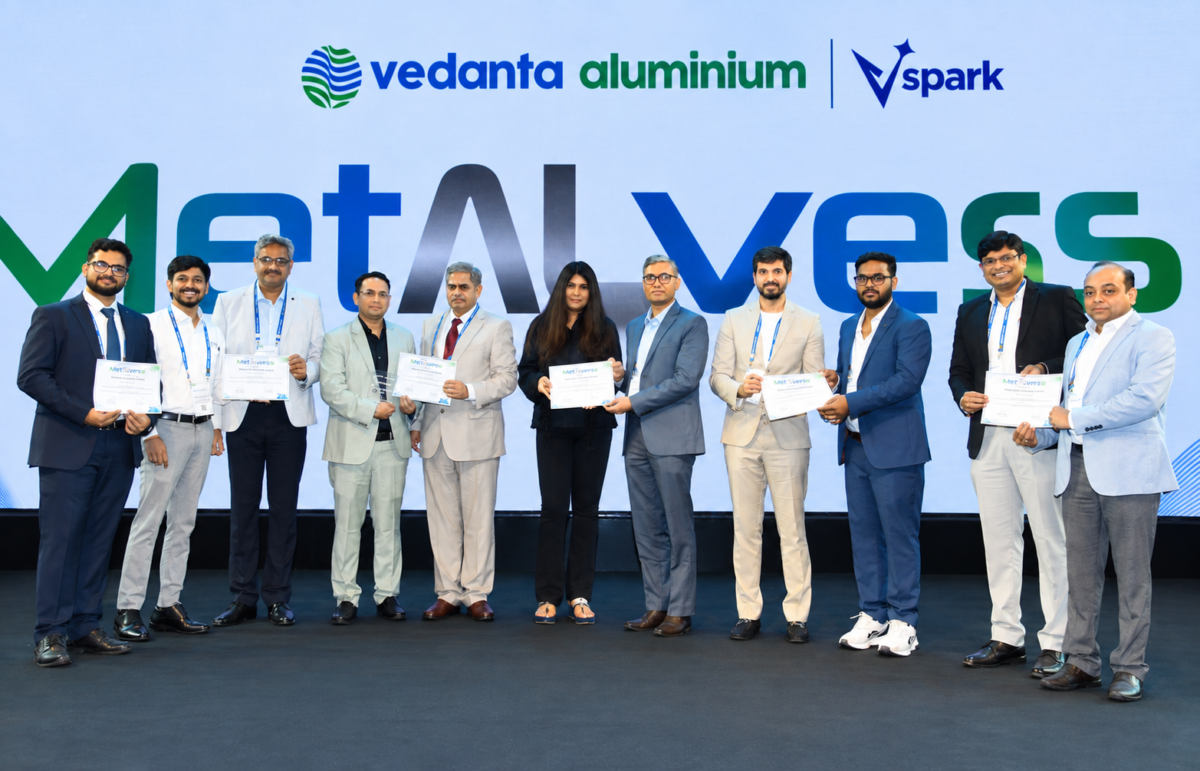
Vedanta Aluminium, V-Spark To Scale Deep Tech Initiatives, Unlock ₹2,100 Cr Value

Vedanta Aluminium, India’s largest aluminium producer, in collaboration with V-Spark, India’s largest manufacturing deep tech incubator, recently hosted MetALverse, an immersive tech showcase in Jharsuguda, Odisha.

The company also announced partnerships with several cutting-edge technology providers, including market leaders such as OpenAI, Microsoft and SAP. Together, they will deploy innovative, multi-pronged solutions to cumulatively unlock up to ₹2,100 crore in value through the enhanced adoption of AI, digitalisation and automation technologies across Vedanta Aluminium’s operations.

Vedanta Aluminium’s MetALverse event was envisioned as a strategic platform to accelerate the deployment of breakthrough technologies across large-scale industrial operations by bringing together global technology leaders, emerging startups, and top business experts. The partnerships will focus on evaluating, piloting, and scaling next-generation solutions across Vedanta Aluminium’s operations. The value opportunity of ₹2,100 crore will be achieved through the integration of innovative solutions for enhanced plant productivity, cost-optimization, asset reliability, and sustainability initiatives across Vedanta Aluminium’s integrated value chain.

The event reflects a shared vision between Vedanta Aluminium and V-Spark to bridge the gap between groundbreaking deep tech innovation and real-world deployment by identifying high-impact technologies, validating them in live operating environments, and accelerating their adoption.

Vedanta Aluminium has already established a fully integrated value chain that ranges from mining to alumina refining to aluminium production. By leveraging the company’s vast, cutting-edge manufacturing plants – some of which are amongst the largest in the world – as a mega incubation environment, V-Spark aims to rapidly transform promising innovations into industry-ready deployments while also co-creating a robust AI-led manufacturing ecosystem.

Priya Agarwal Hebbar, Non-Executive Director, Vedanta Limited and Chairperson, Hindustan Zinc, said, India’s manufacturing sector is entering a defining decade. The future will belong to companies that combine scale with intelligence, sustainability and the courage to rethink what is possible. At Vedanta Aluminium, we see AI as a catalyst for that transformation, with human intelligence providing the judgement and direction behind it. We are bringing together the best minds across industry and technology because we don’t want to simply make today’s plants better.
We want to build the metal of the future, using the technologies of the future.

Akarsh Hebbar, Non-Executive Vice Chairman, Vedanta Aluminium and Chairman, V-Spark DeepTech Ventures, said, “The greatest opportunity in industrial innovation lies in deploying new technologies at scale to create measurable business value. Vedanta Aluminium, as one of the top producers of the metal of the future globally, provides the expansive operating footprint, technical depth and determination to industrialise breakthrough solutions, while V-Spark is the engine that identifies, validates and accelerates these technologies from concept to enterprise-wide deployment. We aim to partner with several industrial solutions to scale and transform creative innovation into tangible productivity gains, stronger sustainability, enhanced reliability and significant
value creation.”

Dattaray, Founder & CEO, Ripik.AI, said, “AI is creating new opportunities for industrial organisations to transform how knowledge is accessed, decisions are made and operations are managed. At Ripik.AI, we are focused on making advanced AI capabilities accessible through tools that help people and organisations solve complex problems and work more effectively. We are excited to collaborate with Vedanta Aluminium as it explores new applications of AI across its business. The company demonstrates how leading manufacturers can combine deep operational
expertise with cutting-edge AI to unlock innovation, improve performance and create meaningful value at scale.”

At MetALverse, Vedanta Aluminium announced collaborations with several top technology companies and emerging innovators to accelerate AI-led transformation across its operations. The identified partners include OpenAI for generative AI and intelligent agents; Microsoft for cloud, AI and enterprise transformation; SAP for integrated enterprise processes; AVEVA for industrial data, digital twins and advanced analytics; Rockwell Automation for smart manufacturing and control systems; Thoughtworks for digital engineering; and Fives for aluminium process technologies and carbon plant optimisation. The company has also partnered with deep-tech innovators including Ripik.AI for industrial vision and process optimisation; XYMA for high-temperature asset monitoring; Faclon for industrial intelligence and connected manufacturing; DesignX for AI-enabled factory workflows; DigitalPaani for industrial water optimisation; AutoVRse for immersive workforce training; Enmovil for AI-led logistics; and ideaForge for drone-based industrial intelligence.

These collaborations will focus on technical evaluation, data integration, pilot deployment and scale-up potential. Through its V-Spark innovation ecosystem, the company aims to rapidly validate and deploy solutions that strengthen productivity, safety, sustainability, asset reliability and operational decision-making. Presently, Vedanta Aluminium is actively collaborating with nearly 70 startups under the program, spanning one of the world’s largest alumina refineries in Lanjigarh, Odisha, the world’s largest single-location aluminium plant in Jharsuguda, Odisha, and India’s iconic aluminium producer, BALCO, in Korba, Chhattisgarh.
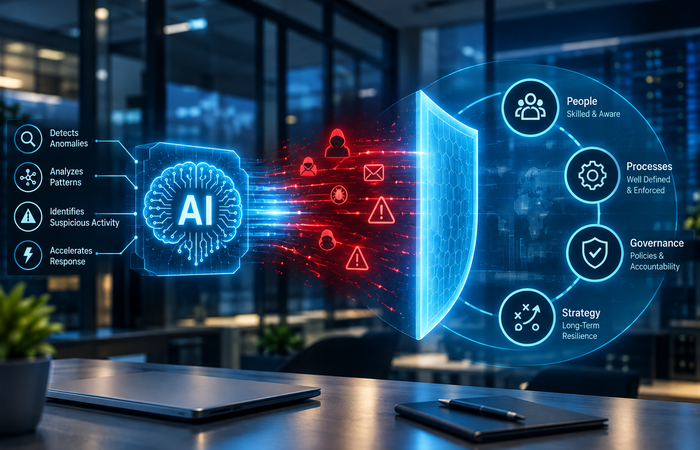

Deploying AI Alone Cannot Secure Your Data

IBM’s 2026 Cost of a Data Breach Report reveals India’s average breach cost hit INR 25.5 crore (up 15.9% YoY), with organizations having 39,500 records compromised on average. Breaches are now major financial and operational events, not just technical incidents. While organizations are slowly but steadily leveraging AI to counter security threats, just implementing an AI solution is not enough.

Where Does the Gap Lie?

Shashank Bajpai, CISO & CTSO at Yotta Data Services, says most large enterprises already have the full security stack, such as firewalls, EDR, SIEM, IAM, vulnerability management, SOCs, and AI-enabled controls; but the real gap is measuring cybersecurity by controls deployed, not by controls that hold up under attack. 

Shashank Bajpai, CISO & CTSO at Yotta Data Services

“A control on an architecture diagram isn’t resilience,” he says. “The operational question is: when an attacker is inside, does that control actually prevent, detect, contain, and recover?”His prescription is simple: move from asking, “Do we have the right controls?” to “Can we prove they work?”

This is where offensive AI comes in. IBM estimates that offensive security can reduce breach costs for Indian organizations by INR 2.47 crore. Offensive AI helps security teams simulate attacks, test defences, and expose weaknesses before attackers exploit them. AI and automation can then help detect, alert, and contain threats faster.

This matters especially for AI security. An AI policy, an approved model, and a data loss prevention system are not enough on their own. Organizations must be able to identify risky data flows, flag unauthorized transfers, alert the right teams, and contain damage when controls fail.

For AI systems, testing must go beyond infrastructure. It should cover prompt injection, insecure plugins, excessive permissions, data leakage, and unauthorized AI use. The aim is continuous validation of the connections, data, and access points around every AI system.

Managing Shadow IT 

AI can also be a double-edged sword. While it can help counter cybersecurity threats, it can also be the source of such threats. 

“Shadow AI is not just an employee-awareness problem. It is often a security-by-design problem,” says Bajpai.

Sometimes, organizations unintentionally develop a parallel AI ecosystem outside formal oversight. Employees looking for alternate options when access to various technology tools becomes difficult results in shadow AI. 

According to the IBM report, Shadow AI, as a factor, is associated with higher breach costs, with its presence adding approximately INR 1.79 crore to the average cost of a breach in India.

To counter this phenomenon, Bajpai says, “Give employees a secure AI path that is easier than the insecure one.”

This approach would require organizations to provide approved AI tools supported by data classification, identity controls, data-loss prevention, usage monitoring, and clear policies. Sensitive information should be prevented through technical controls from reaching unauthorized models, rather than being protected only by written instructions.

This means providing approved AI tools backed by data classification, identity controls, data-loss prevention, and usage monitoring, with clear policies. Sensitive information should be blocked from reaching unauthorized models through technical controls, not just written rules. The Cloud Security Alliance’s 2026 research on shadow AI supports this, finding that 89% of enterprise AI usage is invisible to security teams and that unauthorized AI use drops by 89% when organizations provision sanctioned tools. 

Governance Must Match Risk

Against the backdrop of AI and cybersecurity, Meheriar Patel, CDTO at Continental Carriers, approaches the issue from a governance perspective. He argues that organizations should not frame innovation and governance as competing priorities.

Meheriar Patel,CDTO at Continental Carriers
Meheriar Patel, CDTO at Continental Carriers

“The key principle is that innovation and governance should not be treated as opposing forces.” He identifies two common mistakes: Some organizations move too slowly because they fear the risks associated with AI, while others move quickly without establishing adequate safeguards. 

“Neither approach is sustainable, particularly when AI applications begin handling sensitive data or influencing important business decisions,” he says.

The IBM findings strengthen his argument that security and governance need to evolve together. The report indicates that organizations combining AI adoption with strong governance is better positioned to respond to cyberattacks. It also shows that organizations with more extensive AI and security automation generally experienced lower breach costs and faster breach identification than organizations with little or no such automation.

Conclusion

AI is arming cyber thefts by improving the speed, scale, and sophistication of their campaigns; strict policies alone cannot stop cyberattacks. It is important to connect employees and technology with clearer guidance, tested processes, and practical controls.

The organizations that will thrive are those that can demonstrate, with evidence, that their controls work when the environment becomes hostile, and that their use of AI is both trusted and trustworthy.

BreachX Launches Typhon, India-Built Sovereign Cybersecurity AI for Zero-Day Discovery and Defense

BreachX, an AI cybersecurity company and zero-day research lab, today unveiled Typhon, a family of sovereign cybersecurity AI models designed to discover previously unknown vulnerabilities, determine whether they can be exploited and generate protection-all within infrastructure controlled by the customer.

Built for government, defense, enterprises and critical infrastructure, Typhon can operate on-premises, in private clouds and in fully air-gapped environments. Source code, firmware, vulnerability findings and customer-specific security intelligence do not need to leave the organization’s security boundary.

Typhon is built around a simple security sequence: Discover. Validate. Protect.

In eight weeks of live vulnerability research, Typhon identified more than 100 previously unknown vulnerabilities. BreachX has submitted 65 findings across approximately 50 products to vendors through coordinated disclosure. Five findings have received CVE identifiers, while another resulted in a public Flatpak security advisory.

Typhon works alongside BreachX PatchZero, which uses validated vulnerability evidence to generate protection before an official software vendor patch becomes available.


Moving Cybersecurity from Detection to Discovery

Most cybersecurity technologies focus on detecting known threats, identifying catalogued vulnerabilities or responding after malicious activity has begun. BreachX built Typhon to move security earlier in the lifecycle-to discovering weaknesses before they are known or exploited.

Typhon analyzes source code, binaries, mobile applications and firmware to identify potential vulnerabilities that have not previously been reported. It can reason across those weaknesses to construct plausible attack paths and validate findings by generating and executing proof-of-concept exploits in isolated environments rather than against production systems.

The result is evidence that security teams can use to distinguish theoretical weaknesses from vulnerabilities that represent credible real-world risk.

“Software has reached machine scale, but finding its weaknesses still depends heavily on scarce human expertise,” said Rajshekhar Pullabhatla, Founder of BreachX. “Typhon enables security teams to examine code and systems at machine scale while keeping their most sensitive assets inside their own perimeter. The objective is simple: find the weakness before the attacker does-and start protecting against it first.”

Sovereign AI Designed for Sensitive Environments

Typhon runs within infrastructure controlled by the customer. Source code, firmware, vulnerability information and other sensitive security data can remain within that environment throughout the discovery, validation and protection process.

Organizations can also further post-train Typhon using their own code, security findings and telemetry within their security boundary. Those adaptations remain with the customer and are not returned to BreachX.

Typhon is available in four mission-specific editions:

Typhon Gov – Designed for government and national-scale environments where sovereignty, jurisdiction and control of security data are critical requirements.

Typhon Mil – Designed for defense and restricted environments, including fully disconnected and air-gapped deployments.

Typhon Enterprise – Designed to operate within an enterprise’s existing infrastructure and security controls.

Typhon OT – Designed for operational technology and critical infrastructure, including firmware, specialized protocols and industrial environments.

The editions vary in model size, deployment architecture, data-handling requirements and the cybersecurity research corpus used for specialization.

Typhon models are engineered and post-trained by BreachX in Bengaluru, India, using open base models specialized for cybersecurity, with BreachX-held model weights deployed inside customer environments.

Cybersecurity Intelligence Built Over Years

Typhon’s capabilities come from cybersecurity-specific post-training rather than relying solely on general-purpose model knowledge.

Its training and research corpus draws from three layers of security intelligence:

Public intelligence – CVEs, vulnerability research, security papers, malware samples, threat reports, remediation knowledge and open-source projects.

Community intelligence – Security knowledge generated through the National Security Database (NSD), MalCon, cyber range environments, bug bounty programs and research collaborations.

Proprietary intelligence – BreachX vulnerability research, digital forensics and incident-response investigations, physical cyber range exercises and internal security R&D.

The corpus includes both successful vulnerability discoveries and abandoned research paths, enabling Typhon to learn from the reasoning process involved in vulnerability research-not simply from databases of previously known vulnerabilities.

“AI is going to change how vulnerabilities are found and how attacks are executed, on both sides,” said Vijaykrishna Shetty, Co-Founder and CEO of BreachX. “Reacting faster will not be enough. Organizations need systems that continuously discover vulnerabilities, determine whether they are genuinely exploitable and then protect against them. We engineered Typhon and PatchZero in India with sovereignty, privacy and real-world deployment conditions designed in from the beginning.”

From Discovery to Protection

Typhon and PatchZero operate as a continuous workflow.

Typhon identifies a potential vulnerability, analyzes how it could be reached and validates the finding through controlled testing. PatchZero then uses that evidence to generate protection within the customer’s environment, helping reduce the exposure window between vulnerability discovery and the availability and deployment of an official vendor patch.

Both systems can operate entirely on customer-controlled infrastructure.

More Than 100 Previously Unknown Vulnerabilities Identified

BreachX has tested Typhon against widely deployed production software as part of its coordinated vulnerability disclosure program.

During an eight-week research period, Typhon identified more than 100 previously unknown vulnerabilities.

Of these, 65 findings across approximately 50 products have been submitted to software vendors under coordinated disclosure, with many still undergoing remediation. Additional findings involving defense-sensitive systems remain under restricted review and are not being publicly disclosed.

Five findings have received Common Vulnerabilities and Exposures (CVE) identifiers, while another resulted in a public Flatpak security advisory. Published findings affect widely deployed technologies including Wireshark, NetworkManager and SSSD.

The Wireshark advisory for CVE-2026-76918 credits BreachX Zero Day Labs with discovering a heap overflow in the SSH protocol dissector. The vulnerable code had been present in the codebase since 2020.

A separate Flatpak security advisory credits BreachX Zero Day Labs and identifies Typhon AI Mil v2 as the system used in the discovery.

Independent Assessment and Benchmarking

In August 2026, the Indian Computer Emergency Response Team (CERT-In) independently assessed Typhon in a seeded zero-day discovery exercise.

According to the assessment provided to BreachX, Typhon identified all six seeded flaws and achieved 100% precision in that exercise, while producing supporting evidence for each finding. The assessment also identified areas for improvement, which BreachX says have been addressed in the release announced today.

In BreachX’s evaluation on CyBench, a public benchmark covering professional-level cybersecurity tasks, Typhon achieved a 93.3% solve rate, placing it No. 3 in the evaluated leaderboard configuration.

The AI Security Race Is Moving Upstream

AI is accelerating both software development and offensive security research. As vulnerability research becomes increasingly machine-assisted, the time between the creation or discovery of a software weakness and attempts to exploit it is expected to shrink.

That changes the security equation.

Detection remains essential, but BreachX believes the next frontier of cybersecurity will increasingly move upstream: using AI to discover vulnerabilities before attackers exploit them, validate whether those weaknesses form credible attack paths, and generate protection before an official patch is available.

Industry Perspective

“BreachX Typhon is exactly the kind of leap security needs right now: zero-day discovery, kill-chain generation, exploit validation and patch creation, all at machine speed,” said Sudhir Prasad, Director, Software Supply Chain Security at IBM-Red Hat. “In a world where AI-driven attacks can strike within hours, that speed isn’t optional anymore-it’s essential. And doing it all on-premises, without crown-jewel data leaving the organization’s environment, addresses one of the most important barriers to enterprise adoption of cybersecurity AI.”

From AI-Enabled Tools to AI-Driven Supply Chains: Where CIOs Must Focus Next: Meheriar Patel, CDTO, Continental Carriers

AI is increasingly making its presence felt within organizations across verticals. As a result, various strategic business units, including the supply chain, function are witnessing a transformative change. 

AI’s Impact 

The most transformative shift in my career has been the move from systems digitization to intelligence-driven operations. Earlier, technology leaders focused on automating processes and system integration; today, AI is helping optimize decision making in real time, often across highly complex ecosystems. 

I see the that AI delivers genuine ROI in demand forecasting and inventory optimization, warehouse productivity and labor planning, and exception management through real-time visibility and alerts. These use cases are reducing the operating costs, enhancing service levels, lowering inventory holdings and boosting asset utilization.

Gaps Persist

As per the report ‘Gartner Identifies Top Supply Chain Technology Trends for 2026’, AI would become a part of the supply chain’s core planning by 2026. 

Gartner’s prediction is broadly true. While many organizations are already in the process of implementing AI into planning, procurement and transportation management workflows, there is still a significant variance in using AI enabled software and running a truly AI-driven supply chain. 

We can still see a huge gap between an “AI-enabled software” stack and an “AI-driven supply chain.” AI-enabled software refers to  individual tools that can perform specific tasks, such as forecasting demand, flagging exceptions or planning labor, while an AI-driven supply chain links up with those insights that are woven into the end-to-end operating model, where decisions are actually acted upon and the system keeps learning and improving. Most organizations have the first; far fewer have the second.

AI Framework 

Although AI has a very important role to play in certain types of forecasting, the concept that it’s going to run the whole of the supply chain, the whole business process is over-hyped. Supply chains that are to be used in the real world require input of human relationships and those types of political factors, weather and so on that AI can’t get.

The central thesis is innovation and governance should be complementary, not adversarial.

Typically organizations fall into two camps: too slow due to fear of risks or too fast to allow for appropriate governance. Neither seems to work in the long run.

The Three Pillars

  1. Secure by design: Security, privacy, identity management and compliance requirements must be thought about from day one, not as an afterthought.
  2. Responsible AI governance: Policies are required around data usage, model transparency, accountability, bias detection, regulatory adherence, etc.
  3. Risk based innovation: Not every AI usage case should have the same amount of governance needed. Internal tools for employee productivity and customer facing applications or operational decisions all seem to have differing amounts of needs relative to their criticality.

We are seeing a basic transformation of supply chains into software-defined, data-driven, AI powered businesses. The winning players won’t simply be companies with many AI models; the winners are the companies that bring together technology, business ops know-how, data quality and governing practices to build a robust decision system.

Identity Sprawl is Becoming a Cloud Infrastructure Problem

Identity once felt contained. Most organizations could look at a directory and understand the major groups that needed access. Employees, contractors, and privileged administrators were difficult to manage, but the model was familiar. Identity sat alongside the security architecture as a control over who could reach each system.

Cloud changed that model quietly. Modern environments depend on trust decisions created constantly. Teams grant access to keep work moving. Months pass, the original reason fades, and the permission remains because removing it might disrupt a process. The trust relationship becomes part of how the environment operates.

The scale is significant. Microsoft Entra Permissions Management discovered 209 million identities across customers’ cloud environments in 2023, of which only 34.5 million were human. Workload identities now make up much of many cloud estates, moving identity risk beyond the workforce and into the infrastructure itself.

Cloud moved trust into relationships

Traditional infrastructure relied heavily on boundaries. Modern infrastructure relies on relationships. Applications work because other systems accept their requests. Deployments move because automation has permission to act.

Difficulty arises when those relationships span systems evolving at different speeds. Across APAC, cloud-native platforms often co-exist with older operations and local data requirements. Identity must bridge both environments, even when no team can see the full chain of trust.

Complexity often comes from architecture serving legitimate business needs. Platforms expand to support growth. Engineering teams automate to speed delivery. Cloud services become operational dependencies because they solve real problems. Years later, the organization inherits an identity landscape far removed from the model it originally designed.

Attackers follow trust paths

Attackers do not need to understand an entire cloud environment. They need to find the relationship that moves them closer to something valuable.

A compromised workload identity is useful because the environment already trusts it. Access granted for a legitimate reason may still appear ordinary in a review. Risk comes from how far that trust can carry an attacker who understands the path.

Trusted identities can move through relationships the organization created for itself, often without the friction defenders expect from an external intrusion. During cloud investigations, identity and infrastructure frequently converge because movement through the environment follows a path through trust.

Growth carries old access forward

Identity sprawl usually begins with a business trying to move faster. Access is granted because work needs to continue, while removing it later feels riskier than leaving it alone.

The original context disappears slowly. The environment carries old trust decisions forward as if they still serve their initial purpose. Governance strains when identities are created faster than teams can understand them.

Periodic access reviews still matter, but they were designed for a more stable environment. Cloud infrastructure changes constantly, and an identity created for one purpose may survive after that purpose changes. Attackers look for relationships the organization has stopped questioning.

Identity has become infrastructure

Security teams often discuss identity as one control among many. In cloud environments, identity determines whether infrastructure can function. Systems operate because they know what to trust, and those decisions shape behaviour during an attack.

Well-designed trust helps the business move quickly. Poorly understood trust can provide an attacker with a path through the environment. Organizations adapting effectively treat identity decisions as architecture decisions, designing trust while platforms take shape. Retrofitting it later becomes much harder.

Ownership must also move closer to the teams designing and operating infrastructure. Every platform change can alter the trust model. Security remains essential, but it cannot be the only group responsible for understanding how access and authority move across the environment.

Architecture Must Map What Access Enables

When identity becomes part of architecture, the work extends beyond deciding whether an account should exist. Security and platform teams must understand what each identity makes possible across permissions, systems, and connected services.

A cloud environment can appear well-governed in an access review while carrying trust paths nobody has mapped. Identity sprawl becomes an attack surface along those paths, especially where access has outlived its original purpose.

For APAC organizations, the discipline is essential because modernisation is rarely uniform. Cloud platforms, regional operations, and legacy dependencies often coexist. Identity connects those environments and deserves the same architectural attention given to networks, data, and applications.

The Next Identity Risk

Many organizations still manage identity using assumptions shaped by an earlier generation of infrastructure. Cloud environments have changed faster than the operating models supporting them.

The number of identities will keep growing because modern systems authenticate constantly, often without a person involved. Teams need continuous visibility into permissions, ownership, behaviour, and the trust paths connecting systems.

Risk rises when an attacker can understand a chain of trust faster than the organization can map it. Closing that gap requires security, platform, cloud, and application teams to manage identity as a shared part of infrastructure design.

Mindsprint Launches Conversational AI PR Agent on Procuresprint®

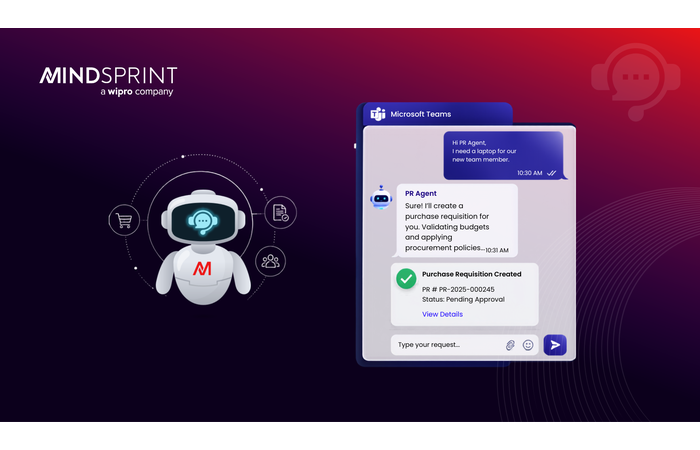
Mindsprint, a technology firm offering purpose-built AI-led solutions to modernize enterprise operations and a Wipro company, announced the launch of a new Purchase Requisition (PR) Agent within Procuresprint®, its autonomous source-to-pay platform.

With this PR Agent, employees can initiate purchase requisitions through a simple conversation in Microsoft Teams, while the platform automatically enforces procurement policies, validates budgets, routes approvals, and synchronizes with enterprise systems. The result is a faster, more intuitive requisitioning experience that reduces manual effort, strengthens governance, and helps organizations improve procurement efficiency at scale.

The addition expands Procuresprint®’s existing ecosystem of specialized AI agents across the source-to-pay lifecycle, including:

  1. Spend Insights- Enrichment & Analytics.
  2. Ask-Me Agent – Conversational Multi-Agent Orchestration.
  3. Supplier Scout – Discovery across massive supplier networks.
  4. RFx Agent – RFx execution & bid management
  5. Communication Agent – Supplier coordination
  6. Deal Advisor – Bid evaluation & award simulation
  7. Agreement Architect – Contract drafting & NLP
  8. Onboard Assistant – KYC & vendor master.
  9. Risk Intelligence – Real-time screening.

“Automation helped procurement do the same work faster. Multi-agent AI enables procurement to work differently altogether,” said G. Venkataraman, President & Business Head – Intelligent Enterprise Operations, Mindsprint. “The next generation of procurement leaders will not define success by how many tasks they automate, but by how intelligently they orchestrate them. That’s the vision behind the specialized AI agents within Procuresprint® — they work together across the source-to-pay lifecycle to enable truly autonomous procurement.”

The launch builds on Procuresprint®’s proven business outcomes. Enterprises using the platform have achieved 30–50% faster procurement cycles, up to 15% cost savings, 40% lower operational costs, and 100% audit traceability and compliance, demonstrating how autonomous AI can transform procurement beyond task automation.

Essar Power CDIO Sapann Talwar on How AI, Data and Cyber Resilience Deliver Measurable ROI in Power Generation

In asset-intensive sectors, the reality of digital transformation is about uptime, safety, compliance, and costs, not just exciting pilots. In a free-wheeling conversation with CIONOW, Sapann Talwar, CDIO, Essar Power, shares what is really working in the field: the one issue resolved only when IT and OT came together as a team, an intelligent roadmap for rolling out AI, analytics and automation, and metrics which show predictive maintenance impacting P&L.

Large conglomerates face a massive balancing act as they must ensure uptime, safety, regulatory compliance and cost pressure. Where can digital technology create the most measurable business value in this mix?

The strategy must address four key areas: uptime, safety, cost and the alignment of physical operations with business decisions. Predictive intelligence is critical—moving from calendar-based maintenance to condition-based maintenance can reduce unplanned outages by more than 20% and extend asset life.

IT and OT must not work in silos; systems like SCADA, DCS and sensors on the OT side need tight integration with IT systems like ERPs to create better metrics. AI can further optimize forecasting and efficiency across both domains. The real value comes from closing the loop between operational events and business outcomes—that’s what the board cares about.

You have emphasized that IT and OT need to break silos. Can you share one operational problem that became easier to solve once data, IT and OT teams began working together, and what made that collaboration stick?

The biggest challenge is that IT and OT see their infrastructure through very different lenses. The breakthrough came when we showed them the common data layer: both have assets, event codes, logs and failure modes that need prediction.

We formed a cross-functional committee, both with collective responsibility and incentives in place. So either we win as a team, or we lose as a team, rather than looking at who to blame. That shift brought the problem-solving time from weeks down to days. The result in bottom-line benefits to management was obvious. They had better problem-solving, more reliable solutions, and regained confidence, because we were able to fill in the blanks, in order to avoid future recurrence.

The common saying is that data is the new oil; yet numerous enterprises find it challenging to extract decisions from this oil. What’s your methodology to create a reliable and accessible data foundation?

Everyone knows data is key, but the focus must be on knitting every data element together into a unified fabric—from OT sensors to IT logs. The challenge is correlating information across different toolsets and validating data quality at the edge, because systems generate a lot of garbage.

We need to validate real data, timestamps and sensor vs gateway levels, then set aside the noise. Tools matter, but humans matter more: engineers must understand the data foundation, correlate insights and enable self-service. It has to be an open-minded way of thinking but with guardrails put in place so the streamed data makes sense to humans not just to dashboards.

With the buzz about AI, how do you figure out when the use case warrants AI, prediction, automation or a better process? How does your team go about doing it?

Begin by establishing the best practice – the majority of the issues result from fragmented processes and manually assigned tasks between functions. 

Automation becomes useful for repetitive, rules based functions like a check on a compliance report and triggering alerts and escalations. 

Application prediction models use time-series sensor data that must be predictable or optimized, and then in cases of non-structured data (maintenance logs, inspection reports or vendor documents) consider generative and agentic AI where natural language understanding is of great benefit.

If a problem can’t be solved by process, automation, analytics or AI, you may need the next wave of technology but that hierarchy ensures you are not over-investing in AI where simpler fixes work.

It is common to have an Industry 4.0 scenario around predictive maintenance. In addition to providing you with information to prevent equipment breakdowns, how would you indicate how this effort has produced results in terms of increased availability, efficiency or lower cost?

Focus first on model accuracy aligned with systems, not just business outcomes. Key metrics include:

Availability: Reduce your unplanned downtime and increase mean time between failures (MTBF) by quantifying pre vs post-predictive maintenance for asset class.

Efficiency: Link predictive alert to specific performance – heat rate, capacity factor, and reduced startup time to evaluate performance of boilers, turbines etc.

Safety: Identify trends in safety events, audit findings and regulatory issues.

Cost: Optimize inventory of spare parts. Minimize emergency maintenance and avoid oversupply.

We run control pilots on comparable assets—isolating technology impacts from variables like fuel quality or loading profiles—to set benchmarks and scale what works.

As generative AI percolates into enterprises, where should the line be drawn between human-led and machine-led decisions, especially for plant engineers, maintenance teams and business leaders?

I view AI as augmented intelligence, not artificial intelligence. The highest value comes from augmenting human expertise with AI systems. Neither humans nor AI alone can deliver the best performance.

Plant engineers will also use generative AI for asking questions about past production runs in natural language and developing explanations much more rapidly than human experts alone could provide. Nevertheless, the final decision, specifically regarding safety-critical or high-stakes choices, will continue to rest in the hands of humans. AI facilitates more timely and data-driven decisions; humans have accountability and understanding.

What’s one piece of advice you would give to CIOs in asset-heavy industries who are trying to sequence their digital investments for maximum ROI?

Don’t pursue AI because it’s AI. Identify fixes for processes, automate them, then, establish predictive analytics and then only AI where absolutely necessary. Build a unified data layer with IT–OT convergence, validate data quality at the edge, and ensure humans are embedded in the loop.

Measure success by uptime, safety, cost, and not about tech deployment alone. Also, put some joint responsibility between IT/OT, so IT and OT do what they do best in partnership, as a matter of course, not an incident.

Zoho Announces Catalyst 3.0, an AI Agent-Ready Platform that Helps Developers Take Apps from Prompt to Production in One Cloud 

Zoho, a global technology company headquartered in Chennai, today announced the launch of Catalyst 3.0, the agent-ready full-stack cloud development platform, equipped with all-new capabilities to enhance the AI-native developer experience. Catalyst 3.0 brings enhancements, including AI IDE (Integrated Development Environment) integrations, Agent Skills, MCP support, and AI-assisted workflows, on a single integrated platform to empower developers by fast-tracking the prompt-to-production process. To enhance accessibility and equip future developers with modern tools, the platform is also offering a free student programme, allowing next-gen developers to learn, experiment and deploy applications seamlessly.  


Over 72% of developers rely on AI everyday to write code. However, coding is only one part of the development process and developers still need to work on provisioning, connecting and operating the underlying cloud infrastructure, often across different platforms. Catalyst 3.0 eliminates this bottleneck by helping developers take an app straight from their Agentic AI coding assistants to production-grade infrastructure without leaving the coding environment. The platform is built for system integrators and software firms building custom solutions, as well as indie developers looking to move from prototype to production without managing infrastructure themselves.


“Agentic AI coding assistants have transformed how quickly applications are being created, but getting that code deployed and operating in production remains a major hurdle,” said Anand Nergunam, Global Vice President, Revenue Growth at Zoho. “For every app being built, developers spend a lot of time stitching together separate cloud services and managing infrastructure. We built Catalyst 3.0 to eliminate that friction. By delivering an agent-ready, serverless full-stack platform, we are providing developers and AI agents complete freedom from managing cloud infrastructure. They can build, deploy, and scale applications faster safely, with far less operational overhead.” 


Unlike its competitors that charge subscription fee in addition to usage, Catalyst has a straightforward pay-as-you-go pricing model with every feature bearing a per-unit cost. Users have complete visibility over their usage within the Console, and can set budget alerts and ceilings to prevent inflated cloud invoices. 


“Additionally, to democratise access we are launching a free student tier. By putting Catalyst 3.0 in the hands of student developers, we are freeing them from the burden of traditional development cycles, so they can thrive in a rapidly shifting landscape. Ultimately, our aim is to remove technical friction so they can instantly convert their ideas into tangible outcomes,” added Anand Nergunam. 


AI-Native Development Capabilities and an Open Source Ecosystem

Catalyst 3.0 brings several improvements to the platform to make it better equipped to work with any AI coding assistant. To reduce the learning curve for the developers, Zoho has added Agentic AI skills that enable the AI coding assistants to understand the Catalyst platform and enable them to write production-grade code. Furthermore, the skills have also been made available across the Claude Code and Codex marketplaces, making it accessible for developers while helping them optimise token consumption.


To further improve the experience of AI-assisted coding sessions, Catalyst has introduced a non-interactive CLI (Command-Line Interface) that can perform tasks from start to finish without prompting the user for manual input during its execution. Additionally, MCP support for Catalyst enables a complete hands-off development process, with developers completing all actions and requests from within a single coding assistant console without the need to perform actions and configurations via the platforms UI console.


Orchestration, built into the Skill, ties the three capabilities together. When an AI coding assistant faces a decision about how to execute a request, the Skill routes it deterministically down the CLI or MCP path rather than leaving that choice to the model. This approach lowers the developer’s cognitive load, reduces the risk of incorrect tool selection, and helps produce more reliable, production-ready applications. 


To strengthen developer trust and transparency, Zoho has made the AI skills available as an open-source repository for developers to be able to inspect and further add to. Zoho is also open-sourcing Catalyst’s SDK (Software Development Kit), CLI, as well as its lightweight Javascript Framework, Slyte.


An Integrated Platform Leveraging Zoho’s Secure Infrastructure

Catalyst 3.0 offers native services to meet all the requirements of a full-stack application from frontend hosting and serverless functions to compute and data management. With every layer of the stack available in one place, developers can focus on building solutions instead of managing infrastructure, which generally spans across multiple providers. 


Any application built on Catalyst inherits the security layer of Zoho’s cloud infrastructure, and the developers have the option to host solutions in the company’s India data centres, respecting data sovereignty. Catalyst has deep integration hooks into Zoho apps. It is available across data centres in regions like US and EU, for developers building compliance-sensitive applications. Catalyst also offers a few open-source LLM models, hosted on Zoho’s secure infrastructure, to add AI capabilities to the apps built on the platform. 


Customer Success: Building with Catalyst

Eternia by Hindalco (Aditya Birla Group)

Eternia, part of Hindalco, uses multiple Zoho applications across its business. As teams grew, employees needed a unified, contextual view of information across these systems. Using Catalyst, Eternia built an experiential application that brings this data together in a single, productivity-focused experience, eliminating the need to switch between applications.


At Eternia, our digital transformation strategy is focused on enabling cross-functional teams with a single source of context across the Zoho applications that power our business. Catalyst provided us with a full-stack platform to deliver this experience end-to-end, eliminating the operational overhead of stitching together infrastructure ourselves. What stood out most was the speed of execution. A single developer was able to take the solution from concept to a fully deployed, production-ready application within a short span of time. For an enterprise operating at our scale, this level of speed and agility does more than save time—it fundamentally reshapes how we approach building and scaling internal digital solutions going forward,” said Aasheesh Agrawal, Lead- Digital & IT, Eternia by Hindalco (Aditya Birla Group).


We The Leaders Foundation (Non-profit Organisation)

We the Leaders, a citizen leadership movement founded by K Annamalai, has rapidly expanded to nearly 2 million leaders. The organisation built its digital engagement platform on Catalyst by Zoho, using managed authentication, datastore, serverless functions, file storage, and scheduled jobs. By leveraging Catalyst’s AI-assisted development capabilities, the organisation went from initial discussions to a full security-audited application across Android, iOS, and the web in just three weeks. The platform serves as the movement’s primary channel for engagement across 38 districts.


Before we launched We the Leaders as a political movement in early June 2026, we were contemplating on how to manage engagement while we reach a certain scale. We needed a secure platform to organise events, verify leader identities, and gain visibility into activities across the state. Catalyst enabled us to get the platform operational in a few weeks through AI-assisted development, without compromising security. Today, every leader has a verified digital membership identity, every event and post follows an approval workflow, and our administrators have a real-time view of engagement across Tamil Nadu & various parts of the world,” Dr. Prabhakaran, Chief Executive Officer, We the Leaders Foundation. 


System Integrators: Build and Scale Their Own Products on Catalyst

“When we built ConfigPilot, and later ActionPilot, we made a deliberate choice to build them on Catalyst rather than stitch together our own infrastructure. Catalyst’s agent-ready approach, where an AI agent can write, deploy, and manage the underlying services just as readily as one of our engineers can, helped us get to first release faster. It also enabled us to turn real-time feedback into shipped changes quickly, rather than waiting on a quarterly release cycle. The same holds for ActionPilot: being built on Catalyst means we can keep reshaping how it connects and behaves without re-architecting the platform underneath it every time a customer asks for something new,” said Gavin Smith, Founder, Element Technology Services, UK


“Working with Catalyst meant our time went into the product our customers actually pay for, not the plumbing underneath it. We built Nibni, our real-estate platform, on Catalyst and sell it to our customers. With MCP, our agents work alongside Catalyst directly instead of us translating for them. For a team our size, that’s the difference between shipping a feature this week and shipping it next quarter,” said Mostafa Wanas, Founder & Managing Director, Wanas Apps, Middle East.

Commvault Integrates Cyber Recovery Actions into CrowdStrike Charlotte Agentic SOAR Workflows

Commvault,  a leader in unified resilience at enterprise scale, today announced a new integration with CrowdStrike that makes Commvault cyber recovery actions available as native steps within Charlotte Agentic SOAR workflows. The integration enables joint customers to automate Commvault recovery actions as part of security workflows, helping accelerate response and forensic investigations while reducing manual coordination between security and recovery teams.


AI-driven automation is helping organizations detect, investigate, and respond to threats at machine speed, yet fragmented tools and workflows can slow security teams at critical moments. The new purpose-built connector enables security teams to incorporate Commvault cyber recovery actions directly into workflows orchestrated by Charlotte Agentic SOAR and rapidly accelerate investigation, response, and recovery. Key capabilities include: 

  • Restrict access in Commvault to help prevent unauthorized changes during an active incident.
  • Preserve clean recovery options by automatically suspending Commvault backup data aging policies to retain viable recovery points during active incidents.
  • Accelerate forensic investigations by restoring potentially compromised assets into Commvault Cleanroom, enabling investigators to begin analysis without disrupting production systems.


“Security and recovery teams need to move quickly and in coordination during an incident,” said Vidya Shankaran, Field CTO, Commvault. “Our integration with CrowdStrike Charlotte Agentic SOAR makes Commvault cyber recovery actions available directly within security workflows, helping joint customers reduce manual handoffs and accelerate investigation and response. This strengthens cyber resilience and simplifies how security and recovery teams work together seamlessly.”

Happiest Minds Technologies announces merger with ITC Infotech 

The combined entity will be a leading Indian IT services company with a differentiated portfolio spanning AI, digital and product engineering, cloud, data, cybersecurity, consulting, and industry-centric technology solutions.

Happiest Minds Technologies Limited, an AI First, customer-centric digital engineering company, today announced the signing of definitive agreements to combine its business with ITC Infotech India Limited (“ITC Infotech”), creating a scaled AI First global technology services enterprise with US$ 1 billion of annual revenue by FY28 1 , 19,000 1 + employees, serving 800 1 + customers and operations across more than 30 1 countries.

The proposed combination brings together two highly complementary organizations with shared values, strong people-centric cultures, and a common vision of helping enterprises accelerate AI led transformation. The
combined company will unite Happiest Minds' strengths in AI, digital engineering, cloud, data, analytics and cybersecurity with ITC Infotech deep expertise in enterprise transformation, SAP, Product Lifecycle Management (PLM), cloud, Industry 4.0 and industry-specific technology solutions.

As part of the transaction, ITC Infotech will acquire an aggregate minority stake of ~22.1% in Happiest Minds from the Promoter and Promoter entities across two tranches for a total consideration of ₹1,330 Cr (average price of~₹395/share). Further, the proposed merger will be effected through a share swap, pursuant to which equity shareholders of Happiest Minds will receive 25 shares of ITC Infotech for every 81 shares of Happiest Minds held by them. ITC Limited will be the promoter of the merged company, with a ~73.4% stake.

The proposed merger is subject to the satisfaction of customary statutory, shareholder and regulatory approvals, including approvals from the Competition Commission of India, the relevant stock exchanges and the National Company Law Tribunal. The companies expect the transaction to be completed over the next 15 months and will continue to operate independently until all approvals have been obtained. The combined company will be listed on relevant stock exchanges post receipt of all approvals.

Ashok Soota, Chairman Chief Mentor, Happiest Minds Technologies said “I am delighted that upon the completion of necessary approvals and legal formalities, Happiest Minds will become an important part of a larger
organization through its merger with ITC Infotech. The two organizations are aligned on our values and shared vision for the future. There is very significant complementarity in our business portfolios which will ensure synergy. We believe that ITC Infotech is the best partner for Happiest Minds to fulfil its destiny and we are pleased that our team will have a welcoming new home.”

1Pro-forma financials Sanjiv Puri, Chairman, ITC Limited & ITC Infotech, said, Today marks an important milestone in the journey towards Happiest Minds becoming an integral part of ITC Infotech, subject to receipt of regulatory approvals. The coming together of our complementary strengths, deep domain expertise and future-ready capabilities will further enhance our ability to deliver cutting-edge solutions across geographies. I am particularly encouraged by the shared values, people and customer centricity that define our organisations. We look forward to the invaluable experience, expertise and dedication of the employees of Happiest Minds as we embark on this exciting new chapter.”

Joseph Anantharaju, co-chairman & CEO, Happiest Minds, said “The merger of Happiest Minds and ITC Infotech brings together complementary strengths towards creating a future-ready technology services organization.

Combining our expertise across AI, digital, cloud, data, cybersecurity, product engineering, and enterprise platforms with those of ITC Infotech in enterprise transformation, SAP, engineering services, Product Lifecycle
Management (PLM) will enable us to deliver greater value to customers across geos and accelerate growth in high-demand industry groups. Beyond the strategic fit, this partnership is anchored in shared values, customer
focus, and a commitment to innovation. Together, we are building a stronger platform for long-term growth and global scale.”

Venkatraman Narayanan, Managing Director, Happiest Minds, said “This transaction reflects a shared commitment to strong corporate governance, financial prudence, and long-term value creation. ITC Infotech brings
the financial strength, scale, and stability of ITC Limited, one of India most trusted business houses, and our combined financials lay a solid foundation to invest, grow, and compete globally. Equally important to me has been the spirit in which discussions between our companies were conducted — candid, respectful, and genuinely collaborative from the very first conversation. That reflects a shared culture of integrity and mutual respect, and it gives me confidence that the people-centric values, entrepreneurial energy, and customer-first mindset that define Happiest Minds will not just survive this integration, but thrive within a stronger, more resilient, and truly future-ready enterprise.”

Strategic rationale: Creating an AI First, Agile Always Platform
The proposed combination creates an AI First, Agile Always Platform that brings together complementary strengths across five strategic dimensions:

– Scale: A technology services platform with approximately ₹7,033 1 crores in FY26 revenue and more than 19,000 1 professionals, enhancing the ability to compete for larger global transformation programmes.

– Capabilities: Integration of ITC Infotech enterprise transformation, SAP, PLM, Industry 4.0 and cloud expertise with Happiest Minds; AI, digital, cloud, data and cybersecurity capabilities across the entire enterprise technology value chain.

– Industry Diversification: The combined company will have deep expertise across CPG, Hospitality, Manufacturing, EdTech, BFSI, Healthcare, providing a diversified and resilient revenue mix.

– Geographic Reach: A more balanced international presence with expanded access to North America1Pro-forma financials
(~38% 1 ) and Europe (~31% 1 ) while strengthening delivery capabilities around the world.

– Culture: Both companies have a strong client-and people-centric culture, with a focus on technology-led transformation and long-term customer relationships. Revenue and Growth Opportunities
The combined company expects to unlock significant growth opportunities through:

– Cross-selling AI, cloud, cybersecurity, SAP, engineering and infrastructure services across a combined client base of more than 800 1 customers.

– Greater participation in large-scale enterprise transformation and digital engineering programmes.

– Expansion of proprietary platforms and industry solutions into new markets and geographies.

– Accelerated adoption of Generative AI and Agentic AI solutions across industries.

– Increased collaboration with strategic partners including Microsoft, SAP, ServiceNow, PTC and leading cybersecurity providers and hyperscalers.
Combined Scale and Market Position

The combined entity creates a powerful platform for the next phase of growth, bringing together complementary strengths in AI, digital engineering, cloud, cybersecurity, enterprise applications and industry expertise. Positioned to capture the significant opportunities emerging from AI led transformation, the combined entity is expected to
achieve US$1 billion in annual revenue by FY28. With a shared vision of innovation, agility and customer-centricity, the new organisation aims to become the most trusted AI First transformation partner globally, delivering measurable business outcomes while creating enduring value for customers, employees, shareholders and the communities it serves.

JM Financial Limited acted as the exclusive financial advisor to Happiest Minds and its Promoter and Promoter entities. PwC and KPMG served as the financial and tax due diligence advisors respectively to Happiest Minds,
while Khaitan & Co. acted as the legal advisor to the Company in connection with the transaction. The share exchange ratio was determined based on the recommendations of joint independent valuers, PwC and Grant
Thornton.

Chat with CIONow.in