





The New Rules of Cyber Resilience

Ransomware doesn’t necessarily “hit” an organization by displaying an ominous message today.   Malicious actors can remain within networks for weeks. They explore their target environment, observe their internal and external relationships of trust and pinpoint their backup system before triggering a damaging operation. When their presence is ultimately detected, backups are typically compromised already.
The old, simple tactic of backing up frequently, ensuring the backup is disconnected or somewhere off-site, and then believing everything is fine, no longer works. Enterprise technology leaders need a fundamentally new paradigm: Cyber resilience must be implemented on the hypothesis that the environment is already breached and you cannot implicitly trust back ups.


Redefining Backup in a Hostile Environment

Historically, backups were devised for operational failures: a file gets deleted accidentally, some hardware fails, a database gets corrupted. The idea was that a backup would be a good and trustworthy environment and that having a recent version was safe enough. Cyber resiliency changes that assumption. It posits that the environment is hostile, not friendly, and builds recovery accordingly.

This necessitates changing the architecture of data protection. We move from isolated silos of backup data to immutable storage with rigorous access controls, completely separating the management and production planes and vaulting them off-site in a controlled manner. The recovery process must occur in an isolated clean-room environment where data is first restored, scanned, and validated before re-entering production. Backups evolve from “having a copy of the data” to “having a copy of the data we can prove is good under attack.”

As Manjunath Prasad, Head of IT and CISO at TVS Mobility, says, “Traditional backup is always kept in an isolated place. We used to keep it safe in that regard. But today, wherever you keep it, we are not assured that the data is safe. So that’s where the resiliency part kicks in.”

Manjunath Prasad, Head of IT and CISO at TVS Mobility

Hemanand Gadgil, Product Manager for Storage Solutions Engineering at IBM

Hemanand Gadgil, Product Manager for Storage Solutions Engineering at IBM, adds that the difference is foundational: “Traditional backup solves operational problems whereas cyber resiliency assumes a determined adversary is already inside your environment, and you cannot trust whether your backups are safe or not.”

From Detection to Clean Recovery

In a resilient architecture, detection and recovery are distinct but tightly linked. A low-confidence anomaly is an alert to investigate. A high-confidence ransomware or destruction event is a trigger to isolate affected systems, assess which snapshots are likely clean and invoke a formal recovery runbook.

Clean recovery is not a point-in-time copy. It is a declared state backed by validation. Data needs to be scanned for malicious content, its integrity verified, and confirmed untouched before it re-enters the production line. The scan would occur in a disconnected, restricted environment, secured by careful authentication and exclusive administrator logins. Application logs must be reviewed for unauthorised changes, and data integrity checks must run on a regular cadence, not just during incidents.

Prasad stresses three critical components: “One is the access control to the data storage, second is the regular malware scanning of that particular data, and the third is the data integrity verification, regular verification.”

Gadgil explains how this changes the workflow: “In traditional backup, I know which version to recover, assuming it’s a clean copy. In cyber resiliency, you must identify and detect the threat, then make a clean copy, and while restoring, ensure you are restoring a clean copy. You have to scan it and make sure that it is always clean.”

Avoiding False Comfort in Immutability and AI

Although immutability copies have been widely hyped as a ransomware protection strategy, real-world use reveals gaps leading to false security. These gaps are due to incorrect retention policies, where attackers simply wait for the immutability window to expire, the existence of service accounts with unnecessary access, or retaining accounts past the necessary window, or poor control over off-site vaulting. Perhaps most dangerous is keeping the management plane, production plane and immutable copies on the same network, which allows lateral movement once any one layer is compromised. Using immutable snapshots for non-production testing can also expose them to unnecessary risk.

Gadgil warns against a common architectural mistake: “Generally, people keep the management plane and the production plane, and the immutable copy, on the same network or in the same place, which is a big pitfall, as the management and production both are on the same plane; one must have been compromised.”

At the same time, AI workloads are reshaping data priorities. AI models and training datasets may need retention for days or weeks, not hours, with stricter RPO and RTO requirements. Data classification itself is changing, as every dataset in an AI pipeline carries different risk and value. Security measures and integrity checks must be part of an AI model lifecycle from the very beginning. With respect to recovery, it’s best to first recover a small but essential subset of AI data, then validate its correctness and then apply it to large data sets.

Prasad highlights how this changes the mindset. “In the modern AI era, data classification itself goes through a lot of changes. Every data set is in a different combination altogether. So data classification is very critical now to handle the AI era.”

Advocating a practical recovery rhythm, he says, “Rather than restoring the whole database and then realizing it’s not doable, it’s better to follow the tiered approach so that we go step by step, validate a smaller set of the data, and then ensure it’s the right data. And then go for the complete data restoration.”

The Bottom Line for Technology Leaders

When attackers assume your backups are reachable, your defence must assume they are compromised. Cyber resilience is the discipline that lets you recover anyway. This means integrating data security from the design phase, protecting isolated recovery environments and regularly testing tiered recovery against real-world attack scenarios. CIOs and CISOs will eventually be measured not by whether their back-ups have successfully completed each day, but by whether trusted, usable data and services can be returned post-breach.

The way forward for  organizations is to move from “backup and hope” to “assume breach, recover clean.”
Securonix Expands India Footprint, Strengthens Partnership with Orient Technologies Ltd. to Drive Mid-Market Growth

Securonix, Inc., a six-time Leader in the Gartner® Magic Quadrant™ for SIEM, today announced the strategic expansion of its partnership with Orient Technologies, a leading technology solutions provider, further strengthening market presence and strategic footprint across India. Orient Technologies is an approximately USD 85 million technology company with significant investments in cybersecurity and plans to invest USD 5 million in its partnership with Securonix over the next two years. It has evolved from its earlier role as a Securonix MSPP to become the exclusive Value-Added Distributor (VAD) and key routing technology partner across India and the US, significantly expanding Securonix’s global channel strategy.

Orient is also strengthening its cybersecurity capabilities and delivery infrastructure through its full-fledged SOC Excellence Center in Mumbai, with plans to expand its team by adding around 100 skilled cybersecurity resources.


Organizations across India are rapidly adopting AI while confronting adversaries that are using the same technology to increase the speed, scale, and sophistication of attacks. Security teams must contend with faster-moving threats while also determining how to introduce AI safely and effectively into their own operations. The expanded Securonix and Orient Technologies partnership brings together Securonix Unified Defense SIEM with Agentic AI and Orient Technologies’ implementation, integration, and security operations expertise to help enterprises modernize detection, investigation, and response with the governance and human oversight required for enterprise environments.


The partnership will also expand Securonix’s reach across India’s growing mid-market segment, giving more organizations access to advanced security operations capabilities backed by local deployment, services, and support expertise.


“AI is changing the operating environment for security teams on both sides of the equation. Adversaries have access to tools that can help them move faster, while enterprises are under pressure to use AI responsibly to improve their own defenses,” said Toby Weiss, CEO, Securonix. “Our expanded partnership with Orient Technologies gives customers in India access to Securonix technology alongside the local expertise required to deploy it effectively, integrate it into existing environments, and build security operations that can evolve as those threats change.”


Under the expanded partnership, Orient Technologies will serve as Securonix’s exclusive value-added distributor and joint go-to-market partner in India, supporting customers and regional partners across the security operations lifecycle. Orient Technologies will connect Securonix with regional partners and enterprises while providing implementation and integration services, professional services, ongoing technical support, and SOC enablement.


The expanded relationship is designed to extend well beyond initial technology deployment. Orient Technologies will work with customers and partners to operationalize and optimize their Securonix environments, develop the skills and processes required to support modern SOC operations, and help organizations maintain those capabilities over the long term.


Securonix Unified Defense SIEM with Agentic AI brings detection, investigation, response, and AI-powered security operations together within a cloud-native platform. Through a human-in-the-loop philosophy, Securonix helps security teams apply AI across analyst workflows while maintaining governance, explainability, and control. The approach enables organizations to improve SOC efficiency and respond to changing threats without sacrificing the oversight required for critical security decisions.


For Indian enterprises, combining those capabilities with Orient Technologies’ regional expertise provides a more complete path from technology adoption to sustained security operations. Customers can draw on local implementation, integration, professional services, technical support, and SOC expertise as they modernize environments and introduce AI into security workflows.


“Our collaboration with Securonix over the past several months has given rise to strong momentum,” said Ajay Sawant, Chairman & Managing Director, Orient Technologies Limited. “By combining Securonix’s AI-powered security platform with our managed security expertise, we are enabling organizations to build more resilient and efficient Security Operations Centers across India and the US.”  Sawant added, “Our shared goal is to expand our customer footprint by 12%, strengthening our managed security services portfolio. This expanded partnership will help customers achieve measurable improvements in response times, analyst productivity, and overall operational efficiency.”


The expanded partnership also strengthens the Securonix channel ecosystem in India. As the exclusive VAD and joint go-to-market partner, Orient Technologies will help regional partners build Securonix capabilities, support customer opportunities, and extend the technical and services expertise available throughout the market.


With organizations facing increasingly complex security environments and increased AI-driven threats, the partnership gives enterprises a combination of technology, local expertise, and ongoing operational support designed to help them strengthen detection and response, improve SOC efficiency, and adopt AI within security operations with appropriate governance and human oversight.

SBI opens Group CISO role with ₹2.5 crore package amid rising BFSI cyber risks

The public-sector lender is looking for one vacancy under Advertisement No. CRPD/SCO/2026-27/21. As per the bank’s recruitment notice, the job applications have been open since 4th September 2026 and will close on 24th September 2026. 


Initially, the role of Group CISO is being offered for a three-year term, with an extended provision of up to two additional years, depending on the bank’s requirements and the officer’s performance. The appointed candidate might be posted in Mumbai or Navi Mumbai. 


The maximum age limit for selection is 57 years as on 31st Aug 2026, with a degree holder in B. Tech/ B.E. in Computer Science/ Computer Science & Engineering/ Software Engineering/ Information Technology/ Electronics/ Electronics & Communications Engineering/Cyber Security or Equivalent Degree in the above specified disciplines with a minimum score of 50%.  Or MCA or M. Tech/ M. Sc in Computer Science/ Computer Science & Engineering/ Information Technology/ Software Engineering/ Electronics/ Electronics & Communications Engineering/Cyber Security or Equivalent Degree in above specified disciplines. (From a University/ Institution/ Board recognized by Govt. Of India/ approved by Govt. Regulatory Bodies .


The KRAs of the Group CISO would be: 

  1. Leading the bank’s cybersecurity strategy and governance, 
  2. Overseeing cyber-risk management, threat intelligence, security operations, incident response, and regulatory compliance. 
  3. Engaging with the Board, senior management, regulators, auditors and other stakeholders.
  4. Managing security risks related to cloud environments, identity and access management, privileged access management, third-party and supply-chain ecosystems, business continuity, disaster recovery and emerging technologies such as artificial intelligence and machine learning.


This job profile showcases the increasing need for cyber resilience across banking operations. The professional is expected to work closely with regulators and government agencies, including the Reserve Bank of India, CERT-In and NCIIPC, while ensuring the SBI’s information-security programme remains aligned with applicable regulatory and statutory requirements.


This appointment by SBI points to the board-level concern for financial institutions. RBI’s IT governance directions require regulated entities to assign the CISO responsibility for driving cybersecurity strategy and compliance, while placing regular cyber-risk and preparedness reviews before the Board or relevant board-level committees.


The wider BFSI sector is also confronting a rapidly changing threat environment. MeitY, CERT-In, CSIRT-Fin and SISA’s Digital Threat Report 2025–26 have highlighted threats including AI-enabled attacks, identity compromise, business-logic abuse, supply-chain vulnerabilities and attacks targeting trust in digital financial systems.


Candidates will be shortlisted and called for an interview. SBI said the compensation offered to the selected candidate will be negotiable and determined based on experience, suitability, and the bank’s assessment.

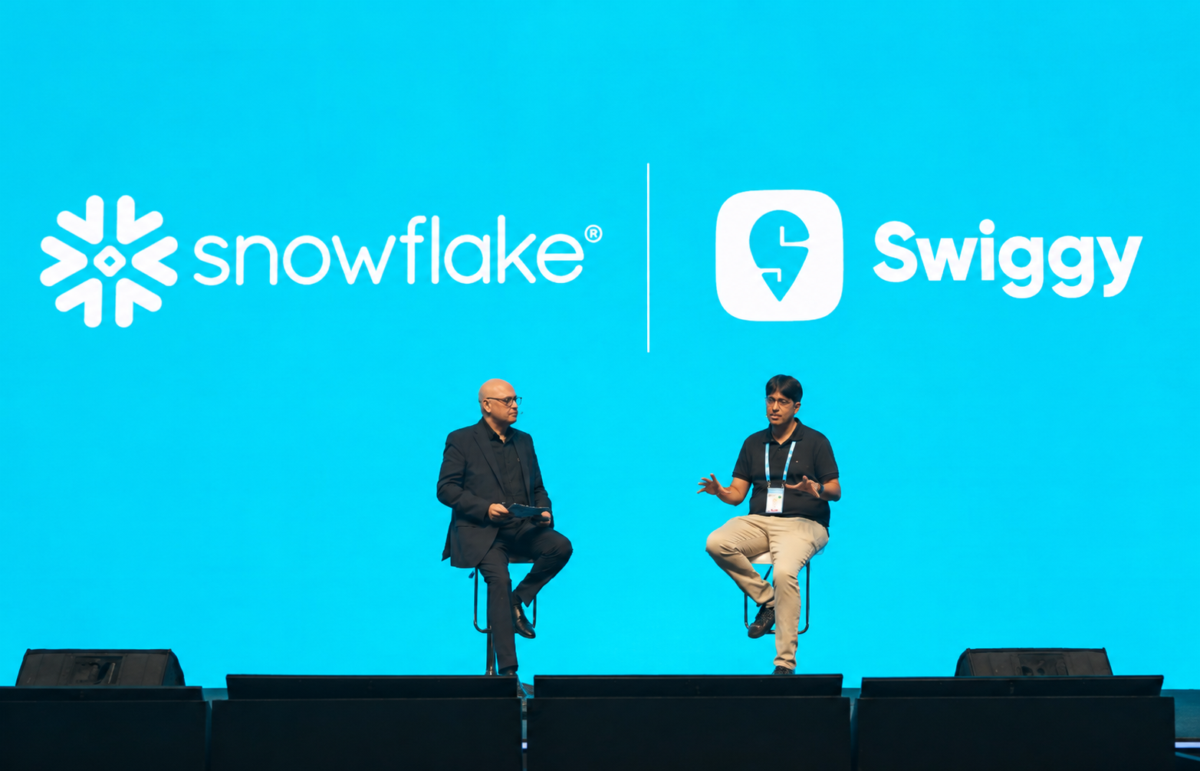
Swiggy Chooses Snowflake to Power Data-Driven Decisions Across Food, Quick Commerce and Dining Out

Snowflake, the AI Data Cloud company, today announced that Swiggy, India’s leading on-demand convenience platform, is leveraging Snowflake as its unified data foundation. Snowflake’s platform empowers Swiggy to democratize insights across marketing and operations, enabling the company to act on customer needs in real time and accelerate business execution at scale.


As Swiggy rapidly scaled to serve millions of customers across food delivery, Instamart, and Dineout, getting insights from fragmented data became a challenge. The company required a unified serving layer to support peak workloads smoothly. Swiggy also sought to empower its teams with easy-to-use, self-service access to insights to reduce dependency on central data teams.


By establishing a central analytical layer on Snowflake using Apache Iceberg, Swiggy has transformed its data ecosystem. This integrated foundation enhanced Swiggy’s slowest data workflows by 90 to 96 percent. Additionally, the company improved its heaviest queries from two hours to just 15 minutes and accelerated data processing from six hours to near real-time.


These performance gains have accelerated Swiggy’s daily execution across departments. Marketing teams now build and launch targeted campaigns directly within their own tools. Product engineering teams rely on standardised metric definitions to evaluate experimental features before release, using an in-house platform running directly on Snowflake.


Operational teams monitor service quality metrics in real time, helping proactively improve delivery logistics. At the same time, finance teams gain workload-level visibility into technology expenses.


Throughout the business, security features like role-based access, column masking, and row-level security enable both internal teams and external partners to interact with data safely using masked data. Snowflake’s governance framework further helps ensure that AI-powered agents and applications inherit the same permission boundaries, short-lived credentials, and audit trails required of human employees.


“At Swiggy, data is valuable only when it reaches the person who can act on it, whether that is a city sales manager, restaurant owner, or delivery partner. With Snowflake, we are making trusted, governed insights easier to access while ensuring that every user and AI agent operates within the same permissions and audit framework,” said Madhusudhan Rao, Chief Technology Officer, Swiggy.


“India’s fastest-moving companies can’t afford to route every data question through a central team. With Snowflake, Swiggy has built a centralised, governed data foundation, consistent controls, and an AI framework that holds agents to the same standards as people. This approach is helping Swiggy create a path toward more capable and accountable AI agents,” said Vijayant Rai, Managing Director- India, Snowflake.  

Automation Anywhere’s New Agentic Procure-to-Pay Solution Extends Autonomous Finance Across the Procurement Lifecycle

Automation Anywhere, the leading provider of agentic automation for the enterprise, announced general availability of its agentic Procure-to-Pay solution, the newest addition to Autonomous Finance, a suite of AI-powered solutions for the Office of the CFO built on the AI-native agentic architecture Automation Anywhere announced in collaboration with OpenAI earlier this year.


In most organizations, the procure-to-pay process spans many disconnected systems, and an issue at one stage can create delays and downstream exceptions. Automation Anywhere’s agentic Procure-to-Pay solution is designed to help address these challenges by acting as an intelligent layer that connects the process end-to-end, including procurement, ERP, finance, and supplier systems to orchestrate the full procurement lifecycle — adapting to existing processes and deployable in weeks – without replacing existing systems of record. 


“Finance leaders understand how quickly manual exceptions, fragmented approvals, and disconnected systems can consume capacity,” said Vikram Khosla, Chief Financial Officer of Automation Anywhere. “Every exception that requires human investigation, every invoice that stalls in a queue, every approval that waits on a handoff is a strategic tax on the business. Our agentic Procure-to-Pay solution gives finance leaders a way to automate the routine, govern the exceptions, and give their teams back the capacity to do work that moves the business forward.”


Automation Anywhere’s agentic Procure-to-Pay solution coordinates work from vendor onboarding through requisition, purchase orders, goods receipt, invoice processing, and payment status tracking — tightly integrated with existing ERP, procurement, and financial systems. When exceptions occur, the solution’s built-in AI assistant identifies the issue, surfaces context, and recommends actions, so finance teams can resolve more quickly. The result: finance and procurement teams shift focus from data entry and exception-chasing toward spend strategy, supplier relationships, and demand planning.


The solution also extends the reasoning-to-action approach that Automation Anywhere and OpenAI collaborated on in January, leveraging OpenAI’s advanced reasoning models in tandem with Automation Anywhere’s agentic solution architecture to bring enterprise context, orchestration, and governed execution into core finance processes. Today, that vision is taking shape as Autonomous Finance — intelligent solutions designed to transform finance operations end-to-end.


“Our Procure-to-Pay solution is one part of a much broader system that brings together advanced AI reasoning, enterprise context, and governed execution to understand and continuously improve how finance actually operates,” said Dustin Snell, SVP of Agentic Solutions at Automation Anywhere. “This is the first part of the story we’re bringing to market from the vision we announced in collaboration with OpenAI earlier this year.”


Organizations across the globe and industry verticals trust Automation Anywhere for finance transformation, including Australia Post, Boston Scientific, Cargill, Grant Thornton, Hitachi, Juniper, KeyBank, UK National Health Service, ResMed, Stanley Black & Decker, and more.


Automation Anywhere brings a proven track record in agentic finance automation to Procure-to-Pay. The solution is built on the same invoice-processing engine behind Automation Anywhere’s Accounts Payable offering, which has helped customers achieve up to 90% straight-through processing (STP) — the rate at which invoices move without human intervention. Procure-to-Pay extends that same proven technology across the full procurement lifecycle. Organizations can start with accounts payable and expand into other workflows as needs evolve — providing a practical path to broader automation and governance without requiring a large upfront transformation. Autonomous Finance already includes more than 55 AI agents across 100+ task types and 10+ finance sub-functions.

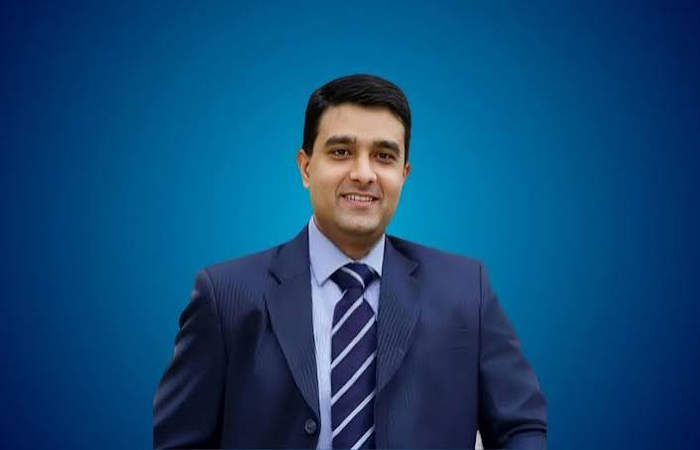
Protect the Core, Accelerate the Edge: Ninad Raje, Times Group

In the media industry, audiences provide an assessment with every scroll, click, or skip. Technology can no longer play a backup role; instead, it has to influence content, experience, and revenue in the present moment.

In an interaction with CIONOW, Ninad Raje, Group CIO, Times Group, provides insights into how dashboards do not make the cut, how one can leverage core-robust systems and high-speed innovation together, and also about the road ahead over 12-18 months on quantum, AI agents, and fake news combats.

You have led tech transformation across manufacturing, BFSI, healthcare and media. What’s fundamentally different about transforming a media business?

In most industries, if you make a decision today, you can review the results tomorrow or at least in a couple of days. In the media industry, by the time you finish discussing the decision, the audience has already moved on.

In sectors like manufacturing or insurance, transformation is often about optimizing a relatively predictable operating model. In media, the operating model itself is constantly being rewritten by consumer and audience behavior. The audience decides what’s relevant, on which device, in what format, and increasingly, in which language. Technology can’t sit backstage anymore; it has to be on stage with the business.

Data tells us what audiences are consuming. AI helps us understand patterns and predict intent. Digital transformation allows us to respond at scale. The real shift is from content‑centric thinking to audience‑centric intelligence, and that changes the CIO’s role dramatically. I no longer just ask, “Is the system available?” I ask, “Can the organization understand the audience quickly enough, create the right experience, and monitor that engagement?” Because in media, your audience doesn’t give you a quarterly performance review, they give you one every time they scroll, click, skip, or switch.

Large media houses can’t afford downtime, yet they must innovate fast. How do you balance stability and speed?

I have always believed: the core should be boring; the edge should be exciting. ERPs, finance, HR, cybersecurity, identity networks, and critical production systems must be so resilient that nobody calls the CIO to say “everything is working.” They should call only when something isn’t. That reliability creates the foundation on which you can safely experiment with cloud, APIs, AI agents, automation, modern data platforms, and new digital products.

The mistake many organizations make is treating innovation and stability as opposing forces. They are two sides of the same transformation strategy. I wouldn’t tell a business, “Let’s stop the engine and redesign the car.” Instead, keep the existing engine running reliably while you build the next‑generation engine alongside it using controlled experimentation, sandboxing, APIs, DevSecOps, and very strong governance. In the media industry, speed cannot come at the cost of resilience. If your digital platform crashes during the biggest breaking news of the year, no amount of innovation will make the audience wait. My philosophy is therefore, protect the core, modernize the foundation, and create a high‑speed innovation layer on top.

Times Group spans print, digital, TV, radio. Data volumes are huge. How do you turn that into real‑time decisions that improve both audience experience and revenue?

The biggest challenge isn’t collecting data; we are exceptionally good at that. The challenge is creating trusted, connected, and contextual data. Data by itself means nothing. It has to be trusted, connected, reliable, and contextual so that a business leader can move from “what happened” to “why did it happen,” then “what will happen next,” and most importantly, “what should we do about it?”

Imagine connecting content consumption, search behavior, engagement, subscriber behavior, advertising response, and audience preferences, instead of looking at each dataset independently. Suddenly, the same data ecosystem helps editorial teams understand what audiences are interested in, helps product teams improve digital experience, and helps advertising teams create more relevant propositions.

The shift we need is from dashboards to decision intelligence. Dashboards are passé. We don’t need another 47‑slide dashboard that nobody opens after the first Monday. We need intelligent systems that tell the business: “This audience segment is losing engagement; this content category is trending; this campaign is underperforming—and here’s the action we recommend.” India has no shortage of data; the competitive advantage is who can turn that data into better decisions, faster.

How do you see the role of the CIO changing, especially across the industries you have worked in?

The role of the CIO has changed a lot. I still recollect when this portfolio was called EDP (Electronic Data Processing). Then it became IT (Information Technology) then just “technology,” then “tech and engineering.” Now we’re in the age of automation, AI, Gen AI, robotics and more.

Portfolios have evolved too. Alongside CIO and CTO, we now see Chief AI Officer and Chief Digital Officer. The function has moved from being a support role to an enabler, and now to a driver. 

CIOs now wear multiple hats: platforms, cloud, infrastructure, security, and most importantly, automation. Boards are asking about automation: “How do we implement AI, and what results can we expect quickly?” That pressure has redefined the role. I would put it this way: CIOs are still called Chief Information Officers, but today they are largely Chief Intelligent Officers. Intelligence is the game, and that’s where data science and AI come in. Combine data science with AI, and you get the new, changed role of the CIO.

Which tech trends will have the most impact on enterprises in the next 12 to 18 months?

Everyone is talking about AI, but the real technology that will make a difference in the near future is quantum. In layman’s terms: if AI can do something in a minute, quantum can do the same thing in a fraction of a second. I recently had the opportunity to be part of a quantum project for the industry, and the technology is mind‑boggling, so fast‑paced and powerful.

Of course, this puts enormous pressure on infrastructure. If AI is a power guzzler, quantum will be an even bigger power guzzler. But the benefits are huge, especially in healthcare, data analysis, and future prediction based on data. We are moving from prescriptive understanding to predictive understanding. That’s where the technology is heading. 

Alongside quantum, with increasing digitization, we cannot ignore cybersecurity. These two, quantum and cyber, will be pillars of the future. And as we improve technology, data will also get cleaned, contextualized, more relevant and more updated. The future of tech is this combination: data, quantum, AI, and cybersecurity.

What are you working on these days? What’s on your short‑term and long‑term priority list for Times Group?

Every organization and tech leader should have a short‑term, mid‑term and long‑term plan.

Short term: Fast‑tracking consolidation of data, making it relevant, controlled and safeguarded. With the DPDP Act now live, this is immediate and non‑negotiable. We need to get this implemented and executed quickly.

Mid term: Doubling down on AI agents. This is where automation kicks in, productivity goes up, and efficiency improves.

Long term: Combining the power of AI agents with editorial content and contextual data so that processing happens in a fraction of a second with minimal human intervention. That demands deep automation. We are already working on robotic AI agents to ensure work that used to take days gets done in seconds.

Another major focus is automation of broadcast technology. Broadcast tech is completely different from “normal” IT. It involves satellites, satellite uplinks, and runs live 24×7 news and movie channels. We are working to automate news generation end‑to‑end.

Very close to our heart is the fight against fake news. We are expeditiously working on an anti‑fake news capability, covering fake news and deepfakes, so that nothing gets published without verification. Imagine publishing fake news unintentionally; it would be a disaster. Today, news isn’t just in print; it flashes across the globe in seconds. Our goal is to have automation identify and block fake or deepfake content before it goes live.

You have worked across media, manufacturing, healthcare, insurance and BFSI. What’s one leadership principle that has remained constant, and one that must change with context?

The principle that has remained constant throughout my career is simple: technology transformation is ultimately people transformation. Boards often say, “This is technology, you get it done.” My philosophy is different: if people don’t understand why the change matters, or don’t believe they can succeed in the new environment, even the most sophisticated ERP, cloud, AI, automation, or data platform becomes like expensive furniture—impressive, but underused.

What changes is the definition of speed, risk, and value, depending on the industry. In BFSI, trust, compliance, and financial risk are paramount. In healthcare, reliability and human impact are critical. In manufacturing, operational continuity and efficiency dominate. In media, speed, experimentation, content relevance, and audience engagement become incredibly important.

That’s why I don’t believe in copying another company’s digital transformation blueprint. I have worked across different companies and industries, and at no point have I adopted the same technology blueprint from a previous organization or sector. Technology may be transferable, but the transformation strategy must be native to the business you’re in. You can reuse technology, but you can’t copy transformation strategy.

After almost 30 years across several industries, my biggest learning is this: technology is the common language, but every industry has a different accent.

Accenture and Google Cloud Deepen Partnership with Formation of New Accenture Gemini Enterprise Business Group

Accenture and Google Cloud today launched the Accenture Gemini Enterprise Business Group, a global group designed to help clients scale Gemini Enterprise outcomes in the agentic AI era.


Part of the Accenture Google Business Group, the new group represents a significant joint investment and brings together Accenture’s Gemini Enterprise-certified professionals, FDEs, specialized Google Cloud engineering talent and Accenture’s industry and functional experience to help clients realize measurable business value from their agentic AI and data investments.


“The companies seeing the greatest outcomes from AI are unlocking new growth, increasing productivity and resilience, and creating better experiences for their customers and employees,” said Julie Sweet, chair and CEO, Accenture. “The Accenture Gemini Enterprise Business Group will help clients achieve these outcomes faster, bringing together the talent, advanced AI and data capabilities, and industry expertise needed to reinvent with confidence and create value at scale.”


“Deploying agentic AI is a top priority for enterprises today, and the Accenture Gemini Enterprise Business Group significantly expands the expertise and resources available to help our customers deliver real business value,” said Thomas Kurian, CEO, Google Cloud. “Building on the success we’ve seen with world’s leading brands, we’re combining Google Cloud’s full-stack AI capabilities with Accenture’s deep industry expertise to deliver transformation at scale.”


Introducing the Accenture Gemini Enterprise Business Group

As organizations shift from traditional software development lifecycles to agentic AI, the Accenture Gemini Enterprise Business Group is designed to meet clients wherever they are in their AI and data journeys—from smaller, unit-level implementations to full enterprise reinvention.


Building on Accenture’s nearly 50,000 Google Cloud-skilled professionals, the group will further expand Gemini Enterprise training and certification and establish a 1,000-person FDE workforce. Operating across the full Gemini Enterprise portfolio, the business group will prioritize four key areas:

  • Increasing adoption of Gemini Enterprise with proprietary accelerators and implementation frameworks purpose-built for Gemini Enterprise deployments;
  • Building repeatable, industry-specific solutions that reduce time-to-value;
  • Bridging the gap between AI experimentation and enterprise-scale transformation with dedicated capability centers; and
  • Driving user adoption and the use of Gemini Enterprise-built capabilities at scale.


Real-World Customer Transformation

The Accenture Gemini Enterprise Business Group extends the agentic AI success for clients with solutions across the Gemini Enterprise portfolio. For example, YouTube partnered with Accenture and Google Cloud to deploy a Gemini Enterprise agent during NFL Sunday Ticket surge demand, boosting customer sentiment by 11% and slashing average handle time by 37%.


Drawing on the success of the companies’ joint Generative and Agentic AI Center of Excellence and the Gemini Enterprise Acceleration Program, the Accenture Gemini Enterprise Business Group is designed to further strengthen Accenture and Google Cloud’s shared commitment to helping clients lead in the agentic AI era. This year Accenture was named Google Cloud’s 2026 Global Services Partner of the Year for the fourth consecutive year and was also recognized as Global Partner of the Year for Artificial Intelligence: Sales & Services and Global Public Sector.


Yugal Joshi, partner, Everest Group, said, “The formation of the Accenture Gemini Enterprise Business Group reflects an evolution in how leading service providers are structuring their commitment to Google Cloud AI delivery. Everest Group has recognized Accenture as a Leader in Google Cloud services, distinguished by its vision and capabilities to industrialize agentic AI at enterprise scale. This new business group aims to respond directly to growing buyer demand for partners that can support AI-led growth and translate AI investments into production-grade outcomes. It also reflects a broader shift toward deeper, co-investment-driven partnerships as enterprises seek to scale AI transformation.”

Deloitte launches the Open Model Engineering practice in India and other key global markets

Deloitte announced the launch of its Open Model Engineering practice in markets around the globe. The practice will initially be launched in India and other key global markets. The move expands Deloitte’s AI services portfolio in response to an evolving enterprise landscape, where competitive advantage is shifting from model intelligence to accelerating enterprise deployment, redesigning organisational workflows and the coupling of human judgement with agentic efficiency.


As more and more enterprises and governments increasingly explore open AI models as a way to gain deployment flexibility, manage token costs, and increase choices through a mixture of models, the new practice aims to help organisations design, engineer, deploy and operate, and scale AI solutions using open models and full stack open-source technologies tailored to each client’s business requirements, regulatory environment and technology footprint.


“Enterprise AI is becoming an architecture choice, not a model choice. Organisations will need the freedom to move workloads across models and environments as economics, regulation and business needs change. Open models add an important dimension to that strategy because they allow enterprises to shape AI around their own data, processes and context rather than designing the enterprise around the limitations of a model. Our Open Model Engineering practice is designed to build that flexibility in from the start, without compromising governance or the distinctiveness of the business,” said Sathish Gopalaiah, President, Consulting, Deloitte South Asia.


According to Deloitte, enterprises today are navigating four important considerations in AI deployment: flexibility to select the right model and architecture for each workload, predictable cost economics as Agentic AI usage scales, sovereignty over where and how models are deployed, and control over enterprise data, intellectual property (IP), and model behavior with transparency on inference.


Through the Open Model Engineering practice, Deloitte aims to help clients make model and architecture choices across proprietary models, open models, Agentic platforms, cloud services and/or on-premises infrastructure; manage token economics by choosing the right model, infrastructure and deployment patterns to improve return on investment; and provide greater flexibility to build AI applications of open models and further fine-tune them for geographical, linguistic and cultural context. The practice also helps clients gain greater choice over where models run, what data is uploaded, and how competitive advantage is retained by protecting IP and the uniqueness of generated inference.


Agentic AI capabilities powered by NVIDIA Nemotron family of open models
Deloitte’s Open Model Engineering practice will initially focus on developing enterprise AI applications built on NVIDIA Nemotron open models and NIM microservices. Deloitte firms will also help clients build Sovereign AI stacks using open-source AI frameworks, fine tune open models, and enhance cyber defenses with open harnesses.


“Enterprises need both open and proprietary models for different workloads,” said Kari Briski, vice president of generative AI at NVIDIA. “Deloitte’s Open Model Engineering practice, built on NVIDIA Nemotron models, gives developers greater control over enterprise data and proprietary information while enabling secure, responsible deployment of Agentic AI.”


As part of this practice, Deloitte firms will leverage the Zora AITM digital workforce platform, with agentic harness capabilities built on NVIDIA Nemotron open models and NIM. This gives clients a path to deploy, continuously optimise and govern AI agents using open models within their own environments.


Investing in talent: Forward deployed engineers
Deloitte plans to hire, train, and certify forward-deployed engineers globally certified in open models. These specialists will work directly alongside Deloitte firm clients to implement open model solutions and will serve as the operational foundation of the new practice.

ADP Partners with AWS to Accelerate AI-Powered Innovation in Human Capital Management

Amazon Web Services (AWS), an Amazon.com company, and ADP, a global leader in HR and payroll solutions, today announced an expanded, strategic partnership. The partnership affirms AWS as ADP’s strategic cloud provider, enabling its continued AI transformation and ongoing innovation of generative and agentic AI solutions for its more than 1.1 million clients across 140 countries and territories. 


“ADP is setting the standard for how AI can transform human capital management at global scale,” said Scott Liska, vice president at AWS. “By combining ADP’s deep expertise in payroll and HR with AWS’s comprehensive AI and cloud capabilities, this partnership gives companies a smarter and more efficient way to manage their people and orchestrate work across the employee lifecycle.” 


“AI is transforming how work gets done, but it also increases the complexity of managing a global workforce. Organizations need trusted partners that can combine advanced AI with deep domain expertise,” said Sreeni Kutam, president of global product and innovation at ADP. “Through our partnership with AWS, we’re delivering faster, more intelligent innovation that helps our clients make high-stakes workforce decisions with greater confidence. By combining AI innovation with human expertise, we are creating meaningful outcomes for employees, managers, HR professionals, and payroll practitioners.” 


The expanded partnership helps organizations navigate increasing HCM complexity with confidence. The partnership builds on years of collaboration between the two companies, including ADP’s recent work with the AWS Generative AI Innovation Center, a global team of strategists and scientists that helps companies design, build, and launch generative and agentic AI solutions.  


Key focus areas for collaboration across the two companies include:   

  • A cloud foundation for scalable AI innovation: ADP is executing a strategic platform transformation initiative on AWS. For example, by implementing agentic services like AWS Transform and AWS Kiro, ADP used AI to accelerate the manual effort of bringing thousands of key applications to the cloud, such as tax and payroll systems. With its workflows on AWS, ADP can now more rapidly deploy new AI capabilities and scale services to meet client demand, all while maintaining enterprise-grade security and compliance standards across geographies. 
  • ADP Assist agents: Built on AWS with Amazon Bedrock, ADP Assist is an intelligent assistant that helps HR professionals automate tedious processes, identify and correct payroll anomalies, find answers to complex questions, and generate instant reports. ADP Assist agents, built with Amazon Bedrock AgentCore, serve as purpose-built agents for employees, managers, and HR and payroll practitioners that think, plan, and take action under human oversight.    
  • ADP Lyric HCM: AWS cloud and AI technology powers ADP’s award-winning Lyric HCM platform. With ADP Assist integrated, Lyric unifies global HR, payroll, talent, and workforce management, providing enterprise organizations with customizable workflows, real-time analytics for decision making, and personalized employee experiences. Through collaboration with AWS, ADP implemented a generative AI-driven client onboarding process that reduced certain critical steps by greater than 50%.  
  • Global Data Platform: ADP leverages AWS to optimize the industry’s largest workforce dataset into an intelligence foundation that powers AI HCM capabilities, including ADP Assist and its AI agents that work across ADP’s solutions. This global data platform on AWS represents an unmatched industry dataset informed by 77 years of data and expertise spanning 42 million wage earners worldwide, providing the architecture for more personalized experiences for clients at scale, with security, privacy, and compliance embedded from the ground up.  

Blue Machines AI Launches Aurora, a BFSI-Native Speech-to-Text Model That Outperforms Leading ASR Models

Blue Machines AI, an advanced agentic CX operating system for enterprises, today announced the launch of Aurora, a multilingual speech-to-text model purpose-built for the Banking, Financial Services, and Insurance (BFSI) sector.


Aurora is designed for real-time financial conversations in India, where customers frequently switch languages, combine English financial terminology with regional languages, and communicate over noisy or low-bandwidth telephone connections.


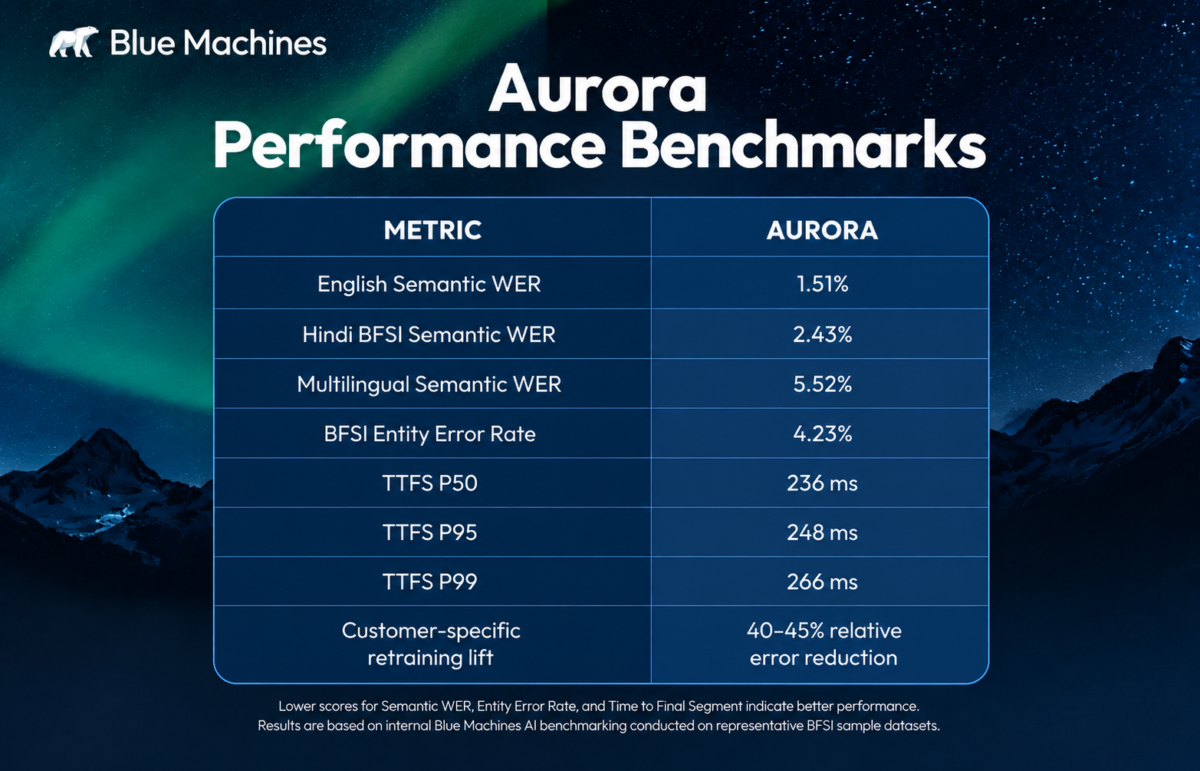
Internal benchmarking on representative BFSI sample datasets showed that Aurora achieved a Semantic Word Error Rate (WER) of 1.51% for English, 2.43% for Hindi BFSI conversations, and 5.52% across multilingual speech. It also recorded a BFSI Entity Error Rate of 4.23% for information such as monetary amounts, interest rates, policy numbers, account references and transaction IDs.

Aurora was evaluated against leading speech-to-text models using consistent audio inputs and scoring methodology. Blue Machines AI’s internal evaluation showed that Aurora delivers higher accuracy at lower latency and is purpose-built for streaming, real-time BFSI conversations.


The datasets covered banking, lending, insurance, collections and customer-servicing conversations. They included Indian English, Hindi, Hinglish, multilingual and code-mixed speech, regional pronunciation patterns, background noise and telephony audio.


Unlike general-purpose speech-to-text models, Aurora is trained to understand BFSI vocabulary such as EMIs, outstanding amounts, foreclosure charges, disbursals, KYC, premiums, SIPs, NAVs, policy numbers, transaction IDs and payment dates. It is also designed to recognise the numbers, currencies, percentages and financial identifiers that drive downstream workflows.


“Aurora reflects our commitment to building sovereign AI infrastructure for Indian enterprises,” said Nirmit Parikh, Founder and CEO, Blue Machines AI. “India’s financial conversations do not happen in a single language or follow a standard script. When AI misunderstands an EMI amount, policy number or repayment commitment, it can change the customer outcome. By building Aurora in India, we are giving financial institutions speech intelligence designed for how their customers naturally communicate, while ensuring greater control over their data, models and customer interactions.”


“Building speech intelligence for BFSI requires more than generic transcription,” said Abhishek Ranjan, Chief Technology Officer at Blue Machines AI. “Aurora’s cache-aware FastConformer encoder and streaming transducer decoder enable it to retain context while processing speech incrementally. The model has been optimized for multilingual and code-mixed speech, low-latency inference and high-concurrency environments. Crucially, it is evaluated on its ability to accurately recognize the entities that drive financial workflows, not merely the surrounding sentences. In internal throughput tests, Aurora supported 960 concurrent real-time streams per H100 at a 320 ms operating point and 2,400 concurrent streams per H100 at a 1.12-second operating point.”


Blue Machines AI has also built custom training pipelines that allow Aurora to be adapted using customer-authorised enterprise data. This enables the model to learn an institution’s proprietary product names, terminology, geographies, accents and interaction patterns. Internal evaluations showed that customer-specific retraining can deliver a 40–45% relative reduction in recognition errors compared with the base model on institution-specific datasets.


Aurora integrates with Blue Machines AI’s enterprise CX AI platform to support customer journeys across acquisition, onboarding, lending, collections, servicing, insurance, claims and customer support. It can be deployed on a managed cloud, within an enterprise VPC or on-premises, enabling financial institutions to align implementations with their security, data residency and governance requirements.

Chat with CIONow.in