




High-Capacity DDoS Attacks Surge 1,286% in 1H 2026:NETSCOUT Research

NETSCOUT SYSTEMS, INC.  released its first half 2026 Distributed Denial-of-Service (DDoS) Threat Intelligence Report, revealing a significant shift in how attacks are launched and sourced. With more than 9.1 million DDoS attacks recorded globally by NETSCOUT between January and June 2026, the report highlights that DDoS risk is growing along three axes: the volume of traffic that must be inspected, the number of places where mitigation must be deployed, and the share of attacks that disrupt service without ever saturating a link.

“The 1,286% rise in attacks clearing 1Tbps or 1Gpps means high-capacity events are no longer anomalies; they are routine,” stated Hardik Modi, VP Engineering, DDoS Solutions, and ASERT Threat Intelligence Team, NETSCOUT. “With the proliferation of residential proxies and short, rate-based attacks from DDoS-for-hire platforms, traditional coarse network controls are insufficient. Providers and enterprises alike need finer-grained, selective mitigation and increased scrubbing capacity at network edges to combat these qualitative shifts in attack sophistication.”

Key findings include:

  • Massive Attacks on a Global Scale – NETSCOUT ATLAS recorded more than 9.1 million DDoS attacks across 209 countries and territories, underscoring the expanding operational risk to enterprises and providers.
  • Surge in High-Impact Capacity – Attacks exceeding 1Tbps or 1Gpps increased 1,286% year over year, suggesting defenders must continue to prepare for greater attack intensity.
  • IPv6 crossed the terabit threshold – NETSCOUT observed its first IPv6 attack exceeding 1Tbps, while active mitigation of IPv6 attacks rose by more than 300% year over year even as IPv6’s share of attacks remained roughly flat, illustrating the need for robust IPv6 protection.
  • Pressure on Carrier Mitigation – Direct-path methods accounted for 64% of observed attacks and gained share for a third consecutive half-year, while carpet-bombing grew from 3.97% to 4.54% of attacks, and outbound attacks clearing 1Tbps/1Gpps caused operational impacts. Dedicated mitigation capacity remains the selective layer that providers need to intelligently filter malicious traffic.
  • DDoS for Hire and Attack Economics – Attacks lasting one minute or less have roughly doubled as a share since 2H 2023, stressing connection tables, application backends, and resolvers, suggesting DDoS-for-hire platforms are shortening the path to attack.
  • Residential Proxy Supply Chain – by pairing residential proxy network tracking with DDoS telemetry, NETSCOUT ASERT identified residential proxy sources participating in DDoS attacks, highlighting that attack traffic can originate from harder-to-distinguish consumer IP addresses.

NETSCOUT maps the DDoS landscape through passive, active, and reactive vantage points, providing unparalleled visibility into global attack trends. For more than 15 years, NETSCOUT has delivered trusted, consistent DDoS Intelligence based exclusively on directly observed, verifiable attack traffic. NETSCOUT does not aggregate multiple alerts or geographically distributed events into composite peak values, which ensures accuracy, repeatability, and true comparability across reporting periods. Peak metrics reflect single-second maximum bits-per-second (bps) and packets-per-second (pps) rates measured at defined mitigation and monitoring points.

From Verified DDoS Intelligence to Layered Protection

NETSCOUT protects two-thirds of the routed IPv4 space, securing network edges that carried global peak traffic of over 800 Tbps. It monitors tens of thousands of daily DDoS attacks by tracking multiple botnets and DDoS-for-hire services that leverage millions of abused or compromised devices. NETSCOUT ARBOR Cloud, backed by ATLAS visibility and dedicated DDoS mitigation capacity, complements on-premises defenses and helps organizations absorb large, distributed attacks before they overwhelm critical services.

These findings show why DDoS resilience now depends on more than stopping the largest attack. Organizations need to recognize changing attack sources and methods, mitigate both inbound and outbound attacks, apply precise protection where services are exposed, and draw on cloud capacity when attacks exceed local defenses. NETSCOUT combines directly observed ATLAS intelligence with on-premises and cloud-delivered mitigation to help customers protect service availability and sustain the digital operations their businesses depend on.

Colt DCS and RMZ Begin Construction of Third Data Centre in Mumbai to Support Growing AI Demand

Colt Data Centre Services (Colt DCS), a global provider of AI-ready, hyperscale and large enterprise data centres, and RMZ, India’s largest privately owned real assets platform, today announced the commencement of construction of its third data centre in the city (Mumbai 3), an AI-ready facility located at the operator’s Navi Mumbai Campus that will deliver 64MW upon completion.

Mumbai 3 is being developed as part of Colt DCS and RMZ’s joint venture (JV), announced in 2024, to invest $1.7 billion in the Indian data centre market. Ground preparation began in December 2025, and construction is now underway following the signing of the facility’s first hyperscale customer. This development is a milestone reflecting the pace at which the venture has scaled just within 18 months of signing.

“The nature of data centre demand is evolving rapidly, with customers requiring larger deployments, higher rack densities and infrastructure capable of supporting increasingly intensive AI workloads. Mumbai 3 is designed to address these needs, further strengthening our Navi Mumbai Campus as a scalable and future-ready digital infrastructure platform. Built with AI readiness at its core, the facility incorporates advanced cooling capabilities, including liquid cooling and enhanced power infrastructure to support high-density deployments. This enables customers to efficiently scale next-generation AI and high-performance computing workloads while maintaining operational resilience and efficiency,” said Pratap Mane, Country Head DCS, India.

“The next wave of digital growth will be driven by infrastructure that brings together scale, resilience, and speed to market. At Mumbai 3, we are developing a future-ready campus designed to enable hyperscalers and neo-cloud providers to scale seamlessly as their capacity and computing needs evolve. This investment reinforces our commitment to building advanced data centre and AI infrastructure that meets global standards and supports the rapidly evolving demands of the digital economy,” said Deepak Chhabria, President, RMZ Digital Infrastructure.

Mumbai 3 responds to growing demand for AI-ready data centre capacity in the region, where the rapid adoption of AI is driving requirements for larger deployments, higher rack densities and greater power capacity. With the data centre fully pre-let, the project will deliver critical AI-ready capacity to the Mumbai market while reinforcing Colt DCS and RMZ’s commitment to India’s growing digital infrastructure.

Mumbai 3 will join existing data centres Mumbai 1 and Mumbai 2 at the Navi Mumbai Campus, which currently supports large enterprise and cloud workloads. The campus has the potential to deliver up to 148MW of capacity at full development and, upon completion, Mumbai 3 will increase the site’s operational capacity to 86MW.

Built for AI Deployments

Mumbai 3 has been designed to support AI workloads and high-density compute deployments, delivering 64MW of secured contracted power, supported by a hybrid cooling architecture that combines traditional air cooling with direct liquid-to-chip cooling. The facility will also benefit from a 220kV GIS substation located on campus, providing high levels of resilience and scalability, alongside carrier-neutral connectivity with access to high-capacity fibre routes.

Sustainable by Design, Creating Local Opportunity

Sustainability and long-term community impact have been central considerations in the development of Mumbai 3. The facility will operate using 100% renewable energy and has been designed with a closed-loop cooling system, enabling near-zero wastewater from the cooling process. In addition to its environmental credentials, the project is expected to create more than 700 jobs across construction and operations, while supporting local suppliers, contractors, and service providers. These initiatives reflect Colt DCS and RMZ’s shared commitment to delivering sustainable digital infrastructure that creates lasting value for local communities and the wider region.

As part of the JV, both organisations have committed to develop 250MW of data centre capacity across Mumbai and Chennai.  The partnership brings together Colt DCS’ global data centre expertise with RMZ’s over two decades of experience in developing, owning and operating high-quality infrastructure in the Indian market.

The AI Compass: Navigating Industry 5.0 with Blue Star’s CIO

In the industrial world, data has become the ultimate compass as it provides business the right direction through AI and ML (Machine Learning). However, moving AI and ML from mere lab experiments to core shop floor reality is an extremely difficult challenge. 

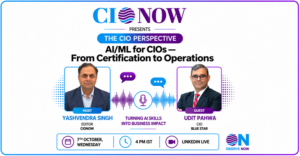
In an interaction with CIONOW, Udit Pahwa, CIO at Blue Star, outlines frameworks for moving beyond experimentation toward scalable business value.  

Where do you see the most meaningful AI/ML opportunities for a manufacturing company like Blue Star today?

In manufacturing, there are plenty of AI/ML opportunities, such as predictive maintenance, R&D research, etc. In predictive maintenance, when there are connected shop floors, lots of data points get collected via signals, SCADA, etc. Putting this data into deep learning and machine learning models, and then building predictive models to identify whether any anomaly is developing on the production line in terms of machine health is where predictive maintenance of machines becomes very relevant. I think a lot of my peers in the manufacturing industry are leveraging this today.

In R&D research, product lifecycle management is complex, and earlier it was driven more by heavy human engineering. This is where AI steps in to design shape-based search. Humans might do data duplication, but with AI, it will not happen. 

For us at Bluestar, we are exploring Vision AI for our service operations. For example, when our customer site breaks down, we get AI onto the video call to observe and comment to identify the quality of installation. 

How far along are Indian manufacturing companies on the path to Industry 5.0? What should CIOs concentrate on next, and how far have they come? 

The Indian industry is on 5.0; I think it’s still in nascent stages. We can’t even claim that we are on the maturity side of 4.0. Many industrial houses today, especially in the MSME sector, are completely averse to 4.0 implementation. Large houses, large companies, etc., have adopted 4.0 and are looking at 5.0, so we are somewhere in the midst of achieving maturity on 4.0 and running, you know, initial trials, learnings, etc. with 5.0.

When you are evaluating multiple AI opportunities, what criteria do you use to decide which use cases should be pursued first?

There are three simple logics. First, is this going to solve the genuine business pain points? Second, if it will solve it, what will be the cost? Third, will it create a unique competitive advantage or USP for the organization?  Broadly, these are the three filter criteria that we apply in assessing a use case to be taken up. 

How can a CIO assess and communicate the ROI of tech investments to upper management, particularly when the advantages are difficult to measure?

I treat ROI parameters as accounting. To measure ROI, the company must consider the cost of each quotation before and after the improvement. If one can produce more quotations at the same cost, it will surely cost less per quotation. Therefore, companies must translate every improvement into financial value, and this helps in measuring the actual return on technology investments. 

Could you share an IT initiative that has moved beyond experimentation and delivered a tangible impact in business for you? Any specific project that comes to your mind that has actually delivered tangible ROI? 

Our company had a large tender business where important data, such as deadlines, penalties, and technical requirements, used to take days to review.

With the help of the startup partner, we developed an AI solution to speed up this review procedure and build a multilingual tool trained on five years of our past tender data. This way, teams were capable of asking queries related to tenders in their preferred language with a voice interface, irrespective of the language of the original documents.

How do you integrate AI into existing enterprise and operational systems such as ERP and manufacturing execution systems and other plant flow technologies without disrupting established processes?

Existing ERPs and CRMs, are themselves coming out with their AI and ML models. Each one of them is offering what we call agentic AI or Gen AI kind of interfaces. So, one can consider adopting the AI offerings because they come from the very same OEM from which we are using the ERP or CRM. We develop our own model through a data interface where we take the data from the respective ERP or CRM and then use that for training and allow our models to use that data and deliver whatever is expected.

There could be times when the OEM’s product is not too mature, and you might have to actually take it from a third party. So it’s all a play of the data that we pull from the respective ERPs and CRMs.

As AI becomes embedded in operations, what changes are required in the IT organization’s workforce skills and collaboration between IT and business teams?

The tech professionals frequently employ specialized jargon that is not widely understood. We must convey ideas simply so that each and everyone in the company can align with the goals of the programs. 

On the technical part, a basic knowledge of Python is helpful for running queries and working directly with data, as AI relies on the right data to get relevant results; a solid foundation of data models and datasets is equally crucial. 

What safeguards are necessary to ensure AI models remain reliable, secure, and accountable once they are making or supporting operational decisions? 

The very first safety measure one can take is to do scrutinize AI model’s outputs regularly, as the data, sales patterns, or seasonal trends keep on changing, which can affect results. We should monitor the data being fed into the model and clearly define who is responsible for its outcomes. Thus, human oversight becomes very crucial until the AI model is mature enough to work independently. There is one principle of Zero Trust in cybersecurity: ‘Trust, but Verify’.

We can definitely trust AI outputs, but a human must verify them. Even as the model matures, regular checks and safeguards are a must to identify and flag any anomalies. 

What other technological factors should CIOs take into account before deploying AI, other than having the appropriate data in place? 

From a tech perspective, CIOs can start experimenting with a very small base. There is no need to go ahead and buy a huge appliance, which will require a huge capex investment. But you can have a very small VM spun off only for experimentation. Always start with only one GPU, for example, and try to run some models on it. Try and scale some data sets on it, and see what is the outcome. So start small and build on it.

Shunya Labs bets on Smaller AI Models to make Enterprise Voice AI more efficient

Indian voice AI company, Shunya Labs is developing smaller, specialised AI models to make enterprise voice applications more efficient, reduce processing requirements and enable deployment closer to where data is generated. Its technology combines speech recognition, voice generation, translation and structured enterprise knowledge across cloud, edge and on-device environments, including offline Hindi speech recognition.

As businesses move AI initiatives from experimentation to production, they face growing concerns around processing costs, data privacy, reliability and infrastructure. Shunya Labs aims to address these challenges by using specialised models for defined tasks rather than relying on large, general-purpose AI models for every interaction.

Four layers, one AI foundation

Shunya Labs’ technology comprises four interconnected layers. Its voice layer supports speech recognition, generation and translation, including accents, hesitations and multilingual conversations. The understanding layer interprets customer queries through a shared processing framework, reducing the need for repeated AI processing.

The knowledge layer organises enterprise information including customers, products, business rules and relationships into knowledge graphs. These enable systems to retrieve relevant information through defined connections and provide traceable answers. The delivery layer determines how queries are routed, checked and processed, and where the AI system operates.

The company believes this integrated approach can improve efficiency, security and operational control while helping enterprises deploy AI at scale.

Knowledge graphs and measurable accuracy

A key element of the platform is its use of knowledge graphs to structure enterprise information and connect data points, business rules and relationships. Instead of relying solely on a model’s ability to generate responses, the system retrieves information through defined connections, making the reasoning path easier to trace.

According to Shunya Labs’ internal evaluation, answer correctness increased from 62.7% with the AI model enabled to 92.1% when the same enterprise knowledge was structured as a knowledge graph. Enabling the AI model, by comparison, improved correctness from 59.9% to 62.7%.

The evaluation was largely based on synthetic data and represents the company’s internal findings, not an independent benchmark. 

Reducing processing requirements and improving control

The platform routes routine queries to smaller, specialised models while reserving larger models for tasks requiring more advanced reasoning. Its delivery layer incorporates routing rules, safeguards to restrict access to relevant customer information, and internal evaluation checks before responses are released.

The architecture supports deployment in the cloud, on customer premises, at the edge, in disconnected environments and within mobile applications, including on standard processors without specialised AI hardware.

Based on its internal estimates, Shunya Labs says approximately 85% of queries handled by its system can be processed without invoking a large AI model. The company also estimates that its approach can require roughly 240 times less AI processing than its conventional design. These figures depend on the tasks, architecture and comparison methodology.

The Stanford AI Index Report 2025 reported that the inference cost of a system performing at a level comparable to GPT-3.5 declined by more than 280 times between November 2022 and October 2024, highlighting the wider industry’s shift towards more cost-efficient AI.

Bringing voice AI closer to users

Shunya Labs’ voice technology covers 55 Indian languages, supporting code-switching between each language and English, as well as 22 East and Southeast Asian languages. Its Radiance Universal model can detect and speak 216 languages.

Its Hindi speech recognition model is designed to run on smartphones without an internet connection, while compact text-to-speech models are being developed for on-device use in six languages. Additional capabilities include voice activity detection, speaker diarization, noise cancellation and accent conversion.

The company sees potential applications across banking and financial services, insurance, healthcare, telecommunications and customer support, where voice interfaces can help customers access information and complete workflows in their preferred languages.

Leadership perspectives

“The next phase of enterprise AI will depend on how effectively businesses connect intelligence with their own knowledge, rules and operating environments. Not every question requires a large AI model. We build voice, understanding, knowledge and delivery as one foundation, and delivery is the layer that decides whether an AI system survives contact with production. By combining specialised models with structured enterprise knowledge and flexible deployment options, businesses can explore AI systems that are more efficient and better suited to their operational requirements,” said Ritu Mehrotra, Co-founder and CEO of Shunya Labs.

Shunya Labs continues to develop voice, language and knowledge technologies focused on efficient processing, multilingual interactions and flexible deployment, enabling organisations to retain greater control over their data and infrastructure.

“Most of the accuracy we measured did not come from a bigger model. It came from how we represented the knowledge. Switching the AI model on moved correct answers by about three points. Organising the same information as a knowledge graph moved them by close to thirty. The information was there all along; what changed was whether the system could reach it. We also publish where our own measurements stop holding, because a number is only useful if you know how it was obtained,” said Sourav Bandyopadhyay, Co-founder and Chief Scientist of Shunya Labs.

NTT DATA integrates Niveus Solutions under NTT DATA brand

NTT DATA is progressing with the integration of Niveus Solutions, following the acquisition of the cloud engineering company in February 2025. As part of this progression, the Niveus brand will transition to the NTT DATA brand in October 2026, and the Niveus brand will start to be retired in the external market.

The brand transition represents an important milestone in the integration journey, creating a unified market presence while operational integration continues over time. Clients, partners, and stakeholders will continue to benefit from the same expertise, talent and innovation capabilities that have distinguished Niveus in the market, now strengthened by the breadth and scale of NTT DATA.

The integration supports NTT DATA’s mission to strengthen its cloud, AI, and Google Cloud proposition, enhancing its ability to help organizations accelerate digital transformation and innovation across industries and markets.

Salesforce’s AI Pricing Trap: Why the New ‘Bundled’ Model Costs More Than You Think

Salesforce has stopped selling AI as an add-on and started baking it into every license. On the surface, it looks like a gift: Agentforce, Slack, Tableau, and Premier Support now come standard, along with a pool of “Flex Credits” to fuel your AI ambitions. But look closer, and the math tells a different story. The new Core, Advanced, and Max tiers aren’t designed for production-scale AI. They are designed for pilots. A single data-unification job can burn through your entire annual credit allowance in one run, and overage charges have no cap.

In this exclusive interview with CIONOW, Dr. Joseph Sweeney, Advisor, IBRS, an Australian ICT and digital advisory firm, decodes the real cost of Salesforce’s new model, explain why 78% of IT leaders are already facing unexpected AI bills, and offers a three-step formula for CIOs to model total cost of ownership without getting burned.

How would you explain, in simple terms, the shift from the old Enterprise/Unlimited + AI add-on model to the new Core/Advanced/Max bundles, and why Salesforce chose this structure now?

Salesforce, like most of the major core systems vendors, has stopped selling AI as an optional extra and started selling integral to the product. Why? Because AI is not, despite the hype, selling itself.  Agentforce is still used by only a fraction of Salesforce’s 150,000-plus customer base, its stock was down 22 per cent for the year before its August earnings.
IBRS has long predicted that AI would quickly be subsumed into process within core systems, becoming ‘invisible’ over time. Witt he new licensing, every Salesforce edition now ships with Agentforce, Slack, Tableau and Premier Support inside the box, with a pool of AI credits as the meter.
The price rose 11 to 13 per cent on the tiers most customers actually use, while the top tier, the one almost nobody had bought, got far more generous at the same price.

In short, Salesforece is using AI is a licensing packaging lever to pull the customer base upward. This is also an effort to boost Agentforce adoption as the default AI platform within it ecosystem, rather than a separate buying decision. Folding security and analytics into every tier partly addresses data readiness and governance objections most often blamed for slow AI adoption.

Based on what you have seen, how were the Flex Credit allowances per tier (e.g., 500,000 for Core, up to 2.75 million for Max) likely calculated? Are they sized for pilot/POC usage or for real production AI at scale?

The Salesforces allowances are sized for a pilot, not production. Core’s 500,000 credits equal about 25,000 standard agent actions a year. In a 200-seat organization, that is roughly one agent conversation per user per month. Nobody builds an agentic enterprise on one conversation a month. These are tasting portions, and they are deliberately so: the allowance gets every customer started, and the meter gets Salesforce paid the moment usage becomes real.

The credit values at list price (US\$2,500 for Core, US\$5,000 for Advanced, US\$13,750 for Max) are immaterial against the seat price uplift, which confirms they function as an adoption incentive rather than a production capacity commitment.

Is the claim credible that a single large Data 360 or data-unification job can burn through a tier’s entire annual Flex Credit allowance in one run? Have you seen customer examples that support or contradict this?

Yes, this is credible, and the arithmetic is on Salesforce’s own rate card. Data 360 unification is billed at 75,000 credits per million rows processed at the base tier. Core’s entire annual allowance is 500,000 credits. So a single unification run over roughly seven million rows consumes the credit allocation in one job.

A 100-million-row customer estate, unremarkable for a large enterprise, would burn through Core’s allowance about fifteen times over and Max’s nearly three times. No customer has publicly confirmed such a bill yet, but the rate card makes the outcome a matter of multiplication, not speculation.

One nuance worth noting: monthly tier thresholds make a single concentrated backfill cheaper per credit than spreading the same work across months, so how the job is scheduled matters as much as its size.

From a buyer’s perspective, how should a CIO model total cost of ownership now: base license + expected overage credits + bundled features they may never use? What’s a realistic range for AI overage costs in year one?

Model it in three layers.

First, the seat price, and be honest about the 11 to 13 per cent uplift if you are not already a Slack, Tableau and Premier Support buyer. These are services you previously did not need, so you are paying an uplift for products that, in theory, you still don’t need.  The challenge now is to discover new business benefits and value from these included offerings.
Second, instrument real consumption for a quarter before renewal. Pull your agent actions and Data 360 processing from Digital Wallet and annualize them, because credits are pooled per organization, not per seat, and most buyers misread that.

Third, sweat the assets you already own. Treat bundled products that duplicate them as zero value, not as savings. On overage: there is no cap and no circuit breaker, so consumption above the pool bills at your contracted rate. Organizations running agents in production should budget overage at 50 to 150 per cent of the included credit value in year one. Anything with heavy Data 360 unification or real-time workloads can exceed that in a single month.

A a side note,  78 per cent of IT leaders report unexpected charges from consumption-based AI pricing, and consumption models are overshooting budgets by around 40 per cent on average versus roughly 5 per cent for seat-based licenses.

How do you expect this pricing model to influence CIO behavior: more conservative AI rollouts, shift to alternative platforms, or deeper negotiation around credits and tiers at renewal?

All three, in that order of likelihood. The near-term effect is quieter, more carefully metered rollouts. Salesforce clients will gate agent deployments behind consumption dashboards rather than ambition. The strategic effect lands at renewal, where credits, overage rates and unmetered tiers become the negotiation surface, and Salesforce has already signalled it will deal. The Agentic Enterprise License Agreement, a fixed-price all-you-can-eat contract, exists precisely to take consumption risk off the table for customers who push. Platform switching is the least likely response as the switching cost of CRM dwarfs a 13 per cent price rise, and every rival is moving the same direction.

My key recommendation: The CIOs who win will be the ones who arrive at renewal with their own consumption data rather than Salesforce’s.

In the broader context of 2026 SaaS pricing, is this more like Microsoft Copilot bundling, Atlassian’s usage-based AI meters, or something unique to Salesforce? What pattern should CIOs watch for next?

It is not just Microsoft doing this sort of bundling of AI (and there is more to come from them in November!).  It is a trend right across all major platforms. Atlassian, Canva, Oracle, Google with Workspaces… this is the future.

Securonix Introduces Advanced Behavioral Analytics to Detect Human and AI-Driven Threats

Securonix, Inc., today introduced Securonix Advanced Behavioral Analytics (ABA), a new capability that helps security teams identify, at machine speed, activity that is technically permitted but operationally abnormal. ABA features Agent and Entity Behavior Analytics (AEBA), which identifies when an enterprise AI agent uses an unexpected tool, accesses data outside its purpose, or changes its operating pattern. It connects those changes with identity, authority, data use, asset sensitivity, timing, and threat context, helping analysts understand what changed, why it matters and what to do next.

Compromised accounts, insider activity and AI agents can resemble legitimate behavior when events are reviewed in isolation. Advanced Behavioral Analytics combines AEBA with User and Entity Behavior Analytics (UEBA), which connects unusual login times, rising data access and contact with sensitive assets across systems and time. Together, AEBA and UEBA help analysts investigate developing risk instead of isolated alerts and carry context through detection, investigation, case management and governed response. Policies, approvals and audit records remain visible and enforceable throughout the process.

“AI is compressing the time between initial access and business impact, while security leaders remain accountable for the decisions made under that pressure,” said Toby Weiss, Chief Executive Officer of Securonix. “Securonix Advanced Behavioral Analytics helps analysts identify meaningful behavioral change earlier and gives them clear control over how AI supports the response. Consequential response actions remain subject to human approval.”

Detect AI-Accelerated Attacks and Govern the Response

Traditional SIEM platforms were built to collect and correlate human and machine activity before enterprise AI agents became part of the attack surface. Securonix extends behavioral baselines and risk detection across users, identities, assets, applications, cloud environments and AI agents. It correlates signals across systems and time to surface compromised identities, unusual access, privilege misuse, sensitive data exposure and abnormal agent activity. An expanding catalog of AI-threat policies helps teams detect established attack techniques such as AI compresses reconnaissance, exploit development, privilege escalation and data movement.

Sam, the AI SOC Analyst, executes repeatable Tier 1 and Tier 2 work across triage, investigation, evidence collection and case creation. The Agentic Mesh coordinates AI-supported workflows, while Agentic Guardrails keep actions policy-bound, visible and auditable. Analysts review and approve consequential response actions. By completing repeatable work, Sam helps security teams absorb growing alert volumes and expand SOC capacity without requiring linear growth in headcount.

For authorized insider-risk investigations, the Securonix Insider Intent Agent adds contextual and corroborating evidence while preserving competing explanations. Analysts review each signal as part of the broader evidence rather than treating a message, search or behavioral deviation as proof of intent.

“In a managed SOC, the hardest part isn’t writing detection rules. It’s understanding each customer’s environment well enough to separate real threats from normal activity. That becomes even harder in cloud and Infrastructure-as-Code environments, where workloads appear and disappear and identities constantly change.” said Darren Humphries, Group CISO, Acora. “Securonix Threat Analytics builds that behavioral baseline automatically, then uses risk scoring and evidence boards to show our analysts what matters and why. For Acora’s customers, that means fewer false positives, faster investigations and quicker containment, without losing the customer context that makes detection effective.”

New Research Supports Critical Need For AI Governance Pressure

Securonix research found increased AI investment alongside continued questions about governance, trust and human accountability. For The Evolution of Cybersecurity Automation: Towards the AI-Governed SOC, Securonix surveyed 1,000 global cybersecurity professionals during summer 2026.

Survey findings show that cybersecurity teams want automation and AI to advance work inside clear approval boundaries. In the survey, 96% of respondents said cybersecurity automation is important to their organization, 49% said they use AI in behavioral analytics with human approval and 99.6% said their organization had increased its budget for AI in cybersecurity automation during the past year.

Investment has moved past experimentation. Security teams want AI to advance the work inside clear approval boundaries, with evidence they can explain and outcomes they can defend. The full report and methodology will be available in November.

Independent Assurance for Governed AI

Securonix has also achieved ISO/IEC 42001:2023 certification, the world’s first AI management system standard. The certification covers the management system used to govern AI across the Securonix product portfolio, including ThreatQ, and follows an external audit with no major findings. It provides independent validation of accountability, AI risk management and human oversight and can support customer due diligence across security, procurement and AI governance reviews. The certificate is available through the Securonix Trust Center.

BlueHands.ai By Trinetra Labs Takes AI Creation Beyond Tech Hubs and Into Everyday Business

BlueHands.ai by Trinetra Labs was today officially unveiled as an AI-powered creation and business automation ecosystem designed to help people turn ideas into working software, AI agents, and real business solutions. The innovative platform aims to make building technology more accessible, transcending developers, technology companies and large enterprises to founders, small businesses, local entrepreneurs, students and first-time builders.

The launch comes at a pivotal moment and intends to bridge a noticeable gap that the AI boom has left in its wake. Today, AI has made software dramatically easier to build, yet the gains have gathered at the top of the market, among developers, technology professionals, startups and corporate teams. But below that layer sits a far bigger crowd with sharp ideas and real problems to solve and a stubborn belief that technology belongs to someone else, someone with a developer on call, an agency on retainer, or a large budget. BlueHands.ai aims to shatter that belief by extending the ability to build beyond the existing technology bubble and integrating it into the mainstream.

The platform brings four connected parts under one roof. BlueHands Build creates websites, applications, internal tools, and custom software using AI. BlueHands Agents sets up AI agents that handle everyday business tasks across web, email, WhatsApp, voice, and CRM. BlueHands Expert puts product managers, designers, developers and other specialists on a project, whether users want guidance along the way or want the whole job done for them. BlueHands Marketplace gives eligible apps, agents, templates and automations a place to be published and used by others. Together they cover the full path from first idea to finished product and, where it fits, to a wider audience.

Out on the ground, the change is easy to see. A shopkeeper builds a website for the shop. A tuition teacher sets up a simple system for her classes. A student turns an idea into an app. A small business automates its daily work without hiring technical staff. BlueHands.ai carries this beyond major cities and startup hubs, into smaller cities, towns, colleges, schools and local markets.

Mr Ravi, Founder of Trinetra Labs, said, “Our ambition with BlueHands.ai goes beyond making software development faster. We want to make building technology accessible to people who have great ideas but have never had the technical resources to bring them to life. Over time, our focus is to take BlueHands beyond traditional tech communities and into everyday businesses, smaller cities and the hands of first-time builders”

To this, Mr Himanshu Dixit, Director, Trinetra Labs also added “With BlueHands.ai, our technical focus is on bringing software development, AI agents, automation and cloud infrastructure into one connected ecosystem. We are building an AI-native architecture using LLMs, multi-agent orchestration, MCP-based integrations, vector databases, APIs, containerized workloads, Kubernetes and cloud-native infrastructure. Users can move from an idea to a working full-stack product, connect databases, AI models and business tools, and deploy scalable workflows. Our goal is to simplify sophisticated software and AI engineering while maintaining reliability, security, observability, flexibility and developer control”

Beneath the simple surface, the platform carries what real business use demands. Hystersis gives it persistent memory that respects permissions, while links to business systems and APIs, flexible deployment, human support when needed and strong controls over access and data keep every build dependable as it grows.

The launch gives shape to the company’s vision behind BlueHands.ai, which is to make building accessible to everyone. Its mission is just as clear, to put software creation and AI execution within reach of every business, from the neighbourhood shop to the growing enterprise. Trinetra Labs stands committed to that mission, and BlueHands.ai is where it becomes a product anyone can use. With BlueHands.ai, users can ensure that no idea stays on the shelf because they never learned to code.

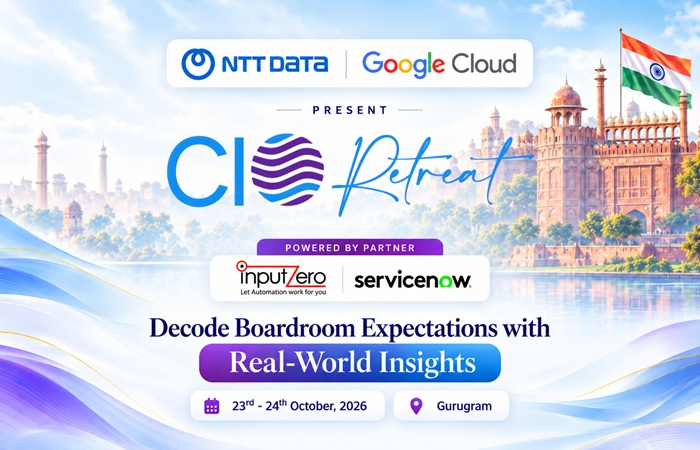
The Unwritten Rules of the Boardroom: Inside the Exclusive CIO Retreat

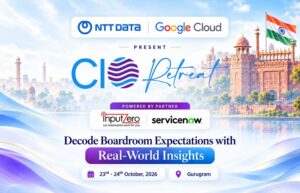
CIONOW, the actionable intelligence media platform for CIOs and a part of ObserveNow, is convening an exclusive, invite-only residential retreat for 50 of India’s top enterprise technology leaders. The CIO Retreat is centered on a theme that rarely makes it into public forums: The Unwritten Rules of the Boardroom.

On one hand, CIOs enable the business and grow its capabilities but on the other hand, walking into the strategy meeting is an uphill struggle, and even the finest technology roadmap is no match for an audience obsessed with cost and risk, with each digital initiative judged in the C-suite as only a capital expenditure.

Ultimately, this is not a technology challenge-it is a translation challenge. This two-day residential retreat, scheduled for October 23–24 in Gurugram, is designed to address exactly this gap. The CIO Retreat aims to shift technology leaders from a mindset of ‘managing systems’ to one of ‘advising on enterprise value.’

A carefully selected group of 50 senior CIOs will attend the retreat to decode the unconscious behaviors, language, and politics of the apex of all corporate leadership.

Through panel discussions, the Retreat will show that the biggest challenge to selling the next big idea isn’t creating an impeccable slide deck, but rather getting stakeholders to buy in to the idea in the hallway beforehand.

In these sessions, enterprise technology decision-makers will learn how to get buy-in from non-technical colleagues, translate technical strategies into financial language that resonates most with CEOs, and how to work with the individual personalities of the C-suite to develop strategic alliances that are imperative to success.

The Benefits for CIOs

Compared to a mega-conference, this C-level gathering of 50 peers promises to provide a safe space and head-clearing forum to share the political and behavioral challenges their peers only talk about behind closed doors.

This is the moment to benchmark your own boardroom practices against industry best practice, and tap into off-the-record advice on managing downward pressure, and develop a supportive network of confidants.

There are sufficient breaks with wellness and engaging activities built into this residential event. For CIOs this is a great opportunity to become a part of a compelling conversation around future enterprise governance and establish thought leadership in a forum of trust and relevance.

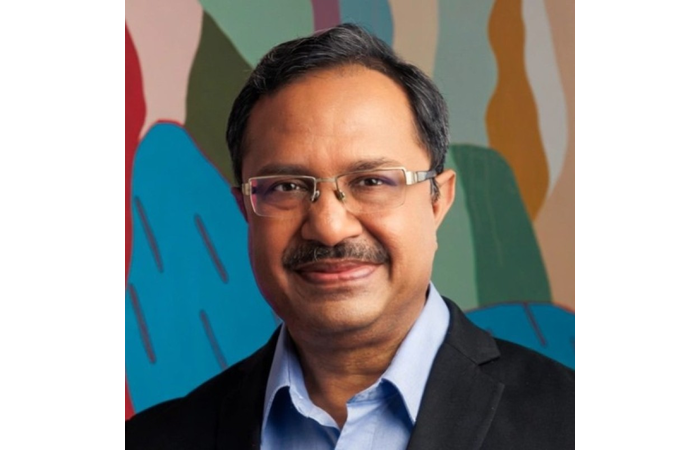
Ravi Garg to Lead Meta’s APAC Enterprise Business 

Earlier, Ravi Garg worked as Country Director, Business Messaging & Payments for WhatsApp India for 5 years. Announcing the move on LinkedIn, Garg said he was “deeply grateful for the opportunity to lead this new business for one of Meta’s largest regions.” 

Garg’s new role comes as Meta seeks to expand its enterprise business across the APAC region, with a focus on business messaging and AI-powered solutions. His responsibilities will include driving the adoption of offerings such as WhatsApp Business Messaging, Meta Business Agents and Muse APIs among businesses.

Before joining WhatsApp, Garg spent 13 years at Microsoft in roles spanning sales, strategy, business planning, and channel management. He has also served as Chief Operating Officer at Nazara Technologies and held a general management role at Sify.

Garg’s expanded role brings his experience in business messaging, enterprise technology, and market development to Meta’s regional operations, as the company works to grow its enterprise offerings across Asia-Pacific.

Chat with CIONow.in