Ravi Garg to Lead Meta’s APAC Enterprise Business 

Earlier, Ravi Garg worked as Country Director, Business Messaging & Payments for WhatsApp India for 5 years. Announcing the move on LinkedIn, Garg said he was “deeply grateful for the opportunity to lead this new business for one of Meta’s largest regions.” 

Garg’s new role comes as Meta seeks to expand its enterprise business across the APAC region, with a focus on business messaging and AI-powered solutions. His responsibilities will include driving the adoption of offerings such as WhatsApp Business Messaging, Meta Business Agents and Muse APIs among businesses.

Before joining WhatsApp, Garg spent 13 years at Microsoft in roles spanning sales, strategy, business planning, and channel management. He has also served as Chief Operating Officer at Nazara Technologies and held a general management role at Sify.

Garg’s expanded role brings his experience in business messaging, enterprise technology, and market development to Meta’s regional operations, as the company works to grow its enterprise offerings across Asia-Pacific.

Moët Hennessy, Analog Devices and UC Davis Join Forces to Advance Wine Production Via AI

Moët Hennessy, the wine and spirits division of LVMH, Analog Devices, Inc. (ADI), a global semiconductor leader, and the University of California, Davis, a world-renowned leading research university, today announced a groundbreaking joint effort to deploy a new generation of technology aimed at enhancing wine quality and supporting the long-term vitality of vineyards.

The collaboration builds on a breakthrough technology that has its roots in early research at the Massachusetts Institute of Technology (MIT). Today, ADI continues to advance this technology platform for analyzing chemical signatures across a broad range of applications and, together with teams from Moët Hennessy and UC Davis, is exploring its use in viticulture and winemaking. The joint effort aims to detect and interpret volatile chemical signatures emitted by grapevines, juice, and wine, giving viticulture and winemaking teams much earlier insights into biological processes and potential quality risks.

A world-first demonstration: predicting Fresh Mushroom Aroma before it develops

The collaboration’s first major achievement addresses one of the wine industry’s most complex quality challenges: Fresh Mushroom Aroma (FMA). Researchers at Moët Hennessy’s Robert-Jean de Vogüé Research Center have built a unique library of samples and associated data to train machine learning algorithms to recognize the chemical signatures associated with this quality risk.

For the first time, the technology successfully identified samples presenting an elevated risk of developing FMA at an early stage, well before the defect would traditionally be detected. This breakthrough creates entirely new possibilities for proactive quality management, enabling earlier interventions and fundamentally changing how quality risks may be monitored throughout the winemaking process.

Powered by ADI’s sensing and machine learning platform, the system analyzes a broad spectrum of chemical information and uses AI to identify which signals matter most, revealing patterns that may otherwise go undetected. Rather than looking only for predefined conditions, the platform continuously learns from complex chemical data, enabling a deeper understanding of biological activity and emerging quality risks.

A technology platform with multiple future applications

Beyond FMA, the organizations view this technology as a scalable platform for living systems analysis, with potential applications wherever biological processes generate meaningful chemical signatures that can be measured, interpreted, and acted upon. Additional applications being researched include early detection of vine diseases, soil assessment, and identification of other defects, especially those linked to climate change and related events (e.g., wildfires).

The goal is to support, not replace, human expertise by equipping researchers, viticulturists, and winemakers with decision-support tools for earlier detection and deeper insights. The technology is designed to augment the expertise of growers and winemakers, providing additional information and context while preserving the craftsmanship, experience, and judgment that remain central to exceptional winemaking.

An international collaboration uniting technology, AI and life sciences

The effort combines complementary expertise from:

  • Moët Hennessy, the world leader in premium and super-premium wines and spirits
  • ADI, a global semiconductor leader that bridges the physical and digital worlds to enable breakthroughs at the Intelligent Edge; ADI Health Solutions, ADI’s business unit focused on developing AI-driven solutions that contribute to the health of people and the planet
  • UC Davis, internationally recognized as a global leader in viticulture and enology

Together, the organizations aim to unlock new capabilities for observing, understanding, and interpreting the complex grape and wine matrix in support of quality and resilience across the wine industry. Beyond this initial collaboration, ADI intends to make this technology broadly available for future industrial applications, while Moët Hennessy and UC Davis are exploring how shared reference libraries could benefit the wider grape and wine industry.

Manuel Reman, member of the Moët Hennessy Executive Committee, overseeing R&D, and Member of the Comité Champagne: “This breakthrough marks the beginning of a new chapter for viticulture and winemaking. We can rapidly detect and interpret the chemical language of grapes and wine to anticipate quality risks before they become visible. Beyond a technological achievement, this opens an entirely new way of understanding and working, one that will help us produce exceptional wines while building greater resilience for the future.”

Max Shulaker, Chief of ADI’s Health Solutions Business Unit: “This collaboration unites world-class expertise in cutting-edge AI-enabled sensing systems and viticulture to accomplish something previously impossible: reading the chemical language that living systems emit themselves. By recognizing these signatures before conventional methods can, this technology can help winemakers shift from reacting to quality risks to anticipating them. Our first breakthrough addresses Fresh Mushroom Aroma, but it marks the beginning of a much broader platform for understanding living systems, one that can improve quality and resilience in ways that are just now being explored and unlocked.”

Ben Montpetit, Ph.D., UC Davis: “In the face of major global challenges, the continued advancement and resilience of the grape and wine sectors will depend on two things: better knowledge and people equipped to put that knowledge into practice. What is especially powerful about this collaboration is that we are advancing both. We are developing technology that can give viticulturists and winemakers the right information at the right time to make informed decisions, while also training the next generation of experts who will know how to interpret and act on those insights.”

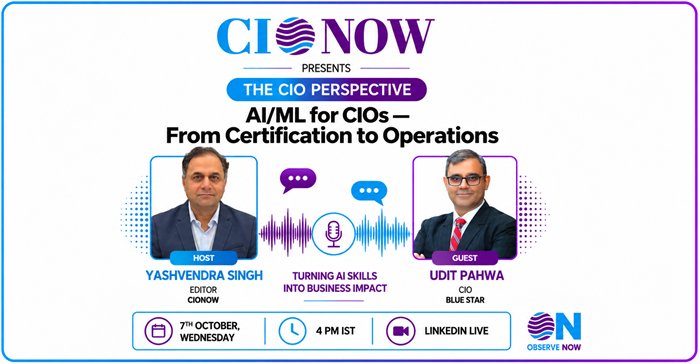
AI/ML for CIOs — From Certification to Operations

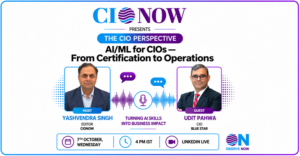
Join CIONOW’s 𝐓𝐡𝐞 𝐂𝐈𝐎 𝐏𝐞𝐫𝐬𝐩𝐞𝐜𝐭𝐢𝐯𝐞 as Yashvendra Singh, Editor, CIONOW, hosts Udit Pahwa, CIO, Blue Star, for an insightful conversation on: “𝐀𝐈/𝐌𝐋 𝐟𝐨𝐫 𝐂𝐈𝐎𝐬 — 𝐅𝐫𝐨𝐦 𝐂𝐞𝐫𝐭𝐢𝐟𝐢𝐜𝐚𝐭𝐢𝐨𝐧 𝐭𝐨 𝐎𝐩𝐞𝐫𝐚𝐭𝐢𝐨𝐧𝐬”

Discover how CIOs can turn AI skills into measurable business impact, move from learning to execution, and drive meaningful transformation across the enterprise.

SAP’s New AI Rules Force CIOs to Balance Control, Cost and Flexibility

SAP’s new policies on AI access are making CIOs question their current agent-based infrastructure to browse and act on SAP’s ERP. New SAP API policy specifies that AI workloads be directed via approved interfaces and guidelines as to when raw ERP data is accessed. Though SAP’s major emphasis is on native software like BDC, BTP and Joule, the key limitation applies to third-party agents accessing sensitive data without restriction.

The direct catalyst is SAP’s restriction on unrestricted Operational Data Provisioning via Remote Function Calls (ODP-RFC). A security patch on June 9, 2026 verifies ODP-RFC calls and declines one that isn’t aligned with SAP’s approved set of subscribers. SAP and integration providers have indicated that a temporary opt-out route is available only for a limited period and should be exercised at the earliest.

For CIOs, the issue is bigger than one connector or one policy update. 

Why is SAP Tightening Access

There’s a governance, security, system stability, and intellectual property angle to SAP’s concern. An AI agent can make thousands of repetitive, automated calls, volumes that would be impossible for conventional user-driven integrations. A badly behaving agent without stricter controls could pose operational risk, a data breach, or an overload on key ERP systems.

A senior CIO from a chemical giant says, “It is also possible that the vendor is apprehensive about giving complete access because it fears reverse engineering. Today, low-code and no-code platforms have made software development very easy. With unabated access to its solution, SAP may fear that its IP can be used to build something similar.”

The policy therefore reflects both a technical and strategic concern. SAP aims to allow access to ERP data from outside tools via governed interfaces, with authentication, identity awareness, usage monitoring, and enforceable rules in place. For third-party agent access, SAP’s reference architecture stipulates that the external agent must be authenticated by SAP Cloud Identity Services; the gateway then decides whether or not the agent has permission to talk to the target SAP service.

That is a reasonable governance objective, especially when agents move from answering questions to creating orders, updating supplier records or approving transactions. However, CIOs argue that the controls must not become a mechanism for limiting choice or charging repeatedly for access to enterprise data.

While enterprise technology leaders agree that a greater degree of oversight is necessary, they also want cost certainty, feasible interoperability, and flexibility to choose the AI stack of their liking.

Challenge No 1 for CIOs: Architecture Reset

On SAP’s new posture Sanchit Vir Gogia, Chief Analyst at Greyhound Research, says the shift requires CIOs to validate their existing AI designs before taking them into production.

“SAP’s policy does not stop AI use but it forces a re-check of whether existing AI setups comply with SAP’s rules before going live. CIOs cannot sign off on a rollout merely because a pilot worked. They need to confirm that the architecture, connector and data-access route will still be permitted in production.”

Qlik, for instance, has confirmed that SAP’s restrictions affect its connectors that use ODP-RFC for bulk extraction to non-SAP systems. SAP’s temporary opt-out mechanism may allow continued use in the short term, but that option is expected to be disabled at the end of 2026.

SAP has gone further to state that organizations won’t be able to make a non-compliant setup compliant just by putting a proxy, gateway or custom middleman in front of it. In other words, putting another layer of software around an impermissible AI agent is not going to be the solution.

This assumes significance for CIOs. A proof of concept may have worked by pulling SAP data into an external environment through a legacy connector, custom extraction method or ODP-RFC interface. But the same setup may now require reassessment, remediation or a move to a supported integration pattern.

Challenge No 2 for CIOs: Data Reconciliation

For a large number of CIOs, the transaction data in SAP alone does not hold true value. The business interpretation stored in the SAP system (such as definitions, hierarchies, the relationships between processes, rules on currency, security roles, the years of application logic) is what is invaluable.

A Delhi-NCR-based global CIO of an infrastructure developer says that transferring raw ERP data to a data lakehouse without that context can reduce its value dramatically.

“Whenever you bring data to a data lake, SAP will not let you bring the meaning easily. You bring numbers—1, 2, 3, 2, 3, 4. It could be sales, purchase, anything. You assign meaning to this data in the data lake manually. But is that humanly possible? ERP systems like SAP have existed for so long and contain so much embedded intelligence that it’s impossible to manually handle it,” he says.

SAP has positioned BDC as a data and intelligence layer with zero-copy integration options, including its partnership with Databricks. The promise is that companies can analyze data in near real time without creating uncontrolled copies or losing business context.

The global CIO argues that SAP’s preferred BDC route could centralize not only data governance but also the commercial value created around enterprise AI. “They don’t want to let this revenue go out of their hand. They are trying to create all the possible hurdles in between,” he says.

To follow the rules and align with SAP’s policy, a senior CIO from a large manufacturing company based in Gurugram is moving to a “two‑layer” setup. 

“SAP stays as the system of record for finance, supply chain, etc. Data is extracted in a controlled way (via CDS views and the semantic layer) into an external cloud data lakehouse, where AI models do their heavy thinking and combine SAP data with other sources. When AI needs to take action inside SAP (create an order, update a record), it writes back only through SAP BTP, with proper authentication and logging. Inside SAP itself, Joule is used for routine, in‑system tasks like navigating Fiori apps, while more advanced, cross‑source AI runs outside SAP on the data lakehouse,” he says.

But this arrangement is far from perfect. “The catch is that this clean, compliant design comes with trade‑offs. The semantic layer correctly reflects SAP’s business logic, currencies and security roles, but it does not automatically fix dirty master data (duplicates, inconsistencies) and is still too slow for some real‑time, sub‑second agent scenarios when pulling from many systems at once,” says the CIO. 

While this architecture provides companies with space to extend into Databricks, Snowflake, AWS, Microsoft Azure, Google Cloud or other AI platforms, it also requires more integration, more governance and more company-wide data management.

This is the key reason why CIOs are concerned that the policy could lead to a costly architecture that does little to address the fundamental issue that keeps AI from going beyond pilots: bad data quality in the enterprise.

Challenge No 3 for CIOs: The Product Readiness Gap

A further concern is that some of SAP’s preferred AI access routes are still maturing.

SAP supports third-party Model Context Protocol, or MCP, access through governed approaches and positions Agent2Agent, or A2A, protocols as appropriate for broader multi-agent interoperability. However, SAP’s own architecture documentation says that bidirectional communication with third-party and self-hosted agents through its Agent Gateway is not yet supported.

That creates a gap between policy direction and product readiness. CIOs may be told to use governed SAP pathways, while some of the capabilities needed for fully functional two-way agent integration are still emerging.

Gogia says this gap must be recognized in planning. “A signed contract or a product announcement is not the same as a working production deployment. There is a journey from setting up the environment and migrating data to running analytics and deploying an agent that can safely act on ERP data,” he says.

This is especially relevant for Indian enterprises with complex SAP landscapes, custom code, multiple business units, legacy interfaces and heterogeneous data estates. Their path to compliant AI will not be a simple connector replacement.

The global CIO flags another problem. “BDC is not that mature. It is very nascent. Even their partnership with Databricks only solves for the core ERP data. What about the broader vision of a corporate knowledge layer or knowledge graph? To achieve that, you cannot rely solely on the ERP; you need the CRM, the MES, time-series data, and shop-floor sensor data. You need to ingest all of this information into one centralized place to form a cohesive company knowledge graph,” he says.

SAP’s policy governs the method of access (the interface pattern), not the vendor of the AI tool. However, using non-SAP products to meet these standards often requires significantly more integration effort than simply adopting SAP’s native stack.

Challenge No 4 for CIOs: The Cost Concern 

The most immediate concern among CIOs is not only access but it is the unpredictability of cost.

The CIO from the manufacturing company describes what may become a “double-cost” model.

“Financially, the company is now paying twice: for BTP capacity and API calls on the SAP side, and for cloud data lakehouse storage and AI compute on the hyperscaler side. On top of that, because SAP is monetizing API calls, especially from autonomous agents, there is a real risk of fast‑growing, hard‑to‑predict bills,” he says. 

SAP says its policy does not create a new charge merely for API access through approved architectures. But CIOs point out that existing Digital Access rules can still create billable events when an external system, bot or automated process creates documents in SAP.

The critical distinction is between an AI system that reads data and one that acts on the ERP system. A read-only assistant might respond to a query regarding inventory, procurement or receivables. An agent that creates a sales order, updates a vendor record, initiates a purchase requisition or approves a purchase transaction may generate licensing, audit and governance concerns.

A CIO shared an example where a procurement agent has thousands of API calls a day to validate inventory, lead times and supplier performance. As per the existing Digital Access rules, a read-only agent may not create a licensing event, but the same agent creating purchase requisitions or orders could. Add BTP integration costs, data lakehouse storage and AI compute, and the monthly bill becomes hard to model in advance.

Gogia says SAP needs to provide much more clarity. “An AI agent that reads data may not trigger a licensing event, but an agent that creates a sales order could count as a billable document. SAP should set out plainly how agent-created documents are counted under each license model.”

There is also concern about fair-use limits. SAP manages call volumes through usage controls, but CIOs do not have published numerical thresholds that would allow them to model the impact of high-frequency AI-agent workloads in advance. That is particularly worrying because autonomous agents are designed to make repeated, machine-speed calls, often near the upper end of normal system activity.

The Road Ahead

India has a big SAP footprint in BFSI, manufacturing, pharma, energy and large conglomerates. Its SAP landscape is often multi lingual, heavily customized and tied to non-standard interfaces with sector-based legal and compliance requirements, besides high cost sensitivity.

Going ahead, the path is clearer: companies will need tighter governance as AI takes a more central role in the ERP system. The CIO test is whether that governance will also preserve interoperability, transparent pricing and portability going forward. Without those, companies may end up with a more automated AI environment but one that will leave their negotiating power and ability to innovate behind.

The core tenet of design is modularity, which means companies should be able to change their AI model, lakehouse or data platform over the years without having to redo integrations, identity and business processes to work with a single vendor.

For SAP’s legacy customers it’s not practical to turn your back on SAP altogether. A more likely scenario is that SAP will be used as the primary source of record and transaction layer, complemented by an ecosystem of outside platforms providing cross-source analysis, reasoning and processing for part of their workloads. But CIOs must guard against sacrificing the autonomy to use multiple AI platforms rather than choosing one platform as becoming the sole gatekeeper.

As Gogia says, “This is not a choice between SAP and independence. It is a choice about where control sits: where business meaning is governed, where the model runs, and where the authority to transact lies.”

For the Gurugram-based CIO, it’s grin-and-bear as he expects the hybrid model to become a practical compromise. “Over the next 12–18 months, the strategy is to live with this hybrid model, optimise how agents call SAP, and accept higher costs in exchange for governance, compliance and a clearer path to production AI,” he says.

Meanwhile, the CIO of a Mumbai-based conglomerate says enterprises are not asking SAP to abandon governance. They want reasonable access, predictable pricing and the freedom to choose where their AI capabilities run.

“Companies that want total freedom and flexibility might lean toward Oracle. However, big, traditional companies running SAP will likely stay put because switching ERP systems is incredibly hard and expensive, even if they dislike SAP’s additional costs.”

That architecture will also require different levels of controls, because not all AI workloads will be equally risky. A read-only helper responding to questions about supplies and finance data is quite distinct from an autonomous agent that can generate a sales order, modify a supplier record, or approve a transaction.

Gogia recommends that CIOs classify the integration estate before making broad compliance decisions.

“A copilot returns an answer to a person and stops. Middleware on a schedule does the same thing every night, in the same order. Then comes AI that helps an engineer write a mapping, which changes how an integration is built but leaves how it runs untouched. And the fourth is the agent that plans its own sequence of calls, and that is the one SAP’s agentic clause is written for.”

The first category needs accurate data definitions, controlled access and logging. The fourth requires narrowly scoped permissions, transaction limits, approval workflows, audit trails, anomaly monitoring, a reversal path and a named business owner. Controls should match the risk of the use case, rather than treating every agent as equally dangerous.

On comparisons with Oracle, Gogia says, ” Oracle is more open at the database, but in ERP its route for outside agents is an A2A call into Oracle’s own Fusion agents under Oracle’s roles, which is the shape SAP describes for Agent Gateway. Oracle shipped that in Release 26A in March, while SAP says its equivalent is not yet supported. The difference is timing, not philosophy.”

CIOs’ Ask From SAP

Before SAP AI investments, CIOs require a contractual confirmation as to what can currently be delivered versus what is planned; how consumption of API, BTP and agents will be metered and charged; how Digital Access applies to transactions created by AI; what are the true fair-use limits; what are the notice periods for policy change; and what are their data export, portability and workload migration rights.

This is particularly important because the commercial impact is not yet fully clear. 

Gogia argues that customers need clarity before they make an architectural commitment. “A procurement lead should feel both relief and unease: relief that an outside model is allowed in, unease that the price of letting it in is not yet written down.”

Summing up the broader sentiment among enterprise technology leaders, the Mumbai-based CIO says enterprises are not asking SAP to loosen governance; they want it to be commercially fair, technically workable and predictable.

“CIO expectations from SAP are increasingly clear: stop charging extra fees simply to read company data through standard AI tools; provide clear, predictable pricing so monthly AI costs do not come as a surprise; and distinguish between a harmful bot and an approved enterprise AI tool operating under proper controls,” he adds.

SAP was approached for comment. The company had not responded by the time of publication.

Eventus Security Expands India Partner Network

Eventus Security is strengthening its Global Partner Program with a selective approach to partnerships across India and other markets where it operates, including Southeast Asia, the Middle East, and the United States. The company aims to work closely with partners that see cybersecurity as a strategic priority and are committed to improving long-term customer outcomes.

Rather than building a large partner roster, Eventus is seeking regional partners, system integrators and IT service providers with established customer relationships, security expertise or a clear ambition to develop a cybersecurity services practice. The programme is designed around joint understanding of customer needs, solution design and sustained engagement after deployment.

“Enterprises increasingly need more than individual security solutions. They need partners who can bring together different elements of their security ecosystem, understand their evolving business and security priorities, and help them focus on what matters most. We want to work with partners who share that approach. The measure of a successful partnership for us is how well we serve the customer together, not how many names we add to a partner list,” said Vikas Somani, Vice President, Sales, India, Eventus Security.

The programme gives partners access to Eventus’s AI-driven security operations capabilities and a portfolio spanning SOC-as-a-Service, Managed XDR, threat intelligence, vulnerability management, penetration testing, red teaming, breach and attack simulation, digital forensics and incident response (DFIR), cloud and application security, and governance, risk and compliance (GRC).

Eventus supports partners with pre-sales and solution design, technical training, joint marketing resources, deal registration and dedicated account management. Its security operations and customer-facing teams remain engaged through implementation and ongoing service delivery.

This model allows partners to bring specialist cybersecurity capabilities to their customers while maintaining a close relationship with them.

India will remain central to the programme’s growth. With its India head office in Mumbai, offices in Ahmedabad, Delhi and Kolkata, and a wider regional sales presence, Eventus combines direct engagement with partners’ local knowledge and customer reach. The same selective approach will guide partner relationships in Southeast Asia, the Middle East and the United States.

Automation Anywhere to Acquire Boost.ai

Automation Anywhere, a leader in agentic automation and orchestration for the enterprise, today announced entry into a definitive agreement to acquire Boost.ai from Nordic Capital. Boost.ai is a leading enterprise conversational AI company whose global customers rely on its voice AI solutions to enhance customer experience. The transaction is expected to close in Q4 2026, subject to customary regulatory approvals and closing conditions. 

The acquisition will mark another major step toward Automation Anywhere’s vision of the Autonomous Enterprise, an operating model in which business functions can run up to 80% autonomously or with AI assistance. Boost.ai will extend that vision into customer experience, so AI can take a request from a customer or employee and carry it through to middle- and back-office execution. It follows Automation Anywhere’s acquisition of Aisera in late 2025, which added enterprise knowledge and automated employee service to the platform.

“As we help our customers increase autonomy and maximize return on their AI investments, this acquisition will take our market-leading offering to the next level,” said Mihir Shukla, CEO and Chairman of Automation Anywhere. “Every enterprise runs on three kinds of work: serving customers, supporting employees, and running the business. Most run in isolation. With Automation Anywhere and Boost.ai, we intend to be the leading offering to give every enterprise an autonomous operation that listens, decides, and acts across all three. This is the Autonomous Enterprise in action.”

Boost.ai: Conversational and Voice AI Built for Regulated Industries

Boost.ai serves hundreds of customer organizations, with particular strength in Europe and a strong base in regulated industries such as financial services, telecommunications, and insurance. That profile fits Automation Anywhere’s thousands of global customers who operate in similarly complex industries. The Boost.ai platform supports more than 36 languages and maintains security and privacy measures aligned with GDPR and HIPAA requirements and supported by an independent SOC 2 report. Its hybrid architecture combines natural language understanding (NLU) with generative and agentic AI, and it reaches a 90%+ resolution rate in production deployments. For four consecutive years, Gartner has recognized Boost.ai in the Magic Quadrant for Conversational AI Platforms, citing its strength in regulated industries and the clarity of its product strategy. 

The acquisition also comes as the conversational AI market is expanding. Boost.ai’s voice capabilities in particular have reached a level at which enterprise conversations feel natural, making voice impactful for sales, customer service, healthcare, outbound calling, field service and more.

“Boost.ai’s deep expertise in regulated industries has proven that conversational and voice AI can operate at enterprise scale with the reliability, compliance, and governance that regulated industries require,” said Jerry Haywood, CEO of Boost.ai. “By joining Automation Anywhere, we can connect the conversation, including voice, directly to the systems and people who get the work done, so a customer’s request is handled from start to finish.”

Better Together: Completing the Conversation-to-Outcome Loop

While the first era of enterprise AI centered on copilots and agents completing individual tasks, Automation Anywhere sees a larger opportunity where AI takes a request and carries the whole process through to completion, bringing in people when a decision calls for judgment or an exception.

“The real transformation from AI will come when enterprises stop measuring agents and start redesigning how work gets done around outcomes,” said Ankur Kothari, co-founder and Chief Operating Officer of Automation Anywhere. “With Boost.ai, we would complete what we call the Conversation-to-Outcome Loop. A customer or employee expresses what they need; AI understands the intent and context; it reasons within company rules, coordinates agents, people and systems; and finally executes the work across connected enterprise applications and systems required to deliver the outcome.”

With the acquisition of Boost.ai – combined with its recent acquisition of Aisera – Automation Anywhere would have the most complete offering in the market to deliver autonomous work across the three critical business motions that all enterprises must transform in the AI era:  

  • Autonomous Customer Operations: Connects customer intent expressed through voice, chat, digital channels, and AI agents to the work required to deliver the outcome. 
  • Autonomous Employee Operations: Combines AI-powered employee service with agentic automation to resolve employee requests across IT, Finance and HR, with people handling judgment and exceptions. 
  • Autonomous Business Operations: Uses the agentic automation platform to orchestrate business-critical processes end-to-end across ERP, CRM, and other enterprise applications, combining AI agents with rules-based automation under enterprise-grade governance. 

No other company connects the conversation to the completed work across customers, employees, and the business in one offering. 

Accelerating Momentum: A Market-Leading AI Offering

The planned acquisition would build on Automation Anywhere’s strong growth and AI momentum. As reported in its Q2 FY27 results, AI bookings have made up nearly 70% of new and upsell bookings over the past six quarters, and agentic AI executions have grown 5x over the past year. Automation Anywhere now delivers nearly half a billion AI agent and automation executions per year.

The addition of Boost.ai would further strengthen Automation Anywhere’s core AI offering with voice and conversational capabilities, including expanding front-office delivery for companies in regulated industries. Enterprise customers would have access to Automation Anywhere’s top agentic automation and orchestration platform; pre-built agentic solutions that can be deployed in as little as one week; and the industry’s most complete Autonomous Enterprise offering that combines the platform, agentic solutions, the most advanced AI agents and Forward-Deployed Engineer-led business transformation services.

In connection with the transaction, BofA Securities served as exclusive financial advisor to Automation Anywhere, and Winston Taylor served as its M&A counsel. Santander served as exclusive financial advisor to Boost.ai.

From IT Custodian to Business Co-Owner: How Tech Drives the Everyday Operating Model at Tim Hortons GCC

In a QSR business, technology isn’t just an IT function. In fact, it is a part of the everyday operating model, from the point of sale and payment to kitchen operations, inventory, workforce management, loyalty, and customer experience. For businesses like this, the importance of tech reliability, simplicity, and speed becomes more crucial as innovation.

While interacting with CIONOW, Mr. Vinay Kumar, Head of IT at Tim Hortons GCC, discusses how tech is influencing the QSR operating model and what CIOs should rethink. 

You have spent much of your career in businesses where technology has to work at the point of sale on the shop floor and in our day-to-day operations. What have you learned about the difference between technology that looks good on a roadmap and technology that actually works for the front-line teams?

Usually, a technology roadmap is closely linked to the business’s ambition, but on the shop floor or at the frontline, it shifts to technology robustness, agility, and ease of use. Even if tech changes might take only a few seconds, but it cannot guarantee success if in need of extensive training or are difficult for end users to understand. Therefore, for a successful roadmap, tech must align with the frontline teams’ easy adoption. 
For example, the store teams’ ordering system should be simple and seamless to use, instead of worrying about the technology running behind. A seamless customer journey from the time of ordering till the time of receiving, without any staff guidance, is a must for a successful business. 

In a QSR business, technology touches almost every part of the operations. So how is this changing the role of the CIO from managing IT systems to actually shaping the business?

Now, the role of any CIO, head of IT, or technology leader has transitioned from being just a system’s custodian to the business co-owner. Now, Tech KPI are not limited to system uptime; they are being measured by their impact on business outcomes. 

In the QSR business, speed of service, margin, loyalty, and growth-these all are the points that convert technology directly into business. The role of IT leaders has changed over the period of time from the ED department to the MIS and then IT head, and now to the boardroom, becoming part of strategic decisions. 

The focus is no longer on data platforms or infrastructure but on translating business ambition into the right platform, data capabilities, and partnerships with the business. 

A modern QSR has POS, kitchen display systems, payments, inventory, work code systems, mobile ordering, and several other platforms. So what does it take to make all the systems work as one connected ecosystem rather than as separate applications?

QSR may appear simple to the customer, but a large number of technology components work behind the scenes to deliver something as basic as a burger. In his previous organisation, one burger required nearly 50 different hardware and software components to work in sync. At Tim Hortons, with around 330 restaurants and an average of 10 pieces of equipment per restaurant, this translates to more than 3,000 devices that need to work seamlessly.

Kumar says, “The foundation for managing this complexity is a strong integration architecture and a single source of truth for critical information such as menus, pricing, and customer data, making master data management (MDM) crucial. An order placed through the POS, for instance, moves to the KDS and then to the front-counter screen and kitchen.”

The same architecture needs to support other channels, including drive-through and food aggregators. Orders via food delivery platforms such as Zomato, Swiggy in India, HungerStation Keeta, and Noon in the GCC, pass through middleware converting them into a format that the restaurants’ system can consume before sending it to the kitchen. 

Kumar shared that this process needs an API-first approach, that has stronger master data governance, and teams that have knowledge of the end-to-end delivery process instead of focusing on particular platforms or aggregators, enabling the different technology components to work together as one integrated system. 

How do you build technology resilience during peak hours, when even a small failure can directly impact customer transactions and business?

Kumar believes that QSR technologies’ real test comes during peak demand, as failure during a meal rush, major events, or a high-volume delivery window can quickly become a business problem. 

“If you design things for the restaurant not based on uptime but based on the failure rate,” he says, the focus shifts to how the business can keep serving customers when something goes wrong.

This approach makes offline capabilities, backup connectivity, and contingency planning essential. It’s simple: the key measure is not how fast IT can fix a component; instead, the focus must be on how quickly the restaurant can resume its operations. 

How can CIOs turn data into useful decisions around demand, inventory, staffing, and customer experience rather than simply creating more dashboards? And, like QSR, it generates a huge amount of operational customer data. So how can this be useful? 

For Vinay Kumar, he sees his contribution as CIO and tech leader as converting raw data into actionable information. He describes that the same data can work differently for different stakeholders. He shared, for instance, that at Bata India, approximately 20lacs line items were generated daily but buyers required category level insights while store teams needed store-level data. Again, at Tim Hortons, this principle follows, where data on inventory, staffing, sales, and customer demand is converted into stakeholder-specific dashboards. In this, AI is being a great help in making these insights more actionable, enabling business teams to make faster decisions. 

So AI is now entering almost every layer of the enterprise technology in a QSR environment. Where do you see AI is moving from experimentation to genuinely useful applications?

“AI as a top layer that can deliver value when the underlying data is reliable,” says Kumar. At Tim Hortons, these use cases in demand forecasting, inventory and raw material planning, waste optimization etc., can be seen clearly. 

With AI, the demand data can be combined with factors such as weather, holidays and events that can help restaurants with improved forecasts, resulting in optimized inventory, reduce waste and plan workforce requirements more efficiently. Customer data can also support personalizing offers on the basis of individual ordering patterns. 

At the same time, Kumar believes AI must simplify the frontline experience, instead of adding more complexity, that where his expertise steps in to make it easier for restaurant teams to do their jobs seamlessly. He emphasizes tech to manage the heavy lifting, such as forecasting and reordering, so frontline employees can spend more time with customers. As he puts it, adding multiple systems in the name of transformation can simply mean “digitising the complexity.”

How can CIOs measure the impact of technology on a customer experience where the customer may never see the technology?

In a QSR business, the success of tech depends on how seamlessly customers experience is. For a successful business, a customer should be able to place an order, make a payment, and receive it without thinking about the technology behind it. 

Irrespective of the mode of order placement, every touchpoint must work smoothly. Payments should be done without any friction, and customers must have clear visibility on their order status. Therefore, the KPI is simple: a smooth customer experience, from the moment they walk in to the moment they leave. 

As restaurants become more connected to payments, cloud applications, devices, networks, and third-party platforms, how is the cybersecurity challenge changing?

Cybersecurity in a connected QSR environment is no longer limited to the restaurant itself. Every connected device, system, vendor, partner, payment gateway, and aggregator can become a potential point of vulnerability, making resilience and continuous monitoring more critical. A cyber attack can occur via a vendor or partner; this implies more need of secure across the entire technology ecosystem.
Kumar explains that the more operations across regions also need an extra regulatory layer, as data and compliance needs vary from country to country. Therefore, this needs robust security monitoring, strong partners, and dedicated security teams to manage both cybersecurity and regulatory needs. 

You have worked across QSR, FMCG, retail, logistics, and manufacturing. What is one technology lesson from these industries that you think can be particularly valuable for QSRs and other customer-facing businesses?

Across different industries, the biggest lesson has been to understand the business first. It’s not just about technology. My experience with companies like Coca-Cola and Pepsi also taught me the importance of standardising repeatable processes and maintaining clean master data.

In QSRs, that translates into using “tech enablers” that simplify store operations and make life easier for the frontline team. Understanding the business, standardising processes, and removing repetitive work are the things that consistently make a difference.

So my next question is about when you are managing technology across a distributed store network, IT teams can sometimes become disconnected from what is actually happening on the ground. So what leadership behaviours are important in helping technology teams understand the business they are enabling?

Kumar explains this in terms of empathy and business understanding. He says, “Firstly, IT teams must be considerate about the pressure on frontline staff. If there is any failure at the payment terminal or POS system, the restaurant staff will have to face the unhappy customer in real time. So, the support team should at least listen, respond politely, and ensure that store problems are being addressed, even if the issues cannot be resolved immediately.”

Secondly, he shared that the team should be aware of which issues affect the business most. For a business like this, the team must prioritize POS or payment failure as it directly influences the customer data and revenue. A back office printer may matter, but not before the counter-side POS printer problem. The focus should not be only on system uptime, but on business interruption- how long a technology issue prevents the restaurant from serving customers.

In a QSR business, this becomes even more important during weekends and festivals, when restaurants are busiest, and technology has to work without disruption.

Anubhav Rajput Joins IIFL Finance as CTO

Anubhav Rajput has moved on from PNB Housing Finance, where he was the CIO and CTO, to IIFL Finance as CTO.

At IIFL Finance, Rajput’s mandate will focus on bolstering the tech department, accelerating digital projects, and enhancing the AI/ML applications in credit, risk, operations, and customer experience.

During his tenure at PNB Housing Finance, he led a multi-year technology transformation, comprising the shift from paper-heavy processes to cloud-native and AI-enabled operations.

With 26+ years of experience in BFSI, telecom, and pharmaceuticals across Europe, the Middle East, and India, Rajput specializes in cloud modernization, large-scale digital transformation, and data-driven decision-making.

GitLab Announces the Foundation for the Governed Software Factory

GitLab Inc., the intelligent orchestration platform for DevSecOps, today announced new capabilities for the governed software factory, a connected system for moving software from idea to production under an organization’s own policy and standards. These new innovations are designed to help organizations ship more AI-generated software to production without taking on more risk or cost.

More than 70 million developers and over 10,000 enterprises innovate on GitLab today. Over the last three months on GitLab, active users of agentic software development grew 200% year over year, while secure repositories grew 100%, user namespaces grew 80%, and CI/CD pipelines grew 40%.

Yet most organizations are running a shadow software factory built from separate tools for coding, issue tracking, source code management, CI/CD pipelines, security, artifact management, and deployment.

These systems have no shared identity, common policy, or a record of how a change was made. That fragmentation slows handoffs, breaks context between stages, and prevents engineering leaders from tracing changes from plan to production or measuring the true impact of their AI investments.

GitLab connects those steps so agents can work within an organization’s context, workflows, and guardrails, while creating an evidence chain that records how changes move from intent to production. Together, these capabilities form the foundation of a governed software factory, helping organizations move from intent to production with fewer handoffs, stronger safeguards, and clearer visibility into what AI delivers.

Orchestrating Agentic Workflows Across the Software Lifecycle

Agentic software development can stall after coding when reviews, tests, security checks, approvals, and deployments require handoffs between people, tools, and stages.

Goal-driven flows in GitLab Duo Agent Platform, powered by /goal in Duo CLI, in headless mode and in Duo Agentic Chat, and the GitLab for Slack app, eliminate waits between handoffs across the software lifecycle.

Custom Flows and flow triggers automate multi-step work under the same identity, policy, and evidence chain. Teams can start and follow the same flows from the tools and channels they already use, under the same identity and policy.

Assembling the Right Software at Agent Scale

Most software that organizations ship is assembled from open-source packages, base images, and libraries. Builds fail when pipelines assemble the wrong or missing components, and agents multiply that failure rate by publishing packages at machine speed across vendor and project registries that carry their own rules.

GitLab Artifact Central, now in beta on GitLab.com with availability on GitLab Self-Managed planned for later this month, lets platform teams assemble the right software the first time. It brings containers and packages into one control plane alongside source code management and CI pipelines. With GitLab Artifact Central, teams set policy once at the organization level, instantly answer what was published, and realize up to 50% lower total cost of ownership compared with alternative tooling.

Securing the Software Factory at Machine Speed

As organizations adopt agentic software development, more code, packages, and credentials move through the software supply chain than security teams can review. Agents can pull unvetted packages into a build or reuse credentials stored in local environments, and each vulnerability that stays open increases the risk of exploitation. At machine speed, agents need a foundation they can prove before they earn more autonomy.

To meet the challenge, GitLab is adding security controls to govern what enters a build, to protect credentials each job can reach, to harden the defensive posture for software delivery, and is providing the best practices engineering leaders can use to assess their risk posture for agentic software development.

GitLab Dependency Firewall, available in early access, checks every package against policy before it enters a build. It warns, blocks, or quarantines packages based on rules the organization sets for package age, vulnerability severity, malicious package detection, and license compliance. One control plane spans source, build, and registry, helping teams trace exposure to affected projects and prioritize remediation in minutes instead of weeks.

GitLab Secrets Manager, generally available on GitLab.com and on GitLab Self-Managed in the 19.5 release, secures build-time secrets in one place, and scopes each secret to the job that needs it. It applies existing group and project permissions, and records every event in the GitLab audit trail. With GitLab Secrets Manager, teams can revoke a leaked credential in one click, and realize up to 50% savings compared to hosting a separate vault.

Anthropic’s Claude Mythos 5 and 5.1 will be available within new GitLab Duo Agent Platform security flows next month, helping organizations with approved environments find and fix vulnerabilities faster than attackers can discover and exploit them.

The GitLab Security Standard, available today, gives security and engineering leaders a way to assess their security posture, build trust in autonomous agents through verifiable outcomes, and protect software already in production. The standard sets five controls for the agentic era and uses time from detection to verified remediation as its core metric.

Optimizing Agentic Workflows for Context and Cost

AI investment is difficult to manage when leaders cannot connect credits consumed to outcomes delivered. Without that evidence, prioritizing the next use case and setting spending limits becomes guesswork. Agentic workflows also incur unnecessary cost when they lack the lifecycle context needed to complete a task, leading to more retries and higher token consumption.

GitLab addresses these challenges by giving agents the lifecycle context they need to work more efficiently and leaders clear visibility into AI cost and impact.

Since its beta announcement in June, GitLab Orbit has been used by more than 3,500 organizations and supported over 280,000 queries from their coding agents. It maps the entire software lifecycle into real-time knowledge that agents can act on, enabling them to complete tasks with up to 45x fewer retries and 4.5x fewer tokens. Orbit will reach general availability next month across all GitLab deployment options.

Duo Agent Platform Impact Analytics, now in early access, shows cost and impact of AI investment by team, task, and model. Impact Analytics complements the recently introduced AI usage caps and controls, which allow platform admins to set spending ceilings at the subscription, group, or user level. Teams see their adoption metrics, results of agentic workflows, and credit consumption alongside the real work that reaches production. This level of visibility is made available even when using a mix of AI models with Duo Agent Platform: GitLab-managed frontier and open-weight models, or self-hosted.

Beer, Data and a 5% Cost Cut: How Real-Time Tech is Brewing Faster Service

For a large-format brewery, technology can make or break business. On a busy Friday or Saturday night even seconds longer than normal to relay an order to the kitchen or bar can mean delaying service, ordering mistakes, unhappy customers and lost revenue.

The Bier Library is among the largest and most popular microbreweries and restaurants located in Bengaluru, Karnataka. As the restaurant grew, technology had to keep pace with the business. With its Bengaluru Sarjapur branch hosting approximately 1,500-2,000 guests, speed, robustness and live orchestration of kitchens, bars and service crews became core to the way it served up its experience.

Scaling a High-Volume Operation

The Bier Library’s requirements went beyond a conventional point-of-sale system. Its restaurants needed a reliable, real-time platform that could handle dine-in orders from captains, QR-code orders placed by guests, takeaway requests and aggregator orders from Swiggy and Zomato, while routing each order to the right kitchen or bar section.

Prashant Kunal, Founder and CEO of The Bier Library

“We looked at a few of the other options. They covered the basics,” says Prashant Kunal, Founder and CEO of The Bier Library. “What I really wanted to know was how they would hold up on a packed Saturday night. If it slows or goes offline at 9 pm, orders get missed and tables sit waiting. Reliability mattered more than anything on a feature list.”

Inventory control was another concern that was critical for a brewery. Beer, cocktails and food had to be tracked in the same detail, from each pour and recipe ingredient to the movement of stock and waste. A delay of even a few minutes meant any discrepancies could go unnoticed for hours.

“Managing inventory for such a large operation needs accurate tracking that works in sync with our existing processes,” Kunal says. “With beer and cocktails, if you are not tracking every pour, you will not notice differences until they add up.”

Bier Library had earlier partnered with a different restaurant technology provider at the Koramangala outlet. As it expanded to a bigger Sarjapur outlet, the new platform needed to be larger in scale and leverage its workflows.

The brewery implemented the Digitory software system, which is a restaurant operations platform, to connect ordering, billing, kitchen processes, recipes and inventory.

A Hybrid, End-to-End Deployment

Digitory deployed a hybrid architecture at The Bier Library. The local server ensures outlets and sales can run without an internet connection. At the same time, the platform syncs with the cloud where the central management can view reports, view results and run the back-office.

Shivprakash S. Mogali, Founder and CEO of Digitory

“Large properties cannot afford downtime. If the system goes down for 30 minutes or an hour, the losses can run into lakhs,” says Shivprakash S. Mogali, Founder and CEO of Digitory. “For such outlets, a hybrid model ensures that the front-end operation continues locally, while the back office and management layer remain fully available in the cloud.”

Digitory deployment at The Bier Library consisted of five to six modules (point of sale, QR-code ordering, inventory, recipes, and a handful of prepaid features). The platform interfaces with a QR-code guest portal, a waiter app, and kitchen display system so orders are sent instantly to the right bar or kitchen station.

This routing is especially important in a venue with multiple cuisines, service zones, floors and preparation stations. Rules can be configured around cuisine, order type, table location and other operating parameters, ensuring that the correct order reaches the correct team without staff manually coordinating between counters.

“The Digitory team thoroughly understood our specific requirements and developed a few features specially for us,” Kunal says. “We have multiple kitchens for different cuisines and locations. Orders are routed based on multiple criteria, which Digitory created for us.”

The implementation was completed in stages. Billing went live in about three to four days, while the inventory implementation took roughly two weeks. The brewery’s existing data discipline accelerated the process; clean recipes, item masters and inventory information are critical to configuring restaurant systems quickly and accurately.

Digitory’s platform is designed to work with relatively lean hardware infrastructure. Beyond the local server, large outlets require a load balancer and a well-planned Wi-Fi network with access points mapped to the property’s scale. Staff can use mobile devices for ordering and billing, while wireless or Bluetooth printers can be used for bills and kitchen order tickets where required.

Faster Orders, Tighter Control

For The Bier Library, the most visible operational change has been real-time visibility. Managers can now see sales, stock levels, ordering patterns and other operational indicators daily instead of discovering issues weeks later during a monthly review.

“The biggest change is that I can see what is happening every day in real time and do not have to wait until month-end,” Kunal says. “Earlier, we would find out about a problem weeks after it started. Now it shows up the next morning.”

“The operational benefits are measurable. Inventory costs have declined by about 5%, while food wastage has fallen by around 2–3%. Beer wastage between production and sale can now be tracked and acted upon quickly, and stock reconciliation, which previously took the team the better part of a day, now takes a couple of hours at most,” he says.

“At our scale of operations, these are real savings,” Kunal says. “My managers spend that time on the floor with guests instead of chasing numbers. And when we change menu prices or place orders, we are working from what things actually cost us.”

On the service side, the connected flow between QR ordering, waiter applications and kitchen display systems has reduced delays in getting orders to the kitchen and bar. Digitory’s platform prioritises orders, aggregates item demand across the outlet and helps teams manage preparation and dispatch more systematically during high-volume periods.

Mogali says this can materially change service speed during peak hours. In a conventional setup, a guest may wait 10–11 minutes for a waiter to arrive, followed by another wait before the order reaches the kitchen or bar. With digital ordering and integrated routing, an order placed via QR can reach the bar or kitchen almost instantly.

“If a restaurant is closing at midnight, a guest can place an order at 11.59 pm from a mobile phone and the order reaches the bar counter within a fraction of a second,” Mogali says. “With the right number of runners, the food or drink can be at the table in four or five minutes.”

He adds that when QR ordering, waiter applications and kitchen displays are used together, staff requirement can be optimised by around 15–20%. The objective, he says, is not to remove jobs but to shift staff from repetitive order-taking and billing work towards higher-value guest service.

Digitory estimates that restaurants can capture 8–12% higher weekend sales when faster service enables more repeat orders during peak periods. The Bier Library did not independently quantify that figure, but Kunal says quicker kitchen and bar coordination has made a noticeable difference to service on full Saturday nights, table throughput and the guest experience.

From Reporting to Predictive Operations

The next phase for The Bier Library is to use its now-clean operational data to make procurement and preparation more predictive.

“Indenting and procurement today still depend on someone’s judgement on a given day,” Kunal says. “We want that driven by demand patterns, so we are not overstocking in a slow week or running out of a key ingredient on a busy weekend.”

Better demand prediction, he says, can create a compounding benefit: the brewery can prepare better, brew better and reduce waste. The company is also evaluating Digitory’s cashless, prepaid module for events, where guests could load a wallet or band and pay across multiple counters. Because the capability is linked to the broader POS environment, event transactions can flow into the same sales, inventory and reporting system, reducing queues and eliminating end-of-night cash reconciliation.

Digitory is building its next set of capabilities around an AI-driven operating model, beginning with demand forecasting. Mogali draws a distinction between simple automation and AI that offers decision support.

“Forecasting by itself is a statistical calculation. For us, AI should help management take decisions without spending time on certain things,” he says.

The company already stores data from ordering, payments, inventory, procurement, loyalty and kitchen operations. Digitory will leverage on this platform to offer demand forecasting, inventory intelligence, menu and pricing optimisations, personalised CRM, anomaly detection and operational insights like prediction of preparation time.

For The Bier Library the short business case still relies on operational efficiencies: fast service, clear cost visibility, less waste and less time reconciling the data. But in the longer term it’s to use those connected signals to make better, more proactive decision.

As Kunal puts it, “If we can predict demand better, we prep better, we brew better, and less ends up in the bin. That is where the real savings are going to come from over the next year.”

Chat with CIONow.in