Netskope, a leader in modern security and networking for the cloud and AI era, today announced Netskope Skylight Agent Action Control, a new capability that classifies every action an AI agent attempts and applies granular controls to stop high-risk actions before they execute. The capability meets security teams’ need for a policy-based way to govern, rather than react to, what autonomous agents are permitted to do.
Agent Action Control arrives as Netskope renames its AI security portfolio to better communicate the company’s broad capabilities across AI security. Formerly Netskope One AI Security, Netskope Skylight is the new family name for the suite of Netskope AI security products including Netskope Skylight AI Command Center, Netskope Skylight AI Guardrails, Netskope Skylight AI Gateway, Netskope Skylight Agentic Broker, and Netskope Skylight AI Red Teaming.
Netskope Skylight Agent Action Control
Today, 91% of organisations cannot stop a risky agent action before it executes, and 54% reported a confirmed or suspected AI agent security incident in the past year. With Netskope Skylight Agent Action Control, teams can more effectively govern what an agent is attempting to do thanks to:
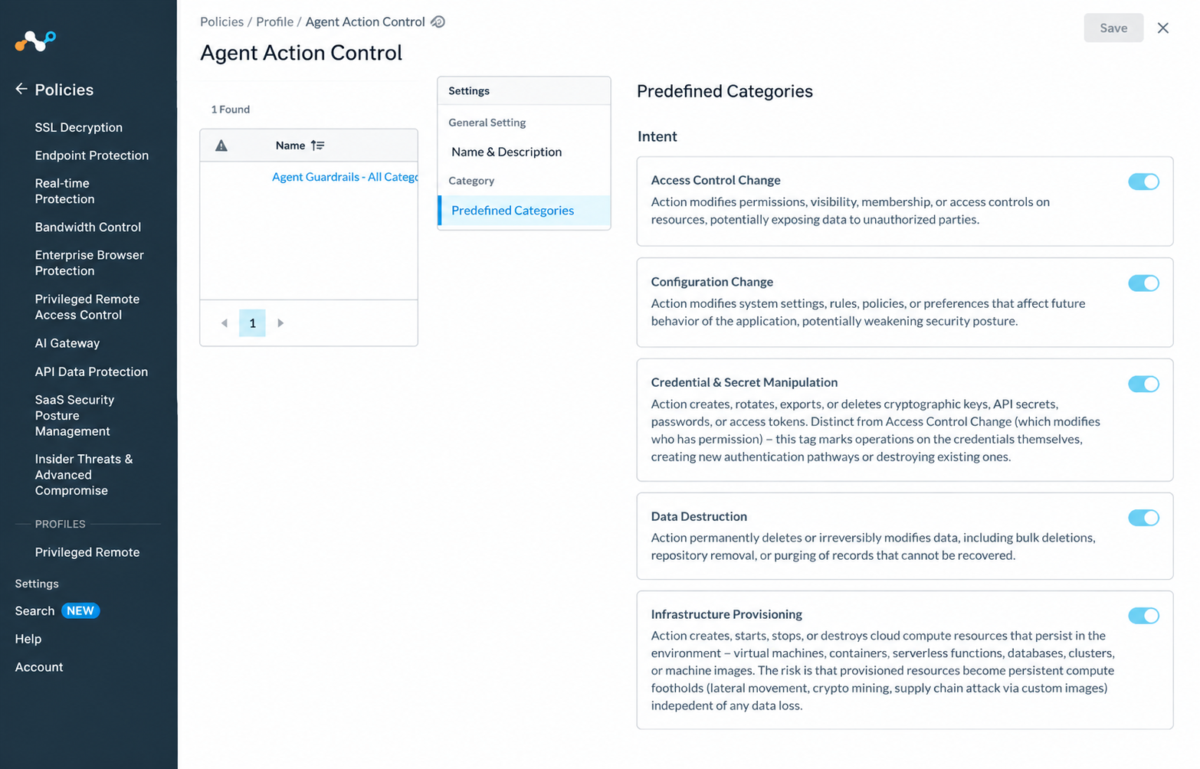
Control over nine different types of action: To enable granular policy definition, every agent action is classified into one of nine intent-based categories prior to execution. These include, access control changes, configuration changes, credential and secret manipulation, data destruction, infrastructure provisioning, potential data exfiltration, potential external communication, remote code execution, or source code change.
Risk-based policy profiles by agent type: Block, allow or alert based on low, medium, high or critical risk categories, with the option to send a default or custom notification to the end-user for user coaching when the action is blocked. Profiles attach to specific agents, so a coding assistant and a chat application do not have to operate under the same rules.
Granular policy alerts: Every action is logged, with security teams able to filter policy alerts by cost exposure, source code changes, infrastructure updates, or external communication to align investigation effort with organisation risk prioritisation.
No new console and no new agent: Netskope Skylight Agent Action Control runs on network traffic the Netskope platform already inspects, so security teams gain enforcement over agent behaviour without deploying a separate tool or standing up a second console.
The result is a policy that governs what an agent is allowed to do before it acts. When a coding agent working from a vague prompt attempts to delete a production repository, for example, the action is classified as data destruction at a critical risk level, and the call is stopped before it reaches the repository. The security team gets a record of the attempt instead of an incident report. This approach provides governance and controls over agents at risk of “authority drift”, or whose harness or instructions are too vague or permissive.
“AI agents tend to act first and explain later, and most security teams only learn what happened after it is done,” said John Martin, Chief Product Officer, Netskope. “Agent Action Control puts a decision in front of every action an agent takes, so a team can say yes to agentic AI without saying yes to the one action that could cost them a production system.”
“As enterprises accelerate adoption of AI agents, we’re finding that probabilistic controls are sometimes insufficient to protect the enterprise, but even occasional failure is unacceptable,” said Dr. Grace Trinidad, Research Director for AI Security and Trust at IDC. “These hardened, policy-based, deterministic controls are the backstop that prevents AI agents from causing an enterprise incident.”
DigiCert, a global leader in intelligent trust, announced the general availability of DigiCert AI Trust Manager, part of the DigiCert ONE platform. The new solution helps organizations discover and manage the AI agents they own or operate, establish each agent’s verifiable identity and ownership, define what it is authorized to do, and revoke that authority with a kill switch when trust changes.
AI agents can access sensitive data, use software tools, write code, make decisions, and complete transactions with limited human involvement. Yet most enterprise security systems were not built to govern autonomous agents moving across applications, clouds, and organizations at machine speed.
The risks are already emerging. In a July 2026 DigiCert survey of 1,001 IT and cybersecurity leaders, 78% reported that their organizations had experienced an AI-related security incident or identified an AI vulnerability in the previous year.
“For more than two decades, DigiCert has provided the cryptographic infrastructure that helped the internet scale,” said Amit Sinha, CEO of DigiCert. “We are now bringing that proven trust model to AI agents so organizations can verify who they are, who owns them, and what they are authorized to do.”
Traditional identity systems work like employee badges, establishing trust within a single organization. At the center of DigiCert AI Trust Manager is the DigiCert AI Passport. It’s a portable, cryptographically signed credential that verifies an agent’s identity and connects it to an accountable owner. Policy-based “visas” define which systems, data, and actions the agent may access, as well as how long that authority lasts.
Because the DigiCert AI Passport and its permissions travel with the agent, other systems and organizations can independently verify them without relying on the same identity provider. A receiving organization can deny the agent access within its own environment. If the agent attempts a prohibited action, DigiCert’s automated kill switch blocks it and, under policies set by the agent’s owner or passport issuer, can immediately revoke its authority at the source and quarantine it before harm occurs.
DigiCert AI Trust Manager allows enterprises to:
Find and identify agents: Discover AI agents that were purchased, built internally, or operating within the business, and connect each one to an accountable owner.
Set clear limits: Define the systems, data, and actions an agent may access, and how long its permission remains valid.
Extend trust across organizations: Allow other systems and companies to independently verify an agent without requiring both parties to use the same identity provider.
Respond when trust changes: Update credentials, expire permissions, or revoke an individual agent or groups of agents upon policy, risks, or any other changes.
“Enterprise AI buying has moved from trust to proof. Buyers are ranking verifiable security controls as their top priority and name unverifiable vendor claims as their top frustration,” said Grace Trinidad, Research Director, AI Security and Trust, IDC. “Cryptographic identity, attestation, and revocation for agents, models, and MCP servers are the machinery that produces this proof, which in turn produces trust, and DigiCert is pointing the identity discipline the internet already runs at scale at exactly that problem.”
“As AI agents become more embedded in enterprise workflows, establishing clear identity and accountability will be essential to deploying them responsibly at scale,” said Ajitha Choudary, Vice President of Global Security Engineering & IAM at UKG. “We see DigiCert AI Trust as a promising approach to extending proven principles of digital identity to this new class of autonomous systems. The ability to verify an agent’s identity, define what it is authorized to do, and maintain visibility into its actions could give organizations the foundation they need to adopt agentic AI with greater confidence.”
DigiCert AI Trust Manager is part of DigiCert’s broader AI trust architecture, which applies cryptographic verification across AI agents, models, and content. It complements existing identity and cybersecurity systems by providing a portable foundation for verifying an agent’s identity and authority wherever it operates.
As business leaders are navigating an increasingly complex digital landscape, the success of a true technology transformation is no longer about its going live but about whether it can keep delivering measurable business value long after execution. For large, process-intensive companies like those in the pharmaceutical industry, this consistency challenge becomes more crucial as ERP, SaaS, OT, data, and emerging technologies must align together without compromising business outcomes.
In an interaction with CIONOW, Chitti Babu, Group CIO at Aurobindo Pharma, discusses what sets transformations that deliver lasting value apart from those that fade; the key metrics of an operating model, the gap between technology design and business reality, and where blockchain justifies its complexity.
He also shares how organizations can balance global standardization with local flexibility, and outlines three principles that future CIOs should build into their operating models from day one.
What patterns do you see in digital transformations that sustain value versus those that fade after go-live?
The decisive factor is whether go-live is considered as the conclusion of delivery or the commencement of value capture. Programmes that fade typically showcase benefits owned by no one, funding that terminates at cutover, adoption measured by training attendance rather than behavioural telemetry, and an executive sponsor whose attention has moved elsewhere. Sustained transformations, by contrast, assign benefit ownership to named business leaders, retain persistent product teams beyond hypercare, and embed outcomes within the monthly operating review. A useful heuristic holds that the half-life of a transformation is determined in the ninety days following go-live, not in the year preceding it.
In practice, what should a transformation operating model include?
A credible operating model is based on three pillars: roles, rituals, and decision rights. The roles encompass a single accountable executive per value stream, a small and senior transformation office, empowered product and process owners, a change lead measured on behaviour rather than communications, and an architecture authority that enables rather than obstructs. The rituals compress a weekly decision forum with a genuine decision log, monthly value reviews tied to corrective action, and quarterly portfolio re-prioritization with explicit licence to terminate underperforming initiatives. Decision rights are the most neglected element that requires a one-page map identifying a single accountable decision-maker for each class of decision, supported by a 48-hour escalation service level.
In complex ERP/SaaS/OT environments, where do you most often see gaps between tech design and how the business actually works?
In ERP, SaaS, and OT landscapes, the voids are remarkably predictable. Systems are configured for the standard flow while the business operates on exceptions; master data drifts from operational reality; OT and IT assign different meanings to the same events; and end-to-end processes break across SaaS boundaries with no single owner. Beneath these symptoms lies a common root cause: design workshops engage process owners describing the process as it ought to be, rather than the practitioners who execute it daily. Direct observation of actual work invariably proves more instructive than any workshop documentation.
For which enterprise problems is blockchain truly the right tool for trust or coordination, and where is it overkill?
Blockchain earns its complexity only when four conditions coincide: multiple organisations that do not fully trust one another must agree upon a shared state, and no party is acceptable as the central operator; trade finance, supply-chain provenance, inter-company reconciliation, and tokenised settlement being the credible examples. It is overkill where a single enterprise owns both the data and the trust problem, where an acceptable central party already exists, or where the true deficiency is data quality at the source. The honest screening question is simply this: if the problem were solved with a shared database operated by a neutral party, what would materially break? If the answer is nothing of consequence, distributed ledger technology is not required.
What non-technical blockers have most slowed blockchain initiatives you’ve seen?
The impediments that prove fatal are rarely technical. Consortium governance, who funds, who operates, who admits members, and who owns the code; consumes two to three times longer than platform construction, and high-profile ventures such as TradeLens succumbed to precisely this, compounded by the bootstrap problem whereby no participant joins until critical mass exists. Legal enforceability, data ownership, and privacy concerns, immutability against erasure rights and metadata leakage among competitors, stall sign-off for years, while fragmented standards and business models that burden one party with costs and reward another with benefits complete the picture. What is noticeably missing from this catalogue of failure is the technology itself
How are blockchain-style ideas (immutable logs, shared state, programmable rules) influencing mainstream enterprise architecture, even without full DLT?
The most enduring legacy of the distributed ledger wave is separating its concepts from its platform. Immutable, append-only logs now support event sourcing and cryptographically verifiable audit trails; content-addressed integrity is appearing in software supply chains and regulatory reporting; programmable rules have re-emerged as policy-as-code; and decentralized identity is quietly maturing in KYC and credentialing. The pattern remains the same: enterprises kept the guarantees; integrity, provenance, shared truth, and executable agreements, while removing the consensus mechanism wherever a trusted operator exists.
How do you balance global standardisation with local flexibility when designing transformation programmes?
The efficient framing is to standardize decisions, not merely processes. This entails defining a deliberately small non-negotiable core: the data model, chart of accounts, master data, controls, and integration backbone, typically 60-80% of the whole, and classifying every local deviation request into three categories: legal mandate, genuine competitive differentiator, or inherited habit, the last of which constitutes the majority and must be absorbed into the standard. Localization must be engineered as a paved road through extension layers and configuration, never as a waiver, and regions must hold a formal voice in the design authority rather than recourse to escalation after the fact. Finally, sequencing should begin in a market of middling complexity and neither the simplest, which teaches nothing, nor the hardest, which overwhelms.
What three principles would you tell a future CIO to embed in their operating model from day one?
First, own outcomes rather than systems: structure the operating model around value streams with named business owners; for the moment, it is organised around applications and projects, and one is managing cost rather than transformation. Second, design for continuous change rather than episodic programmes, through stable, funded product teams, architecture as guardrails rather than gates, and rituals that render re-prioritisation routine. Third, treat data ownership and decision rights as first-class citizens of the operating model, since transformations are seldom undone by technology but almost always by unowned data and undecided decisions. Embed these three disciplines from the first day, and every subsequent challenge becomes materially easier to resolve.
As India’s technology landscape is evolving rapidly, engineers are playing a major role in shaping the country’s digital future. From artificial intelligence and digital infrastructure to sustainable computing and resilient systems, we mark 15 Sep as Engineering Day, which is increasingly about building technology that is not only innovative but efficient, with responsible, scalable execution.
On National Engineers’ Day 2026, the industry leaders share how the engineering profession is changing and what it will take to build a more sustainable and resilient digital future for India.
Engineering for a More Sustainable Digital Future
Simon Rizkalla, Vice President, Customer Advocacy APJ, New Relic
Simon Rizkalla, Vice President, Customer Advocacy APJ, New Relic, highlights the growing importance of sustainability in engineering. As technology infrastructure expands, engineers are increasingly expected to consider efficiency and environmental impact alongside performance.
He points to the growing importance of optimising infrastructure and computing resources, particularly as AI adoption accelerates. AI workloads can involve significantly more compute than necessary when processes are not properly monitored. Greater visibility into how AI systems use models and resources can help engineering teams identify inefficiencies and redesign workflows.
The message is increasingly relevant as AI becomes embedded in software development and enterprise operations: responsible engineering must also consider how efficiently technology is built and operated.
AI Is Changing the Engineer’s Role
Abhilash Shetty, Vice President and Head of Engineering & AI, Visionet
For Abhilash Shetty, Vice President and Head of Engineering & AI, Visionet, engineering remains fundamentally rooted in curiosity, critical thinking and problem-solving, even as AI changes how systems are developed.
With AI making knowledge and expertise more accessible, engineers are moving beyond simply finding answers. Their role is increasingly about asking better questions, challenging established approaches and translating insights into meaningful outcomes.
As AI and emerging technologies reshape systems and business processes, the ability to adapt and think critically will remain central to engineering.
Building Digital Systems That Scale Responsibly
Praveer Kochhar, Co-Founder and CPO, KOGO AI
Praveer Kochhar, Co-Founder and CPO, KOGO AI, connects sustainable engineering with the need to simplify increasingly complex technology environments.
As enterprises adopt multiple AI systems, engineering teams face growing complexity across infrastructure, governance, monitoring and integration. Reducing unnecessary duplication and building simpler technology architectures can help organisations use computing resources more efficiently while reducing operational complexity.
He also emphasises the importance of ownership and control as organisations increasingly adopt AI-driven workflows. Sustainable digitalisation, in this view, is not simply about deploying more technology. It is about creating systems that organisations can control, govern and evolve over time.
Innovation, Resilience and the Future of Engineering
AS Prasad, Vice President – Product Management, Vertiv India
AS Prasad, Vice President – Product Management, Vertiv India, believes engineers are the architects of progress, turning bold ideas into practical solutions that shape our everyday lives. Their curiosity, problem-solving mindset, and commitment to innovation continue to drive the evolution of technology and digital infrastructure. As India moves toward an increasingly AI-driven future, engineers will play a vital role in building systems that are efficient, sustainable, and resilient. On Engineers’ Day, we celebrate their contribution to technological progress and the role they play in shaping a stronger, more connected India.
The Infrastructure Talent Gap
The changing engineering landscape is also creating a talent challenge.
Milind Shah, Managing Director, Randstad Digital, India
Milind Shah, Managing Director, Randstad Digital, India, points to a growing competition between engineering disciplines. AI and product roles are attracting significant attention, while the less visible work of building platforms, systems architecture, and digital infrastructure risks receiving less attention.
India’s digital ambitions, however, depend on both application-layer innovation and the underlying infrastructure that supports it. Ensuring that engineers see long-term opportunities in infrastructure and systems engineering will therefore be critical to sustaining India’s digital growth.
Engineering the Next Phase of India’s Digital Growth
The common thread across these perspectives is that the engineer’s role is expanding. Engineers are no longer focused solely on building functional systems. They are increasingly responsible for efficiency, sustainability, resilience, governance, and long-term business value.
As India moves deeper into the AI era, the challenge will be to ensure that innovation does not come at the expense of efficiency or resilience. The engineers shaping this next phase will need to think beyond individual technologies and design systems that can scale sustainably.
This Engineers’ Day, the focus is not just on what engineers build, but on how thoughtfully, efficiently, and responsibly they build it.
India’s data-sovereignty debate is entering a more consequential phase. The country is generating vast volumes of data, building digital public infrastructure and developing domestic artificial intelligence models. But much of the infrastructure required to store, process, secure and operate these systems remains connected to global technology providers and supply chains.
That dependence is becoming more significant as geopolitical conflicts begin to affect digital infrastructure directly. Data centres, cloud platforms, connectivity networks and AI systems are no longer merely commercial assets. They are increasingly part of a country’s strategic and economic infrastructure.
This has shifted the concern for India from where its data is stored to whether the country has control over its data and digital systems when foreign laws, sanctions, cyberattacks, supply-chain restrictions, or armed conflict disrupt the technology ecosystem.
Microsoft restricted Nayara Energy’s access to services including Outlook, Teams and other cloud-based tools after sanctions connected to the company’s ownership structure. The dispute raised questions about whether an Indian company could lose access to its communication and cloud services because of legal or regulatory decisions originating outside India.
Nayara approached the Delhi High Court, after which access was restored. This incident showed that data does not necessarily have to leave India for a sovereignty concern to emerge. A customer may retain physical custody of its data while losing practical access to the systems through which that data is used.
However, the case raises several questions relevant to critical sectors, such as: Can a foreign cloud provider suspend an Indian customer’s access due to external sanctions? How much notice must the customer receive? Can the customer access and export its data during a suspension? Are backups and recovery tools controlled by the customer or the provider? How quickly can the organisation shift to another platform?
In India, the problem is not limited to one company or sector, as all sectors, including banks, manufacturers, hospitals, government departments, and infrastructure operators, rely heavily on cloud-based email, identity, collaboration, security, and application platforms.
In June 2026, a similar case in the AI sector emerged when the US directed Anthropic to suspend access to its Claude Fable 5 and Mythos 5 models for foreign nationals. Anthropic took both models offline temporarily to comply with the order, affecting users outside the US region even though their data and AI workloads may have been hosted anywhere globally. Later in July 2026, the restrictions were lifted, and access to Fable 5 was restored globally.
However, this incident highlights that data sovereignty also includes continued access to the software, models, and cloud-based capabilities used to process data. This also raised concerns about government control over frontier AI releases and highlighted the possibility that foreign governments could influence access to critical AI services.
This raises additional questions for CIOs: Can the organisation continue its AI-enabled operations if a foreign provider restricts model access? Does it have an alternative model, local deployment option, or exportable workflow? And how quickly can it switch without disrupting critical services?
When Data Centers Become Targets
Kanishk Gaur, Founder at India Future Foundation, brings a second dimension to the debate: the physical and operational resilience of digital infrastructure during conflict.
Kanishk Gaur, Founder, India Future Foundation
Gaur points to the Russia–Ukraine war and the conflict involving Iran, the United States and Israel as examples of how modern warfare is affecting digital infrastructure. Military establishments and airports are not the only targets. Data centres, telecom networks and other technology facilities can also become part of the conflict environment.
The consequences extended beyond physical facilities. AWS reported disruption to cloud services in the affected regions and advised customers to move accessible resources to other regions or restore inaccessible resources from remote backups. By the end of April, Amazon said recovery of its damaged operations in the UAE and Bahrain could take several months, with 31 services still listed as disrupted.
This case is significant because customers did not need to be directly attacked to be affected. A disturbance to power, cooling, physical infrastructure, or regional connectivity was sufficient to affect cloud availability.
It also argues against a common assumption about cloud resilience that workloads are automatically safe as they are distributed across multiple availability zones. If multiple zones are sharing the same physical region, power network, connectivity routes, or geopolitical exposure, regional redundancy may not provide enough protection.
This episode underscores the need for end‑to‑end domestic ownership so India is not left as collateral damage.
When Cloud Resilience Becomes a National Concern
For India, a similar disruption could affect more than individual companies. Cloud platforms increasingly support digital payments and banking applications, telecom and mobile services, manufacturing and supply-chain systems, healthcare records and hospital applications, energy and utility operations, government portals and public-service delivery, logistics, aviation and transport systems, and retail, e-commerce and customer-service platforms.
Prominent economic disruption can arise even without data being permanently damaged by a cybercrime or physical disturbance. Business disruption, delayed payments, production halts, and a decline in public trust could result from even a brief incapacity to authenticate users, access apps, conduct transactions, or repair systems.
The impact could also cascade. A cloud outage could affect a bank’s applications; a telecom disruption could affect payment authentication; a power failure could bring down a data centre; and an identity-system compromise could spread across multiple services.
This makes data sovereignty partly an economic-continuity issue. The question is not simply whether data is protected from unauthorised access. It is whether essential digital services remain available during a crisis.
Sovereignty is not a Residency Checkbox
Rahul Vatt, Group CRO and Director–Corporate Affairs at Bharti Airtel, argues that data residency is only the first layer of sovereignty.
Rahul Vatt, Group CRO & Director–Corporate Affairs, Bharti Airtel
Vatt says, “Sovereignty is really about how you are controlling the end-to-end stack of what you are trying to create in an AI,” and identifies four pillars of sovereignty – Data residency: Data generated in India should be stored and protected in India; Digital sovereignty:
The systems and control plane managing that data should remain within the sovereign stack; Operational sovereignty: The country should control who operates, administers and secures the infrastructure; and Jurisdictional sovereignty: The data and systems should remain subject to Indian law rather than external legal authority.
He also referred to technological sovereignty as an additional consideration. This includes control over the hardware, software, processors, networking equipment, and other components required to operate the infrastructure.
The variance is crucial as data can be physically stored in India while the systems used to manage, secure, update, or recover it remain controlled by companies incorporated elsewhere.
The Way Forward
CIOs and CISOs should incorporate data sovereignty considerations into their design, rather than viewing it as a compliance requirement. The first step is to begin by tagging every classification of vital citizen data (PII, identity, telemetry, logs, models) with its physical and logical location across cloud, SaaS, oron-prem, then harden their usage via sovereign-by-default region-locked storage, compute,guest i/o, customer-managed keys, and formal data egress restrictions while migrating their high-value workloads into trusted countries or jurisdictions.
Technology leaders must combine that with a sovereign control plane: a single, policy-as-codeengine for readability on residency, storage, and access; persistent data lineage and egress monitoring; and contractual and/or technical assurance that AI backfilling, training, inference, and backups cannot leave the jurisdiction, absent not just compliance but explicit approval by the citizen.
Finally, stress-test this architecture as a tool against geopolitical risk scenarios (VSP vendor embargo, DMCA cross-border block, export restrictions on compute / ML model training) so that even if a third-partyprovider enforces restrictions, every core constituent experience, event, orservice remains untouched on domestically isolated infrastructure.
Experian, a global data and technology company, today launched its latest report, “Unlocking Enterprise Intelligence: A Journey of Innovation and Transformation with Agentic AI”, exploring how Agentic AI could reshape the future of financial services by supporting more connected and context-aware decision-making within governed frameworks across the credit ecosystem. The report highlights the emergence of the Agentic consumer and explores what it means for consumers, lenders and the broader credit ecosystem as financial services become increasingly AI-enabled.
The report highlights that financial services are entering a new phase of transformation driven by the convergence of digital ecosystems, expanding data availability, advanced analytics and rapid progress in Artificial Intelligence (AI). AI is evolving from primarily predictive and assistive applications towards systems that can increasingly interpret intent, comprehend context and act within defined boundaries. It has the potential to transform how consumers discover, compare and access financial products, while creating new opportunities for lenders to deliver more connected, personalised and seamless customer journeys.
The report considers how an increasingly agent-enabled financial ecosystem could allow AI to support consumers in understanding financial concepts, comparing options and moving from intent towards informed action within clearly defined permissions and controls. As financial institutions navigate this shift, the opportunity is not simply to deploy more agents, but to provide Trusted AI that combines intelligence with reliable information, appropriate financial context and strong governance.
The report emphasises several shifts that could shape the next phase of financial services:
The emergence of the Agentic Consumer, with AI potentially playing a greater role in supporting how consumers discover, compare and access financial products.
Trust could become an increasingly important differentiator, as consumers seek intelligence supported by reliable information and appropriate financial context.
Product discovery and comparison could become more intelligent, creating opportunities for institutions that are discoverable, responsive and trusted.
Agent capability and trust infrastructure need to evolve together, with transparency, governance and accountability becoming increasingly important.
Connected and governed platforms could help reduce friction across financial journeys by stitching data, analytics, and decisioning with context.
Agent-ready institutions could be better positioned to support more connected customer experiences, while maintaining evidence and accountability across decision-making processes.
Commenting on the findings, Manish Jain, Country Managing Director of Experian in India, said:
“Artificial Intelligence has the potential to reshape the next phase of financial services, not simply by making existing processes faster, but by changing how consumers and institutions interact, make decisions and take action within clearly defined boundaries. India’s retail credit market is already operating at significant scale, with lenders sourcing 51.69 crore loans worth Rs.97.7 lakh crore in FY26. As AI becomes more embedded across this ecosystem, trust, governance and clear accountability will be critical to scaling its use responsibly. The next phase of adoption will be defined not by how autonomous technology can become, but by how confidently consumers and financial institutions can trust it.”
“The opportunity ahead is to build a financial ecosystem where technology helps people and organisations make better decisions while trust remains the foundation on which those decisions are made. This means combining innovation with reliable data, transparency, appropriate human oversight and clear accountability. Those that can combine innovation with transparency, accountability and responsible governance will be best positioned to create long-term value and stronger customer relationships.”
As organisations prepare for an increasingly agent-enabled future, Experian believes that trusted intelligence, contextual decisioning and responsible innovation will play a critical role in helping lenders create more seamless customer journeys, make better decisions and drive sustainable growth. Through its data, analytics, decisioning and platform capabilities, Experian continues to help financial institutions navigate this transformation with confidence while maintaining trust, transparency and governance at every stage of the customer lifecycle.
Addressing the concluding session of the 2026 BRICS Summit in New Delhi, Modi stressed the importance of cooperation at a time when geopolitical tensions, supply-chain disruptions and competition over strategic resources are reshaping the global economy.
He argued that emerging technologies and critical mineral resources should contribute to development rather than become instruments for restricting access or creating economic pressure. Critical minerals are increasingly important for industries such as semiconductors, electric vehicles, renewable energy, batteries and advanced manufacturing, making their availability a major strategic concern for economies worldwide.
Modi also highlighted the need for more resilient and diversified supply chains. Greater cooperation among BRICS members, he suggested, could help countries manage disruptions while ensuring that developing economies are not left behind in the technology race.
The Prime Minister called for technology to remain accessible and inclusive, particularly for sectors that directly affect people’s lives. He pointed to areas such as agriculture, where digital tools, artificial intelligence and innovative solutions could improve productivity and support farmers.
His remarks came as BRICS seeks to strengthen its role in shaping global economic and technological cooperation. The expanded grouping now represents a significant share of the world’s population and includes major producers and consumers of energy, raw materials and technology.
Chinese President Xi Jinping, meanwhile, announced an initiative to develop an open-source artificial intelligence ecosystem among BRICS countries, underscoring the growing importance of technology on the grouping’s agenda.
The summit’s discussions reflected a broader push by BRICS members to build stronger cooperation in technology, trade, supply chains, energy and sustainable development. India’s emphasis on preventing the strategic misuse of technology and resources adds another dimension to the bloc’s efforts to promote a more resilient and inclusive global economic system.
The manufacturing operation is becoming smarter with data, edge computing, and agentic AI working in sync. The industrial CIO stands at the most significant turning point in the history of enterprise technology leadership.
For years, the role was defined by a singular expectation, i.e., to ensure 100% uptime for IT infrastructure and applications while operating as a cost center buried deep in the organizational chart. That era is over.
Now, the CIO community has evolved into forward-looking core strategic leaders navigating IT as a profit center that aligns with people, process, and technology with their respective organization’s vision and objectives.
In an interaction with CIONOW, Sumit Duttagupta, CIO at Haldia Petrochemicals, discussed the transition in the CIO’s role from implementing Sensors to Boardroom data architecture to deploying an Agentic AI system.
In your view, what specific behaviors or decisions signal that a CIO has moved from support function to profit-center leader in an industrial setting?
The industrial CIO has shifted from a support and cost-centric mindset, ensuring 100% uptime of IT infrastructure and applications, to a forward-looking core strategic leader driving IT as a profit centre and aligning people, process, and technology towards the company’s vision and objectives. In the present fast digital and smart manufacturing world driven by AI, it’s imperative for CIOs to be in sync with new technologies and manage change within the organization, leading to agile digital outcomes.
Where do you see the biggest gap betweenhyper-automated smartfactories (Industry 4.0) and human-centric, resilient ecosystems (Industry5.0)?
Moving beyond Industry 4.0 means entering Industry 5.0, a paradigm shift that elevates the industrial CIO from a builder of hyper-automated smart manufacturing to a champion of human-centric, resilient, and sustainable ecosystems, guiding the focused deployment of GenAI/Agentic AI/Cobots. This will require greater emphasis on upskilling people so they can collaborate more effectively with the AI world.
While Industry 4.0 focused heavily on machine-to-machine communication, data collection, and minimizing human intervention, the next phase pivots toward human-machine collaboration, powered by the AI ecosystem.
How do you ensure security and data integrity while enabling near real-time flow from OT to IT?
This is very crucial for any smart digital outcomes and is a very foundation for an agile AI framework. The sensors-to-boardroom connection is a key outcome of this plant and business interface of datasets in a near real-time environment.
A strong framework is needed to ground with a strong master data foundation and ensure seamless connectivity and interface in a secure environment. ISA 95 is one such methodology that can be deployed as a guiding principle to have a seamless data ecosystem. The ecosystem of your instrumented data, IIOT data, DCS/SCADA data, historian data, MES data, and interfacing it with business data from ERP/CRM/SCM systems needs a sound architecture that is sustainable and scalable. The essence is to find the right technical framework that can host this seamlessly. We use the MCUBE AI-based Analytics Platform.
Taking an example of what we have gone through in our implementation in the petrochemical industry, where the manufacturing process is continuous in nature, is worth mentioning to get a better practical insight through these five steps:
Step 1: Integrate your DCS/SCADA/IIOT data to your historian system only (ensure only a read-only view from the historian for interfacing with IT layered systems). Deploy edge computing devices at the plant level. Security at the physical level is of paramount importance.
Step 2: Ensure that your core manufacturing process (bare minimum critical to operations) is fully automated, which impacts Operational Integrity and ensures safe and reliable operations and maintenance. Create a manufacturing execution system stack.
Automate the manual Logbooks into E-Log to ensure better visibility across your shift operations
Automate the manual Field Round Logbooks (LLF) to ensure sync-up with field and control room operations with better integrated insights
Rationalize and automate your DCS Alarms by deploying an Alarm Management System
Automate the Lab Sampling through a Laboratory Information Management System (LIMS) with online analysers
Deploy real-time optimizers for Key process plants and ensure near real-time recommendations
Reconcile your Production Data and ensure a daily Hydrocarbon Balance from Load Port to Bagging and Flare Management.
Ensure near real-time monitoring of Power and Utilities with an overall complex-wide balancing
Ensure a cause & effect relationship for effective process monitoring of your plants
Step 3: Once the above items are automated, develop an “Integrated view of your operations – right from Feedstock loading to Process Plant operations to bagging” – Create an “ONLINE PLANT INFORMATION SYSTEM” with a contextualized view developed in sync with your business data from ERP / 3rd Party systems.
Step 4: Now plan to monitor the following:
Track Lost Opportunities in Dollar value and ensure action tracking
Monitor your HOURLY & DAILY EBITDA and give a sense to your plant & senior stakeholders – how they are performing
Ensure you stay focused for effective planning and a supply chain model based on this integrated view, and arrive at an Integrated Margin Management to forecast scenarios.
Step 5: Now, once you are on track for a certain period, explore ways to utilize the analytics workbench and data and information foundation created to harness the potential of Gen AI and deploy Agentic AI for further autonomous automation.
What does your evaluation framework for agentic AI look like, and how do you continuously test that agents are safe, accurate, and valuable?
Today, everyone is talking about AI, Agentic AI and automation through the lens of digital or business transformation. The real practical value of AI lies in people transformation, with roles in an enterprise as the key focus. Let me illustrate this in detail:
Legacy enterprises ran on siloed, disparate databases. Three key AI changeovers unified them into a common data fabric, enabling Agentic AI to reason and act across the enterprise.
Let us understand what the three key changeovers are that this AI world has brought.
First: AI Infra
Higher processing power (GPUs/TPUs)
Scalable cloud data platforms
Consolidation of siloed databases
Foundation for unified data fabric
Second: LLM → SQL
Natural language to SQL translation
Conversational data access for all users
Eliminates dependency on schema experts
Faster, self-service insight generation
Third: Transformers
Handle unstructured data natively
Unify text, images, logs, PDFs, sensors
Vector embeddings as common language
Enables true cross-domain agentic reasoning
Agentic AI systems go beyond traditional automation — they perceive, reason, decide, and act independently within defined guardrails, continuously learning from their environment.
Perceive & Reason
Real-time sensor fusion
Anomaly detection
Context understanding
Multi-source data synthesis
Decide & Act
Autonomous decision-making
Process parameter adjustment
Workflow orchestration
Proactive risk mitigation
Learn & Adapt
Continuous model refinement
Feedback loop integration
Performance self-assessment
Predictive foresight
So, from a common database to autonomous execution, there are two phasesthat move the enterprise from talking to doing.
Common DB → GenAI – Shift from retrieving records to generating insights.
Gen AI → Agentic AI – Move from talking to doing — agents that reason and execute.
Finally, this AI and Agentic AI world will lead to an autonomous Agentic World where the People & Roles will be key to success. The information ecosystem should drive on these following 3 foundational pillars:
Tool Integration — secure APIs
Security & Governance — strict RBAC
Continuous Evaluation — eval pipelines
What controls do you put in place to mitigate data poisoning, adversarial AI attacks, and automated ransomware in an OT context?
In today’s AI-driven world, the OT/IT interface has dramatically expanded the cyberattack surface.
Historically, factories relied on air-gapping (physical isolation) for security. Today, AI models require continuous, bidirectional data streams between sensitive plant floors and cloud environments. This makes traditional perimeter-defence models obsolete.
The fusion of AI with IT-OT convergence introduces three critical threat vectors: Data Poisoning, Adversarial AI Attacks, and Automated Ransomware. To secure this pipeline without choking the data flow needed for AI, industrial CIO/CISO must implement an adaptive security framework based on IEC 62443 standards and Zero Trust Network Architecture.
What happens when a digital initiative meets its technical targets but fails to move the business KPIs you committed to?
The measurement of digital transformation outcomes is very critical. There is a saying that “unless you measure, the improvement opportunities are never realized”. The outcomes need to be measured both in quantitative and qualitative terms. In most cases, outcomes are measured based on certain baselining. The outcomes are monitored on a regular basis based on key operational KPI’s and values vetted by the finance team.
What is the future of technology-led industrial transformation?
The future of technology-led industrial transformation in an AI world moves beyond discrete and isolated smart factories into a reality of autonomous, self-healing, and universally hyper-connected value chains.
As we look beyond, the role of the industrial CIO shifts from managing digital tools to orchestrating a fully integrated cyber-physical organism.
To realize the vision of the factory floor as a fully integrated cognitive infrastructure, the industrial CIO must stop treating IT, OT, and AI as separate layers. Instead, they must blend them into a single, self-healing system where digital software loops and physical hardware actions are completely interdependent.
In this ecosystem, data acts as the nervous system, edge compute serves as localized muscle reflexes, and agentic AI functions as the central brain.
The NASA-IBM Lunar Foundation Model was trained primarily on data collected by NASA’s Lunar Reconnaissance Orbiter, which has mapped almost the entire lunar surface in high resolution over the past 17 years. The model was trained on roughly two million image tiles, including more than one million high-resolution camera images and nearly 964,000 multispectral images.
Researchers can fine-tune the model for tasks such as mapping craters, identifying volcanic features, and estimating the location and stability of ice near the Moon’s polar regions. It can also help detect new surface changes, including impact craters, across large volumes of lunar imagery.
“NASA has spent decades building an extraordinary scientific record of the Moon, but collecting data is only part of the job,” said Kevin Murphy, NASA’s chief science data officer and acting chief data and AI officer. He said the model could help turn NASA’s large scientific datasets into new discoveries.
Unlike conventional AI systems developed for a single task, foundation models are pre-trained on large datasets and can be adapted to multiple research applications with comparatively small amounts of labelled data.
The model was also trained using imagery and terrain data from NASA’s GRAIL and Lunar Prospector missions, as well as Japan’s Selenological and Engineering Explorer mission. NASA said it performed as well as or better than several baseline models across the evaluated tasks, with a notable advantage in estimating polar ice stability.
The NASA-IBM Lunar Foundation Model, along with its codebase, datasets and benchmark collections, has been made publicly available through Hugging Face, GitHub and the open-source TerraTorch toolkit. NASA said the release is intended to support reproducible research and enable scientists worldwide to test and improve the model.
The initiative is part of NASA and IBM’s wider collaboration on AI for science, which also includes the Prithvi models for Earth-observation applications and the Surya model for space-weather prediction.
Digital Divide Data (DDD), a global social enterprise and provider of AI and data services, today announced the opening of its wholly owned Global Capability Center (GCC) in Dehradun. Focused on robotics, physical AI and generative AI data services, the centre is expected to grow to between 800 and 1,000 employees in the coming months, creating one of Uttarakhand’s largest concentrations of specialist AI roles.
Operational since 1 August 2026, the center has already onboarded 150 employees across three joining batches. Reaching that scale in roughly six weeks reflects both the depth of graduate and technical talent available in the region and DDD’s ability to build and train teams quickly for increasingly complex AI and data operations.
The facility is DDD’s first GCC in India and marks a significant expansion of its global AI delivery network. The Dehradun center will support specialised work in physical AI and robotics, including the collection and annotation of egocentric video, sensor and multimodal datasets that help machine-learning systems understand and operate in real-world environments.
Steve Larson, Chief Operating Officer, Digital Divide Data, said, “India has become a critical center of gravity for enterprise AI, and Dehradun is an important investment in DDD’s next chapter. It expands our ability to support clients building increasingly sophisticated AI products, including physical AI and robotics, while strengthening the technical and delivery capability of our global network.”
Bethuel Jabez, Vice President of Operations, Digital Divide Data, said, “We chose Dehradun because of its depth of talent and its potential to create meaningful technology careers for people in Uttarakhand. With 150 colleagues already onboarded, we are building a center that combines rigorous training, high standards, and real opportunities for people to grow with the work.”
Capabilities and clients
The Dehradun center supports DDD’s broader AI and data-services portfolio, including egocentric data collection, multimodal data annotation, data curation, LLM fine-tuning support, low-resource language services, AI model evaluation, and data preparation and validation. These capabilities underpin the development and improvement of AI models across text, image, video, and other multimodal formats.
Located at Doon IT Park, SIIDCUL, the center provides enterprise-grade infrastructure, security, and a delivery environment to support global engineering and technology teams with AI model training services from India.
Building technology careers in Uttarakhand
The center also extends DDD’s impact sourcing model into India. Hiring in Dehradun is focused on fresh graduates and local candidates: DDD selects for aptitude and potential rather than prior experience, then puts every recruit through structured induction and role-specific training before they begin live production work.
Founded in 2001, DDD has used this approach to help more than 15,000 people build careers across the United States, Cambodia, Kenya and Laos, with 95% of its workforce coming from economically and socially marginalized backgrounds. Dehradun brings that model to a state where high-end technology employment has historically been limited, giving graduates access to advanced AI work without having to relocate to a metro.